

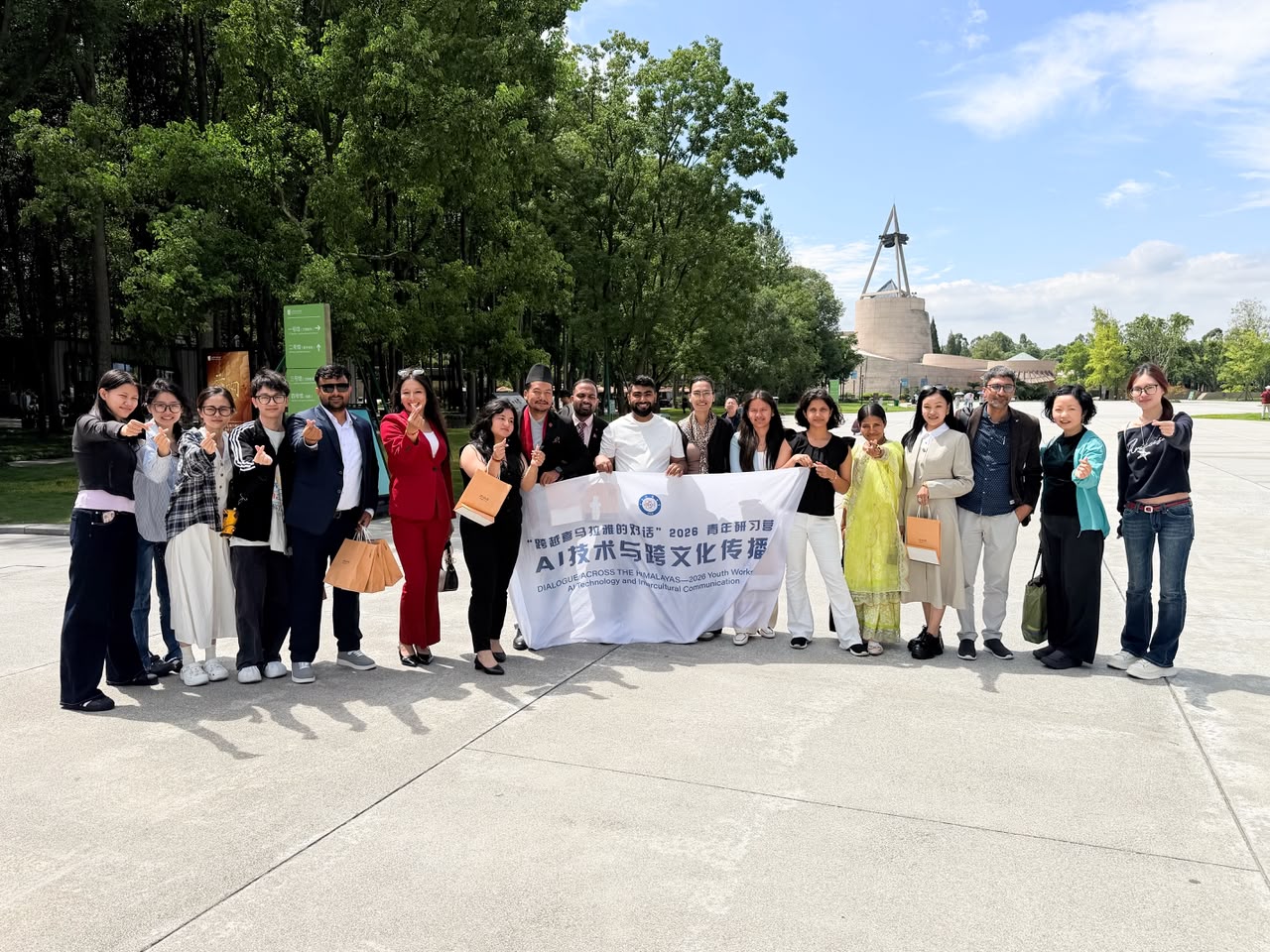
Kathmandu. Five students of the Central Department of Journalism and Mass Communication, Tribhuvan University, have completed a week-long study tour on AI and Digital Communications in Sichuan, China.
In the program organized under the academic collaboration between the Central Department of Journalism of Tribhuvan University and the University of Electronics Science and Technology of China (UESTC), Nepali students learned theoretical and practical knowledge on how to use AI in the daily workflow of newsrooms, digital content production and visual storytelling, misinformation detection and management, among others.
Nepal-China relations have completed 71 years. Various activities have been carried out to connect friendly relations not only from government to government but also to the people’s level. UESTC professor Zhang Xun said that cooperation in academic sector would continue in the coming days as well.
Anusha Kafle, Diksha Rai, Monica Waiba, Laxman Giri and Priyanka Sunar were present in the program. The Nepali team was led by Dr. Hrishikesh Dahal, Assistant Professor of Central Department. Rishikesh Dahal.
The academic cooperation between Nepal and China will continue in the coming days as well. Dahal informed.
“This kind of academic collaboration will help to understand the dimensional changes in communication,” Dahal said, “There is a huge digital divide in media technology between China and Nepal.” In order to enhance digital capacity, more Nepali students studying journalism and communication will go to China to study in the coming days. There were 7 participants from TU and two ÷ from Pokhara University and Lumbini Buddhist University. One person from Kathmandu University participated in the program. Sharmila Gorkhali and Israfil Gadi from Lumbini Buddhist University, Shristi Khadka and Amrit Bagale from Pokhara University and Shiva Thapa Magar from Kathmandu University participated in the program.
Prof
Dr. Kundan Aryal, Chief of the Central Department of Journalism and Mass Communication, said that the collaboration with UESTC will continue to attract more students in the coming years.
Dr.
Aryal went to UESTC last year to teach as a visiting professor of intercultural communication. Professor Dr. Chang has also been teaching as a visiting professor in the central department.
from AI to Human-Machine Collaboration
The week-long event discussed a wide range of topics related to AI and communication technology. Participants studied about the use of AI tools in newsrooms, news production through human-machine collaboration, management of misleading information in the AI era, role of communication using AI in rural development, and the social and cultural value of the digital gaming industry.
Similarly, training was imparted on the basic aspects of microdrama production and AI Generative Content (AIGC) through AI. The participants said that they received practical information on how to make news and other digital content more effective through the use of modern communication technology. The participants were also given a field visit to various organizations related to China’s technology, communication and creative industries.
From the media organization to the supercomputing center
During the study tour, the Nepali students watched the ipanda channel of CCTV located at the Giant Panda Breeding Research Center in Chengdu. There was information about the production and digital broadcast of targeted content to the international audience.
The team visited the Chengdu National Supercomputing Center, the Chengdu Science and Technology Innovation Ecological Island, the Tianfu Changtao Digital Cultural and Creative Park, and the Sichuan Heart Future Robot Park. During these visits, they were directly informed about the developments in the supercomputing, robotics, AI and digital creative industries. The visiting team also visited Sichuan University of Media and Communication, Chengdu Film and Television City, and other institutions to understand the practice of communication and film. The participants also gained hands-on knowledge about the Metaverse Experience Center, AIGC workshop, virtual production studio and motion-capture technology.
Live Observation of Chinese Communication Practices
As another important aspect of the program, the participants visited Sichuan Newsnet Group and Sichuan TV. During the visit, they learned about news production, digital communication and the use of technology, said Laxman Giri, a participant of the visit.
“As Nepal’s media institutions are shrinking, we got to experience how China is strengthening the media institutions,” said Giri, who is pursuing a master’s degree in the Department of Journalism. “
Similarly, the visit team also got an opportunity to study about China’s ancient civilization, culture and history. The participants said that the visit to the Shanghai Dui Museum took information about how China is preserving culture and civilization along with technology and modern communication.
The Central Department of Mass Communication and Journalism of Tribhuvan University (TU) has announced that this is the second year of the China-Nepal Youth Educational Exchange Program in collaboration with the UESTC. In the first phase of last year, postgraduate students and two professors of the Central Department had participated. The
program will provide Nepali students with international exposure to new practices in the field of journalism and communications that are changing with the rapid development of AI and has also prepared the basis for expanding educational and professional relations between the youth, universities and media sector of Nepal and China.

 प्रतिक्रिया दिनुहोस्