

Announcing the end of factionalism within the Nepali Congress, Gagan Thapa said, “Now the train of the party has moved forward”
Kathmandu. Nepali Congress President Gagan Kumar Thapa has announced the end of the politics of various groups and factions that have been in the party for a long time.
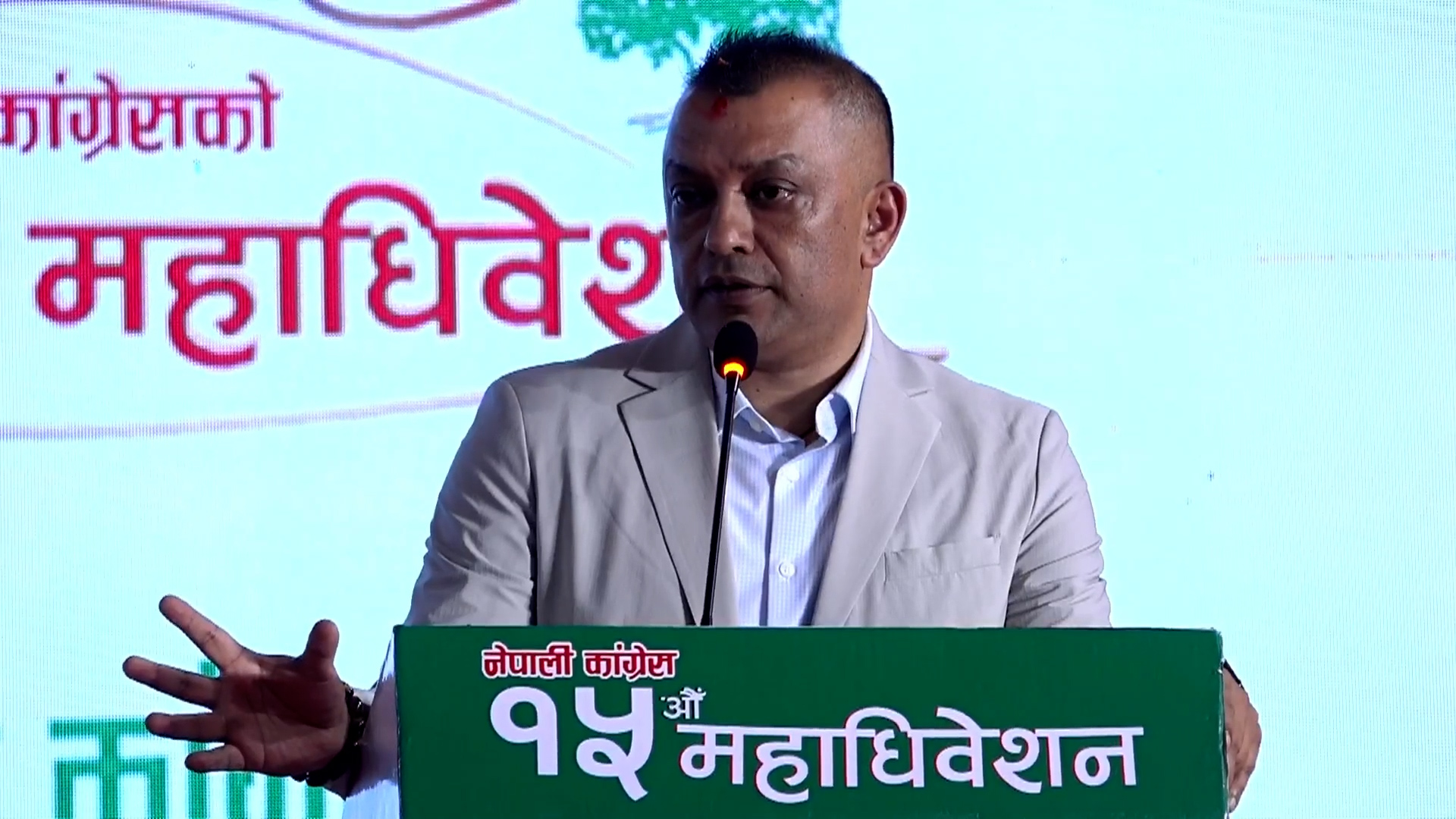
Addressing the closed session of the 15th general convention of the Nepali Congress (NC) here today, Thapa said that the factional politics being carried out in the name of Deuba-led group, Koirala group, Poudel group among others has now ended.
‘074, 036, Deuba group, Koirala group, Poudel group, special and non-special have all ended from today,” he said. This is one of the biggest achievements of this convention. Thapa urged the general convention delegates to choose the leadership of the party keeping in mind the future of the party, the party’s values and ideology and not on the basis of any particular group.
He said that the Congress is not just a political organization for them, but like a family and home. He said that he had rejected the proposal to leave the Congress and form a new party because of the values and ideas associated with the party.
“The party became like a home for me, like a family. The party is not just a structure or office of an organization,” he said, “The value associated with it is the most important thing.” Thapa also narrated the proposal made to him in the past to form a new party and lead it. According to him, in 2070 BS, an activist had proposed to form a new party and make him the president. However, he said that he rejected the proposal because he had a deep connection with the values and traditions of the Congress.
Thapa said that if there is no dissatisfaction with the values and ideology of the Congress, then we should fight against the wrong behavior, decisions and policies within the party. He also said that there is a basic equality of rights and status between the party president and the general cadre.
“The president of the party is not honorable or honorable, it is only a responsibility, that too it is a responsibility given by time,” Thapa said, “We are all equal.” Thapa said that the reform of the Congress should start from the lower level members of the party. He said that there is a need to make a big change in the party membership, leadership selection, organization and internal working methodology.
Stating that the party’
s sovereignty rests with the active members and supporters and well-wishers of the Nepali Congress in the broadest sense, he stressed the need to take the organization forward in a new way.
He said he would spend 20 per cent of his time on internal management of the party and 80 per cent of his time to strengthen the party nationally. Thapa said the expansion of social media and digital medium has added new challenges to democracy.
He said that the competition of ideas and ideas can be weakened as social media algorithms keep people confined to the topics and ideas they like.
“The most important thing about democracy is multi-ideation, competition between ideas,” he said, “but what has become social media by design is that there is no competition of multiple ideas within it.” Stating that emotional content is more effective than fact and logic on social media, he said democracy not only in Nepal but across the world is facing such challenge.
Thapa said that although NC is the oldest political party in Nepal, it should develop capacity to win the trust of the new generation. Stating that Nepal is now one of the youngest people in history, he said that it is not possible to connect the youths with the Nepali Congress just by narrating the past history.
“We have to tell him the history, but we also have to convince him that we will create a new history,” he said.
He said that he joined the NC not because of the work done by the party in the past but because of the belief that the party can do something in the future. Thapa urged the Congress leaders to end the dispute in the court over the legality of the special general convention.
He said that the issue should be resolved within the party rather than going to court again and again.
He recalled that he was ready to return to the 15th general convention by accepting the verdict of the court that the special general convention was illegal.

 प्रतिक्रिया दिनुहोस्