

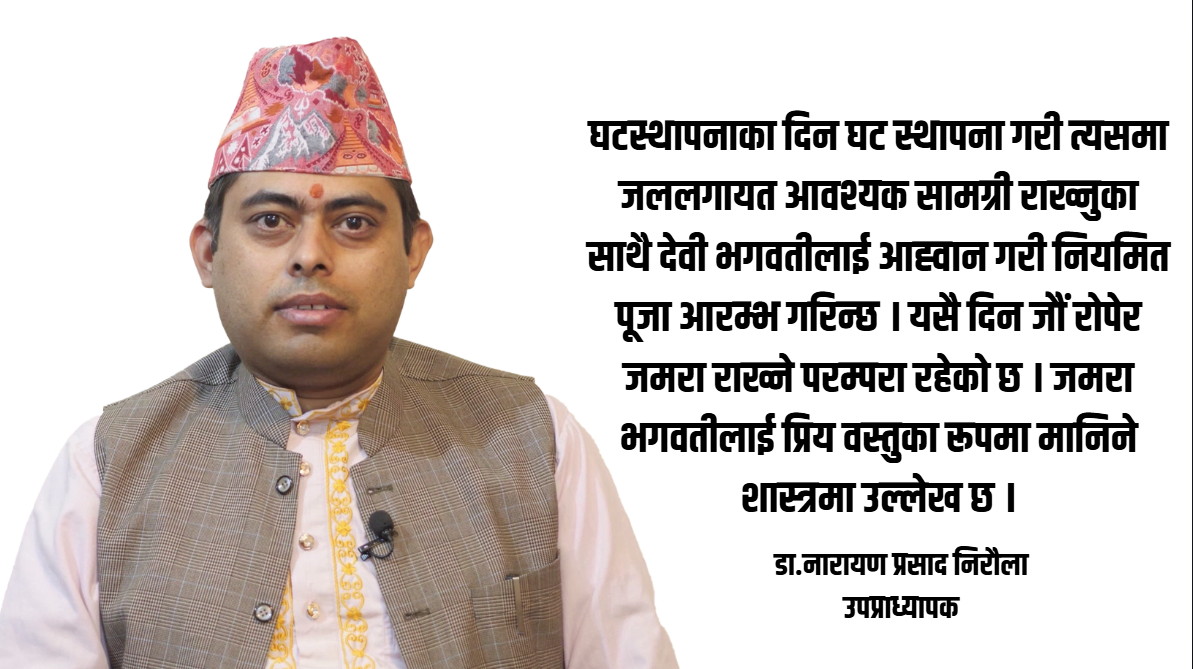
Dr. Narayan Prasad Niraula
Assistant Professor
Ghatasthapana
Kathmandu. Ghatasthapana is being celebrated with reverence and devotion throughout the country on the first day of Bada Dashain, the great festival of Nepalis. Navratri begins with Ghatasthapana, which is celebrated on the day of Ashwin Shukla Pratipada.
On the day of Ghatasthapana, there is a tradition of keeping Jamara in every house and worshiping Durga Bhawani by installing Kalash. Special worship is performed throughout Navratri by establishing the Kalash as a symbol of happiness, prosperity, opulence and auspiciousness.
On the occasion of Ghatasthapana, the Jamara is kept by scattering barley on the soil or sand by worshiping it in a pure place in the morning. After this, the Kalash is established and Goddess Bhagwati is worshipped.
In a conversation with Nepal News Bank, Assistant Professor Dr. Narayan Prasad Niraula clarified the religious and cultural significance of Ghatasthapana and said that this Navratri is an important day to start the worship of Goddess Bhagwati. According to him, ‘ghata’ means pot and ‘establishment’ means to keep, so the act of installing a pot is called ghatasthapana. He said that Ghatasthapana is associated with Sharadiya Navratri and there is a tradition of worshiping Goddess Bhagwati for nine days from this day. According to him, although there are four Navratras in a year, there are two major Navratris, two Gupt Navratras, and Sharadiya and Vasanti. He said that although Vasanti Navratri falls in the month of Chaitra, Sharadiya Navratri has special religious significance in the context of Nepal.
‘Ghat means pot, Sthapana means to keep, to establish the pot. The purpose for which the pot is established is related to Navratri and is related to the worship of the Goddess. This is Sharadiya Navratri. There are four such Navratri. There are two Gupt Navratri,” he said, “Two of them are Sharadiya and one is Basanti. If it falls in the month of Chaitra, then in the context of Nepal, Sharadiya Navratri has special significance. In Navratri, Bhagwati is worshipped for nine days and on the tenth day, prasad is taken and concluded. He said that on the day of Ghatasthapana, a pot is established and water and other necessary materials will be placed in it, and regular worship will be started by invoking Goddess Bhagwati. Stating that there is a tradition of planting barley and keeping Jamara on this day, he said that Jamara Bhagwati is mentioned in the scriptures as a favorite item.
He said, “Basically, the method is the same. Barley is planted, the pot is established, water is placed. The practice of Ghatasthapana is done in the same way everywhere. According to him, items such as pots, lamps, kalash, Ganesh and the idol of Goddess Bhagwati are required for Ghatasthapana. Similarly, sandalwood, akshata, flowers, padya, offerings, achmani, panchamrit, fruits and offerings are also used for the Shodashopachar puja. He said that there is a tradition of reciting Durga Saptashati or Chandi during Navratri and Devi Bhagwat will also be recited according to the place and tradition.
He said, “It is time to start worshipping the goddess for Ghatasthapana. At this time, a lot of materials are needed. Pots, lamps, urns, Ganesh should be worshipped. The idol of Bhagwati should be installed. Other items of worship such as Shodashopachar, sandalwood, akshata, flowers, padya, offerings, achmani, panchamrit etc. are required. Similarly, fruits, offerings, etc. are the items of common worship. He said that there is no belief that maize should be kept everywhere when it comes to keeping jamara. According to him, ‘yav’ i. e. barley jamra is considered the best in the classics. He said that although in some places, the jamara of wheat or other grains is kept according to the local custom, but religiously, barley is preferred.
He said that the material of the pot used in Ghatasthapana may also be different according to the place and tradition. He said that although the pot made of clay and copper and other materials is used in some places, the main method of installation will remain the same. He said that there is a tradition of keeping water, all medicines and other materials in the pot according to the method.


 प्रतिक्रिया दिनुहोस्