

Age does not stop Deusi Bhailo
from senior citizens to the younger generation
Manisha Basnet, Nepal News Bank
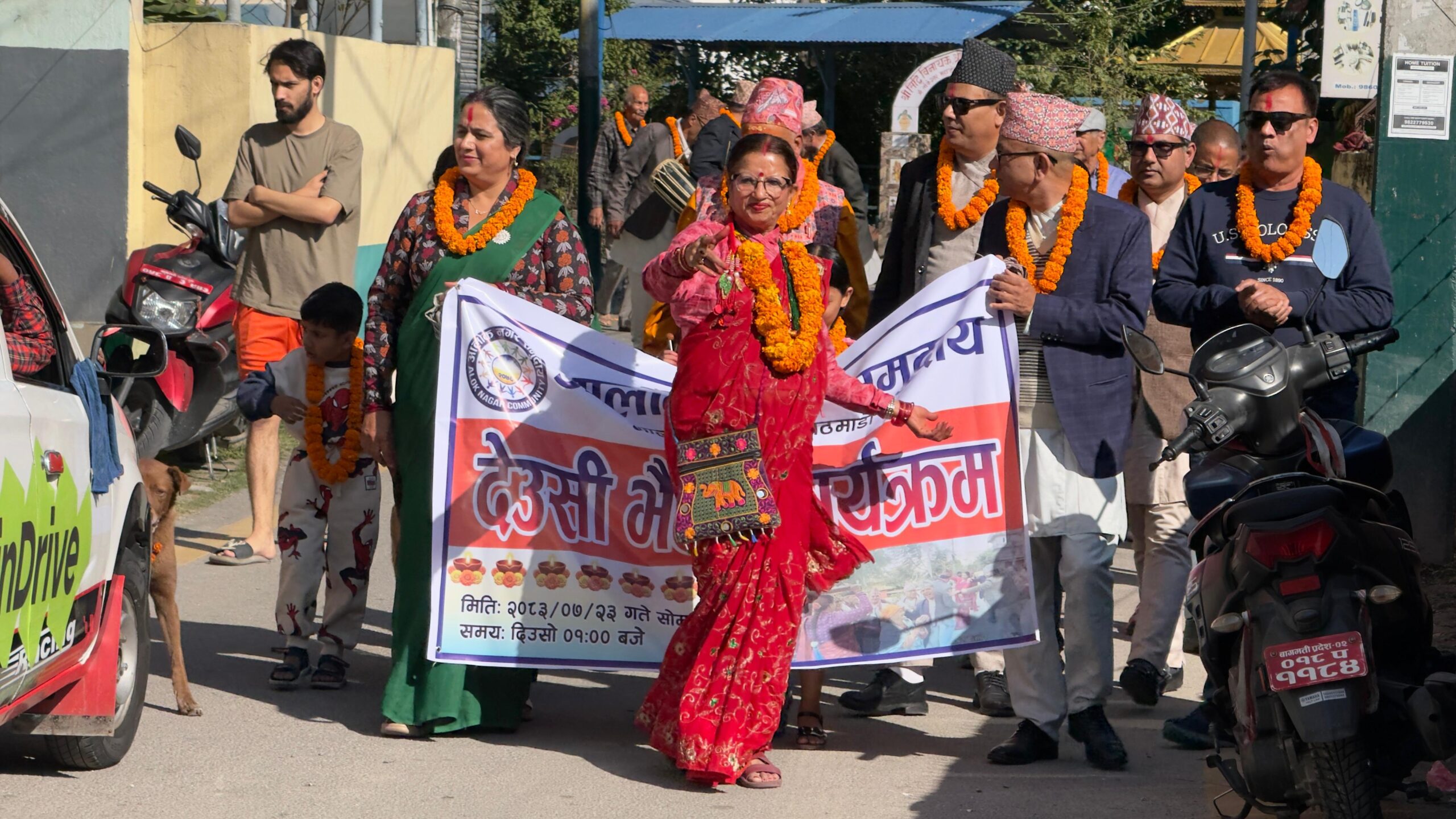
Kathmandu. Gopal Prasad Sharma, a senior age group, was seen laughing on Monday afternoon in Aloknagar, Kathmandu. The reason for his busyness was to form a group to play Deusi Bhailo. The elderly Sharma was also calling other people to play Deusi Bhailo. With the excitement of Tihar, the songs of Deusi and Bhailo were echoing.
People of all age groups gathered at the initiative of Sharma, who is also the president of Aloknagar community. They were dancing to the rhythm of traditional Deusi Bhailo songs. This scene in Aloknagar was an example of how age does not stop the preservation of the traditionally established culture in Nepali society. On Monday, children and senior citizens were seen active in Deusi Bhailo in various places of Kathmandu including Aloknagar.
Sharma said that he has been conducting the Deusi Bhailo program in his community for the last seven years. He said that the program has been organized to inform the younger generation about the culture, culture and religion and to continue the tradition.
“We have been organizing this Deusi Bhailo program since the inception of our organization. We have started this program seven years ago. The purpose of doing Deusi Bhailo is to give this program to the younger generations so that they can continue to know about our culture, culture and religion,” he said.
He said that in the past, Deusi Bhailo was understood as a means of collecting donations, but now there is an understanding in the community as a tradition for the preservation of traditions and culture.
He said, “We have got different than before. Because earlier there was talk of coming to collect donations, now it is for the preservation of our culture, culture, religion. There is awareness in the communities that this should be continued.” He stressed on the need to protect the traditional culture by discouraging the tendency of drinking and creating ruckus in the name of Deusi Bhailo. “We have to continue it in a way to create awareness so that there is no such thing as dancing and singing, such as drinking alcohol, drinking alcohol, crowding. This is our culture and we want the younger generations to wake up,” he said.
Gayatri Acharya, a member of the group, said that she has been playing Deusi Bhailo since her childhood. According to her, the tradition of going to play Bhailini after Lakshmi Puja has been associated with her experience since childhood.
‘We used to play Deusi Bhailo and Bhailini since we were kids. After Lakshmi Puja was done at home, we used to play Bhailini since childhood, now when we grow up, we are playing to save the culture in the community. From the time of Baliraja, we say that now we should do this to save our religion and culture. Ours is a Hindu country. That’s why we have to save it,” she said.
Deusi Bhailo works to build a relationship between the family and the community. She said, “We have festivals throughout the twelve months. Similarly, it is a festival of love and affection because it includes Lakshmi Puja, our Bhai Tika and our Deusi Bhailo. This Tihar is a special festival of love between brothers and sisters. Our culture is going away. That is why we are trying to save our culture that has been going on since our community has been going on since ancient times. She also shared her experience of the songs of Bhailini played in her childhood and the changes that have taken place in today’s Deusi Bhailo.
‘Now we used to be called Bhailini, which we used to play in our childhood. We used to walk saying ‘Bhailini came to the courtyard, Gunyu Cholo Magan, Hey Aunsi Bar Gai Tihar Bhailo. And then we would roam on the roof, see what was given. We used to talk about such fun things. Now we have been doing programs with the message that we should save the culture by modifying it,” she said.
She pointed out the need to pass on the various traditions and rituals of Tihar to the new generation.
“The present generation should know what to celebrate our festivals, what not to do, what to do. Our country Nepal follows every religion,” she said.
Acharya said that respect for nature, animals and family is associated with the festivals from Crow Tihar to Bhai Tika.
She said, “Before the Crow Tihar, it was customary for the crow to carry a message like television. It was customary for the crow to carry the message. Bhai Tika is celebrated by worshiping the crow, worshipping the dog, and worshiping Lakshmi. Lakshmi is considered like a mother. Today, the cow is worshipped. Even while bringing the paddy, we cannot eat without worshiping. Our country is such that we have a culture of respecting everyone, giving recognition to everyone and respecting everyone. According to Acharya, the participation in Deusi Bhailo is decreasing compared to before. Recalling that earlier it was customary to give rice, rice and selroti while playing Deusi in the village, she said that the practice of giving cash has increased now.
He believes that the reason for the decrease in the participation of the current Deusi Bhailo is that the younger generation is migrating abroad and the number of members at home is less.
She says that playing Deusi Bhailo only for the purpose of garnering views on social media will not maintain its originality and continuity. “It is right to do it in a way to preserve our culture and promote it. Now it is only for the purpose of collecting video for video and a few views, it cannot continue and it cannot be sustainable,” she said.
Deusi-Bhailo is an important cultural aspect associated with Lakshmi Puja and Govardhan Puja of Tihar. According to Shaligram Dhakal, assistant professor of Nepal Sanskrit University, the tradition of playing Deusi-Bhailo has gradually developed from the tradition of feeding sweet dishes, giving fun and giving Dakshina to children. He said that this tradition, which was initially limited to family and neighborhood, has now spread to people far and wide.
The religious context of King Bali is also associated with Deusi-Bhailo. According to him, there is a religious belief that the three days of Kartik Krishna Trayodashi, Aunsi and Shukla Pratipada are considered as the kingdom of sacrifice.
‘Lord Vamana asked Bali for three feet of land. After Bali surrendered everything to God, he became the lord of Sutala Lok. When the Lord asked him what he wanted, he asked him to attain the dominion of the mortal world for the three days of Kartik Krishna Trayodashi, Aunsi and Shukla Pratipada. The Lord said ‘Athastu’. That is why these three days are called the kingdom of sacrifice,” he said.
Due to this religious context, the saying ‘We did not come just like that, the sacrifice was sent by the king’, he said. He says that Deusi-Bhailo is not only a means of entertainment and collecting Dakshina but is also associated with the feeling of charity, dedication and devotion.
‘Bali had surrendered everything. Therefore, we should not sit idly by saying, ‘This is yours, this is mine’. ‘Tvadiya Vastu Govinda Tubhyameva Samarpayami’ means that the entire universe belongs to you, I also belong to you, you should offer everything,” he said.
He said that the important message of this festival is to give alms to those who come to play Deusi-Bhailo, to worship Goddess Lakshmi and to realize that God has a share in all living beings.
The song sung together in a group is Deusi, which is sung during Tihar. The tradition of the team leader dancing in a dramatic style with rhythm and the participants dancing collectively saying ‘Deusi Re’ is a unique feature of Nepal.
Similarly, the song sung by the women in a group is Bhailo. When a Bhailo is sung, there is usually one main person and the other people in the group follow the main person till the end of the song. At the end of the song, the main person greets and blesses everyone in the house, while the people of the group join us by saying ‘Bhailo’. In this way, Deusi Bhailo has been connecting religious beliefs, cultural traditions and social harmony in Nepali society for generations.



 प्रतिक्रिया दिनुहोस्