

Although the consumption of sweets has increased during Tihar, the business is normal, the consumer has reduced the amount of purchase
Kathmandu. Although the number of consumers consuming sweets during Tihar has increased, the amount of people buying sweets has decreased, according to sweet entrepreneurs. They say that the business of sweets used to increase during the festival in the past years, but in recent times, the business is normal due to the decrease in the quantity of per capita purchases due to the increase in the number of consumers.
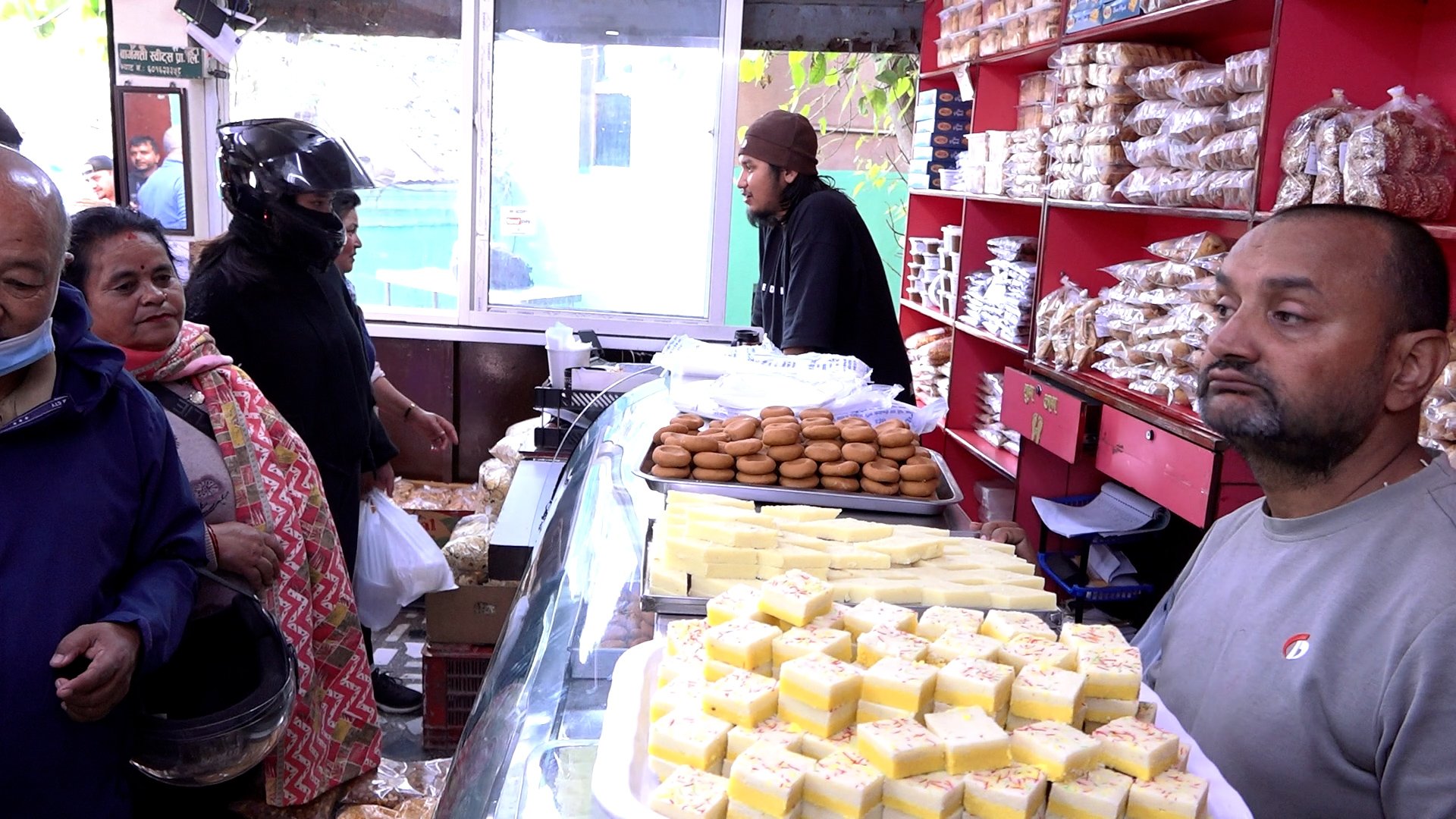
Shivaram Khatri, a businessman of Bagmati Sweets, who has been operating in Tripureshwor of Kathmandu for the past 40 years, said that the business that should be done during the Tihar festival is normal this year.
Talking to Nepal News Bank, he said that although the number of consumers has increased, the number of sweets has decreased.
He said, “The quantity units of consumers have decreased. The number of consumers has increased but the number of bringing units is less. Earlier, people used to buy one kilogram, if they bought half a kilogram, if they bought half a kilogram, it is 200 grams.” According to Khatri, Bagmati Sweets offers everything from traditional sweets to modern sweets. Along with traditional sweets like Road Khajuri, Anarasa, Lakhamari, Barfi, Kalakand, Lalmohan, Raspberry, Rasmari and Milk are also sold.
He said, “We have Nepali sweets, old road khajuri, anarsa, lakhamari and now modern sweets are barfi, kalakand, lal mohan, rasbhari, rasmari, milk. Now even modern sweets, ancient old sweets are also sold.” He feels that in recent times, consumers have become aware of the quality of sweets and the duration of consumption. Along with dates and lakhamari that can be eaten for a long time, customers are also buying sweets made from milk that should be consumed immediately.
He said, “Now people have to take it a little farther away than before, after a few days, they will also bring such road dates, lakhmaris. Now these days, we have to finish it in Parsi, now take the milk sweets Barfi Surfi, eat it, and finish it.” Consumers have become more aware than before. Khatri said that the price of sweets has not been increased for the last three years. He said that even though the price of daily consumables has increased in the market, the price has not been adjusted so that it does not affect the customers immediately.
He said, “The price of everything has increased while buying daily use items, but we have not sold it at that much. We should not increase the price just because the price increases for a short period of two to four months, but we do not increase it in terms of whether we have to consume it or bear it.” He said that in Bagmati Sweets, mixed sweets are being sold at Rs 1,300 per kg and sweets made from maida and ghee at Rs 1,100 per kg. He said that dishes including Nimki are available for Rs 30 to Rs 40.
Khatri said that there is a demand for sweets like sale, anarsa, barfi and peda during Tihar.
During Laxmi Puja, sweets like unspoiled laddoos, barfi and pedas are sold more and customers also buy sweets for Bhai Tika. He said that various offices order sweets to give gifts to employees and shop owners to give gifts to their customers.
Similarly, Laxman Adhikari, manager of Doodh Sagar Mithai, which has been in operation for 32 years, also said that the sweet business has fluctuated due to various reasons in recent times. According to him, the weather, the situation of the country and political activities also affect the business. According to the official, South Indian dishes are available along with Bengali sweets in Dudh Sagar. Dudhbhari, Raspberry, Lalmohan and Barfi are among the sweets that customers like.
According to him, although sweets were taken as an essential commodity in the past, the consumption has decreased now.
He said, “Now our sweets are full of milk, raspberry, Lalmohan, barfi items from there. Earlier, it was said that we should keep sweets in the kitchen. Now it is a little less, but the population is not decreasing but it is increasing. The official said that the taste of the customers has also changed in the last few years. He feels that the customers, who used to like very sweet sweets earlier, now prefer less sweet and juicy sweets.
He said, “In the past, customers used to like sweets very much. Earlier, people do not compromise much. Now sweets are less sweet and juicy items are liked like this.” The official said that even when the price of raw materials has increased, the traders are finding it difficult to adjust the price of sweets. According to him, even though the price of raw materials has increased by three times, there are complaints from customers when the price of sweets is increased.
He said, “Materials have to be purchased at a very high price. Even if the price is increased slightly, the price of the customer has increased. On the other hand, the customer did not compare the material. If I increase the item of sweets, it means that it will become expensive. But here the material increases three times. When we increase the total of two times, one time, the customers complain. He said that Dudh Sagar has not increased the price of sweets for the last two years. At present, mixed sweets are being sold at Rs 1,600 per kg. He claims that the price of his shop is lower than other shops based on quality, quantity and price.
Adhikari said that preparations are made in advance for Tihar. He said that the number of customers during Diwali increases by three times as compared to daily sales, so priority is given to the advance orders from companies and restaurants. He also said that Doodh Sagar has been selling sweets only from shops and has not sold them online or through supermarkets.
According to businessmen, although it is easy to sustain business due to old customers and shops that have been operating for a long time, the rising cost of raw materials and manpower management are becoming challenging. Adhikari said that the overall business has become more difficult than before.
He said, “Even as an old man, we have been working for many years, we have not found it very difficult to survive it. But if you look at the manpower and materials now, it is a little bit more difficult than before.” ’



 प्रतिक्रिया दिनुहोस्