

changed in ten minutes Lamusoti
The flooded settlement of Trishuli, the dreams buried under the mud and another struggle that started after surviving life
Radheshyam Bishwakarma, Nepal News Bank
Nuwakot. Only ten minutes ago, the village of Lamusoti was normal.
There was a lot of people in the courtyard of the house. Food was being cooked in someone’s house. There were cattle and goats in the cowshed. There was paddy in the field. The old parents were at home. The pregnant woman was resting. The children were going to school.
But ten minutes later, the scene was gone.
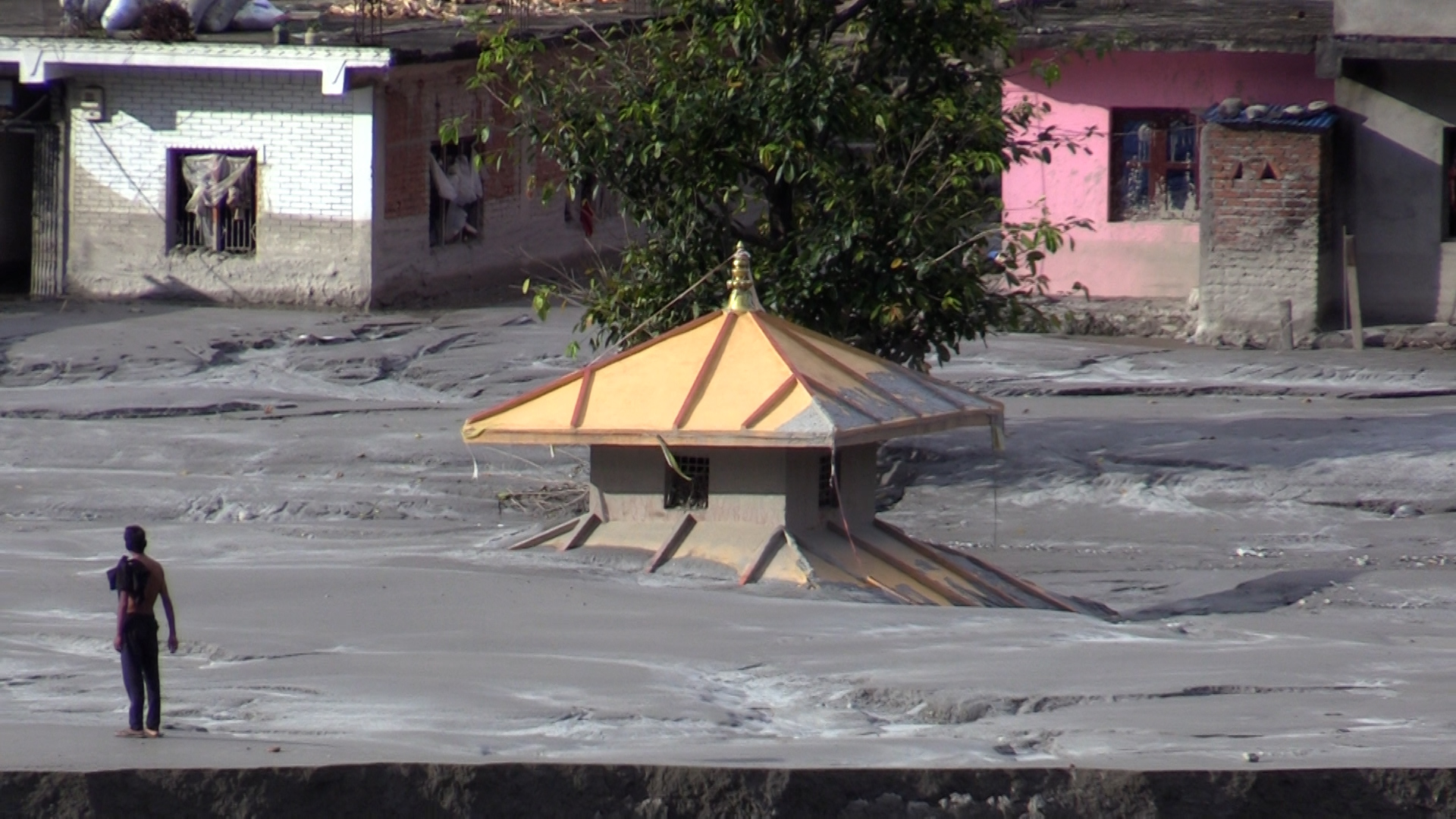
The sudden flood from the Trishuli or Big River changed the geography of Belkotgadhi Municipality-7, Lamusoti of Nuwakot. 28 houses in the settlement were buried under mud, mud and sand. The upper floor of some houses was filled with mud. The fields were not visible. The cattle tied in the cowshed were buried. The grains, utensils, clothes, documents and years of earnings inside the house were buried under the soil in a few minutes.
28-year-old Rajendra Nepal was in the field on the day of the flood.
Paddy was being cultivated. The day was passing normally. Suddenly, the news of the water in the river increased. “It was only 10 minutes before we got the news that the river was coming. I was in the field at that time,” he recalled.
As soon as he got the news, there was a stampede in the village. Rajendra also ran towards home. The speed of the river was increasing. When he reached the main road leading to Rasuwa, the flood came after him. “He ran just two feet ahead of the flood and reached the upper hill,” he said.
That race was not just a race to a safe place. It was a race between life and death. He himself does not have the answer to the question of what would have happened if he had been a few minutes late.
Life was saved. But his house was not saved. Two floors of the house were filled with mud and mud. Kitchen appliances, gas stoves, clothes and other household items were all buried in the debris.
Today, Rajendra’s house is not there. There is mud in the place where the house is. When night falls, he sleeps in the neighbor’s house with his family. “Now we are sleeping in the generation of someone else’s house,” he said. But there is no means to cook rice. It is raining. The wood does not get wet. The gas stove is all buried. It is very difficult. ‘
A sack of rice can last for a few days. But it does not meet the needs of the house. A gas stove can cook food. But it cannot provide a safe roof. This difference is troubling Rajendra now.
The flood water has receded.
But the disaster in Lamusoti is not over yet.
For the people here, the flood is no longer flowing in the river, but in their daily life. The only question before them is, ‘Life has been saved, now how to save life?’
When you reach Lamusoti after the flood, it is difficult to find houses. Where once there were walls of houses, now there is a pile of mud. Where there was a courtyard, there is a mud of sand. Where there was a stove, there is mud. People are scouring sand and mud by hand to find household items.
70-year-old Lal Prasad Nepal was looking for a sign of his house in the same crowd. The house he spent years in does not look like a house anymore. There is no door, no window. There is no courtyard, no kitchen. While digging the mud, a rusted iron rod came in his hand. He looked at the rod for a while. Then, pointing to the pile of mud in front of him, he said, “This is my house.”
‘
For him, that rod was not just a piece of iron. It was the last sign of his house.
There are currently 28 families in Lamusoti looking for such signs. Some are looking for the door of the house. Some are looking for utensils. Some are citizenship. Some are land certificates. Some are jewelry. Some are grains.
But most of all, people are looking for their old life. The story of 68-year-old Loknath Nepal is another painful chapter of Lamusoti.
When the earthquake of 2072 destroyed his old house, he dreamed of building a house again. He received a grant of three lakh rupees from the government. He raised the rest of the money from his own earnings.
He built a concrete house by putting 14 pillars. He said that about 27 lakh rupees were spent on the construction of the house. The house that resurfaced after the earthquake was not just a structure for him. It was a symbol of life after the disaster. But now that house is not there.
The flood has buried the house so deep that it is difficult to identify its mark.
Loknath’s voice is painful.
‘How do I know that the house built with misery will be destroyed in a minute?’ After a pause, he added, ‘The earthquake had demolished the wall, this flood has erased the mark of the house.’ ‘
His four and a half ropanis of land have also been affected by the flood. House, fields, three goats, two goats, 18-19 quintals of paddy, bed, drawer, utensils, jewelry — most of the property he has added in his life has gone under the soil. According to him, the total loss is about Rs 50 million.
The flood did not only bury Loknath’s house. His citizenship, land ownership certificates and other important documents are also buried. “We don’t have anything left now,” he said. “
Imagining the situation of having to rebuild a house at the age of 68 gives him helplessness in his eyes. “The earning age has also fallen. Now there is no place to work.” “
For Sri Krishna Nepal’s family, security is a bigger concern than relief. His three-and-a-half-storey house has been flooded. Four and a half ropanis of land have also been affected. There is an 88-year-old elderly mother in the house. There is also a pregnant woman in the family. A total of seven members are currently looking for temporary shelter.
Sri Krishna complained that there was not enough warning from any government agency before the floods. “While I was sitting at home, there was a flood from above. We ran away after seeing it. Lives were saved, but all the kitchen items, cattle, property and jewelry were buried inside the house.
His three goats and two goats have also been buried in the flood. It has not been even a month since his son went abroad for foreign employment. The road of movement of his daughter and daughter-in-law has also been affected.
In such a situation, who would understand more than themselves how risky it is to keep an 88-year-old woman and a nursing mother in an open place in the rain? “It is difficult to live under a tarpaulin,” said Sri Krishna, “For the safety of the elderly mother and the new mother, temporary accommodation should be arranged immediately, even if it is with a toss of tin.” “
Warning: Was ten minutes enough or not?
The Lamusoti incident, along with the natural disaster, raises another important question: How effective was the early warning system? According to the victims, the information was sent only about ten minutes before the flood came. After getting that information, many people were able to save their lives. In this sense, ten minutes became life-saving for them. But another question is equally important, if the information had come some time ago, would they have been able to save their cattle, important documents, medicines, food or essential items?
It may not be possible to save the house in the face of floods.
But a little
extra time can make a big difference in getting people to safety, evacuating the elderly and children, moving livestock, and securing necessary documents and medicines.
The Lamusoti incident has necessitated a serious debate not only on the accessibility of early information, but also on its timing, reliability and effective communication to the local level.
The role of the local government and the people’s representatives in the search for the people’s representatives
After the disaster, the role of the local government and the people’s representatives is the most expected. But Srikrishna’s complaint is different. “Unfortunately, neither the ward chairman nor any other public representatives came after the incident,” he said.
Such a complaint raises the question of how the presence of the state is felt in times of disaster. In times of disaster, a family needs not only relief materials but also people to listen to their sorrows.
How to start the recovery process if someone’s citizenship is buried? If the land ownership certificate is buried, how to collect the proof? Who will make the proof that the house is completely damaged? How to get compensation if the cattle are buried? If the agricultural land is filled with sand, where will the farmer do the farming next year?
These questions are not answered by the distribution of sacks of relief.
sacks of relief and mountains of rehabilitation
The family of Lamusoti now needs food. Drinking water is needed. Clothes are needed. Temporary shelter is needed. But after a few days, the relief rice runs out. The tarpaulin is torn. The rain stops.
?
Then begins the real challenge, rehabilitation. If 28 families have to be shifted to a safe place, where will they be moved? How to make land available in a new place? How to build a house?
How to make special arrangements for the elderly, women, children and new mothers? How to restore the citizenship and land proof of the citizens who have lost their documents? How to compensate the farmers for the loss of food and livestock?
These questions need to be addressed now.
Otherwise, the pain of Lamusoti’s family may disappear from the news once the initial excitement of distributing relief is over.
The survivors of the
disaster often say the same thing, ‘Lives were saved.’ ‘
The people of Lamusoti also say the same. But now they are facing how difficult it is to start a life after a life. Rajendra is satisfied that his children are safe. Loknath is relieved that his family members are alive. Shri Krishna is happy that the old mother and the mother have survived.
But then when they try to go back to their old lives, there is nothing. There is no house. There is no cowshed. There is no rice. There is no farm. There are no belongings. Some have no documents. And most importantly—there is no basis to go back to the old place.
Lamusoti doesn’t just need sympathy now. He needs planned help. In the first phase, he needs safe temporary shelter. Then food, water, health care, clothing and daily essentials.
Assessment of livestock damage. Continuation of children’s education. Special protection for women, new mothers, the elderly and the disabled. Only then long-term rehabilitation. If the old settlement is at risk, it may be necessary to relocate to a safe place after conducting scientific studies.



 प्रतिक्रिया दिनुहोस्