

After enjoying floriculture for 35 years, 63-year-old Sanu has been enjoying floriculture for 35 years
and now earns up to Rs 80,000 annually
Pramila Karki, Nepal News Bank
, Bhaktapur.Those who were once involved in vegetable farming in Bhaktapur are now making marigold-leaf and velvet flower farming a good source of income.
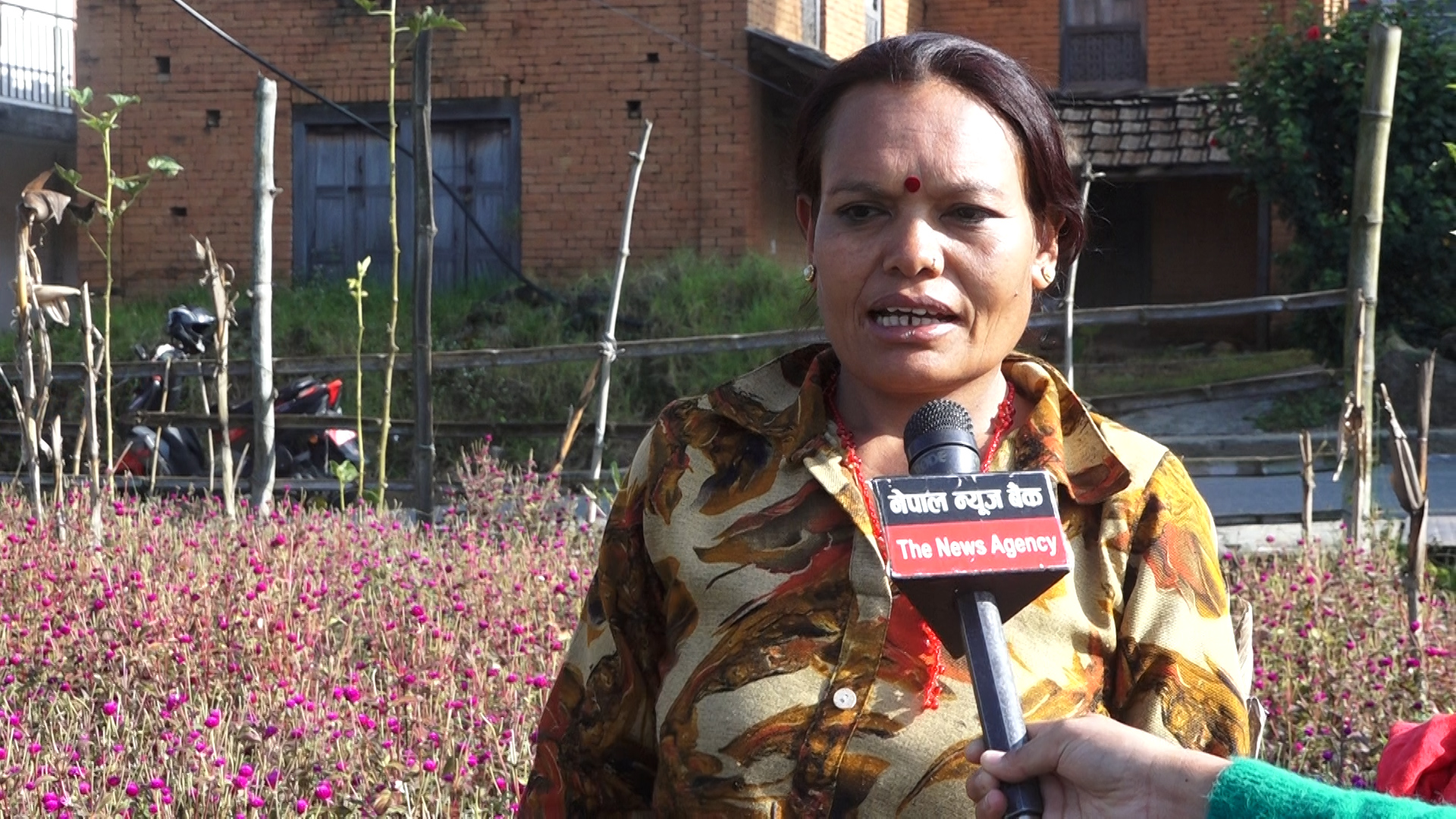
They are busy with floriculture along with household chores. Sanu Nagarkoti, 63, of Gundu, Bhaktapur, is one of them. Now, not only Sanu, but many farmers like her are engaged in earning money by changing the traditional farming system in Bhaktapur.
She has been doing floriculture for about 35 years and is now earning income from the cultivation of marigolds and velvet flowers. She started flower farming with a small area and has been expanding and now she has been planting flowers on her own land as well as by renting others’ land.
Sanu initially started farming by planting two to four dang flowers. After earning 7-800 rupees in the first year, her enthusiasm for floriculture increased. Then the next year, she planted more flowers. In the second year, after earning four to five thousand rupees, she decided to take it forward professionally.
According to Sanu, she now earns Rs 70,000 to Rs 80,000 annually from floriculture. She has also grown flowers in her own garden and rented out others’ land.
But this year, due to excessive rains, flower farming has been affected. She said that due to heavy rains, the roots of the flowering plants die and the flowers do not bloom on time. According to him, the production has decreased this year as the flowers started flowering from the first week of August.
‘This time there was a lot of water, so the flowers did not come quickly. The roots died due to too much water. After applying the medicine, the flowers started coming a little bit from the first week of August,” she said.
Sanu feels that even though there is income in flower farming, the cost and labor are the same. She said that there is a lot of expenditure on fertilizers, medicines and the wages of the workers. She said that one has to pay up to five hundred rupees just to sow medicines in a field and the cost of lunch of the workers also increases the cost.
However, she says that floriculture has given good opportunities especially to women who want to earn income from home. She had been cultivating vegetables before and was attracted to floriculture as she did not get the expected income from it.
‘Earlier we used to sell greens. We used to grow mustard, mustard greens, chickpeas and spinach. Later, after planting two bangles of flowers, there was a lot of harvest. Even when I took them to sell, they sold well and I felt happy. It was easier to carry flowers than greens and the money was also a bit better,” she shared her experience.
According to Sanu, the price of marigolds was Rs 20 to Rs 30 per kg in the month of July.
But by August, the price had come down. She expects the demand and price of flowers to increase as Tihar approaches.
She said that the price of garlands is also lower this year compared to last year. She said that last year it was sold for Rs 50 per garland, but this year it was sold for Rs 30 to 40.
She feels that it is difficult to compete in the Nepali flower market due to Indian flowers and garlands. She says that Indian garlands are uniform in shape and texture, so consumers prefer them more.
‘The Indian garland is the same, people like it. We have big and small flowers, so making garlands is not the same. That makes it a bit difficult,” she said.
But Sanu says that she feels happy to hear that Nepali flowers are reaching foreign countries as well. She has heard that Nepali flowers are sent to different countries where there is a Nepali community including India, Australia.
Along with floriculture, Sanu has also been selling organic fertilizers. She said that she also earns income from the sale of fertilizers and farmers have been using them to get good results.
Even at the age of 63, Sanu is still active in farming and business, she says that farmers should get a fair price for their hard work.
He expressed the hope that the farmers would be more attracted to agriculture if the market for flowers and agricultural products is guaranteed.



 प्रतिक्रिया दिनुहोस्