

The plan for the construction of new cities is limited to the report, due to lack of budget, the construction of infrastructure did not move forward
Kathmandu. The plan for the construction of new cities initiated by the government with the objective of developing well-managed and well-equipped cities in the hilly areas and curbing migration has been limited to the report due to lack of budget.
The plan to construct 10 modern cities along the Mid-Hill Highway and North-South Corridor has now expanded to 54 cities across the country. Although the government has selected the places for the construction of new cities at different stages and conducted feasibility studies, the construction of physical infrastructures has not started in these cities due to lack of investment.
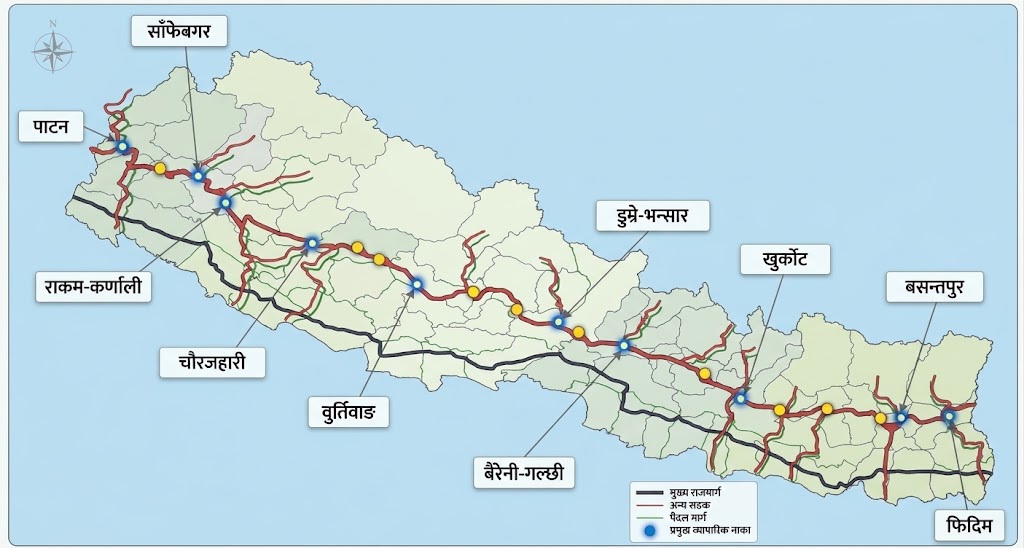
At present, the project is focusing its investment on 12 cities under the Mid-Hill Highway. The plans of the remaining cities are limited to the study and report preparation stage.
According to Suman Salike, project director of the New City Project Coordination Office, Phidim, Basantapur of Tehrathum, Khurkot, Baireni-Galchhi, Dumre-Customs, Burtibang, Chaurjahari, Rakam-Karnali, Sanphebagar and Patan of Baitadi have been prioritized. Currently, infrastructure works are being carried out in these cities through 11 project offices. Apart from this, the government has a plan to develop 15 new cities, including 10 located on the Postal Highway and 5 in the Terai Madhes. Similarly, according to the master plan of 13 smart cities, the government has a plan to protect and promote the form of 10 settlements located on the Himalayan footpath.
‘Out of the 54 cities, studies and reports have been prepared in some of them. However, the investment has not been started,” said Salik, “Due to the lack of budget, we are now focused on only 12 cities. The work has been started on the basis of priority as the budget will be scattered by investing in all the cities at the same time.” According to him, the situation of infrastructure construction in 12 cities is not the same. Community buildings are being constructed in some cities, while roads and other urban infrastructure works are being done in others. The land development program has also reached various stages. In some places, preparations are being made to develop the land and return it to the landowners, while in some places, the study work is being done.
The government had put forward a plan to build a new city in the financial year 2067÷68. The then Finance Minister Surendra Pandey had announced through the budget speech that 10 big modern cities would be built for business and settlement along the Mid-Hill Highway and North-South Corridor.
The program, which was started with the objective of reducing migration by developing systematic settlements, creating employment and expanding basic services in the hilly areas, was later expanded to include the Postal Highway, Tarai-Madhes and places in the mountainous region. However, even though the number of cities increased, the budget and implementation capacity could not be expanded accordingly.
Since the start of the new city project, the government has allocated billions of rupees for it. According to government data, the budget has been allocated Rs 23.70 billion so far. However, there is a huge gap between the budget allocated and the implementation of the plan as the infrastructure construction has not started in most of the cities.
The 62nd annual report of the Auditor General also questioned the progress of the construction of new cities. According to the report, land development programs were conducted on 4,777 ropanis of land in 10 places, 189 ropanis of land were purchased, 589 km of roads were upgraded, 34 km of roads were blacktopped and 51 km of roads were paved. However, such infrastructure construction has not taken the form of a well-managed and self-reliant city. According to Project Director Salike, a 20-year plan was initially made for the construction of the new city. However, due to the budget not being mobilized as expected, the program is now being reviewed mid-term.
“Initially, the investment could not be done as expected. The budget also did not come as expected,” he said, “Now we are doing a mid-term review. A study is being done on how to take it forward more effectively.” He said that the government’s investment alone is not enough for the construction of new cities. He said that the participation of various government agencies and the private sector is necessary for this. However, it has become difficult to move the project forward in some places due to lack of expected investment and cooperation.
Salike also said that the land development program has been given priority over the purchase of land during the construction of the new city.
Under this, the land of the local landowners is consolidated and roads, drainage and other infrastructure are constructed and the developed land is returned to the concerned owners. According to him, the project has not yet planned to purchase new land.
The main objective of the construction of the new city is to develop a regional economic center by expanding agriculture, tourism, industry, trade, education and health services in the hilly region. However, due to the delay in the construction of infrastructure, the goal of expanding employment and economic activities at the local level has also been affected.
Due to the lack of basic facilities like roads, drinking water, drainage, electricity, education and health in the hilly areas, people continue to go to the headquarters, Terai cities and Kathmandu Valley in search of employment and facilities. In such a situation, there is a need to focus investment on the basis of potential, population, economic activities and available infrastructure rather than increasing the number of new cities. Otherwise, there will be a risk that the new city will be limited to planning, study, report and budget allocation.

 प्रतिक्रिया दिनुहोस्