

Manisha Basnet, Nepal News Bank
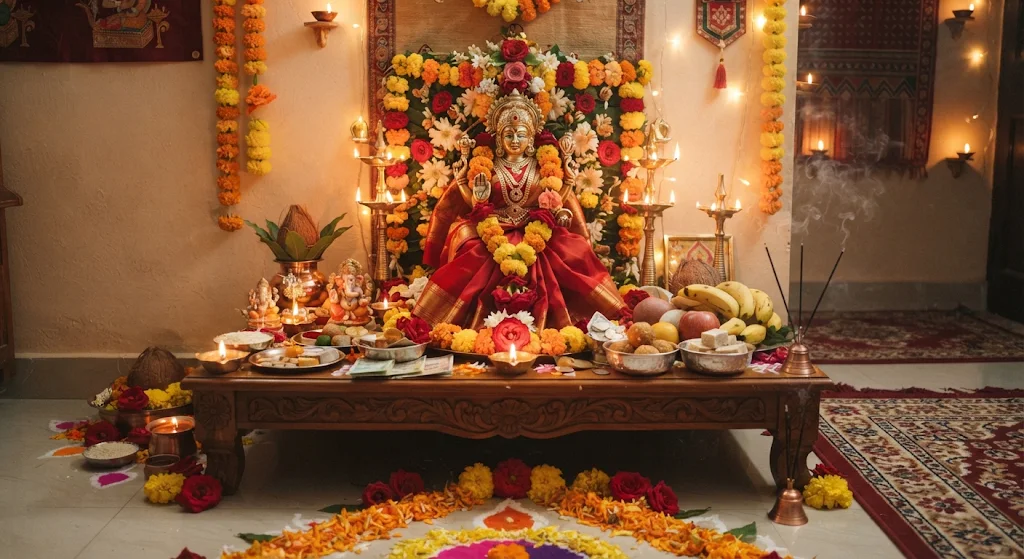
Kathmandu. Hindus celebrate Lakshmi Puja on the occasion of Kartik Krishna Aunsi by offering special prayers to Goddess Lakshmi, the goddess of wealth. Today, as a special day of Tihar, the house is cleaned and illuminated with lamps, twinkling lamps, and various decorative items. Wishing for wealth, prosperity, and happiness, there is a tradition of worshiping Lakshmi, Ganesh and Saraswati in the house.
According to religious beliefs, the night of Kartik Krishna Aunsi is called ‘Sukhratri’.
In a conversation with Nepal News Bank, Shaligram Dhakal, assistant professor at Nepal Sanskrit University, explains why the night of Laxmi Puja is called Sukhratri and various religious beliefs associated with it.
According to Dhakal, there are four types of special nights in Hinduism. The night of Falgun Krishna Chaturdashi is called Shivaratri, the night of Bhadra Krishna Ashtami is called Moharatri, the night of Dashain Ashtami is called Kalratri and the night of Kartik Krishna Aunsi is called Sukhratri.
‘Especially the worship of Lakshmi, this new moon night, the night of the new moon of Kartik Krishna Paksha is called Sukhratri. There are four types of nights of Sukhratri. Among them, we know that Shivratri is Phalgun Krishna Chaturdashi. The other is Moharatri, Bhadra Krishna Ashtami, the night of Lord Krishna’s Janmashtami is called Moharatri. Similarly, the night of Ashtami of Dashain is called Kalratri and the night of Lakshmi Puja is called Sukhratri,” he said.
According to him, this night is called Sukhratri because Lakshmi is worshiped with the wish of happiness, prosperity and prosperity. He said that there is a tradition of worshiping Lakshmi by wishing for wealth, children, health, opulence and various types of happiness in life.
‘Alakshmi, no matter how lazy everyone goes, we worship Lakshmi so that all Lakshmi is attained. Especially, Lakshmi is worshiped according to the rituals to get all the movable Lakshmi, Achala Lakshmi, Aishwarya Lakshmi, Vidya Lakshmi, Dhan Lakshmi, Santan Lakshmi, Bhog Lakshmi, Rajya Lakshmi, all the things in oneself.
According to him, the main worship of Lakshmi Puja is done at midnight. On this day, the house is cleaned, decorated from noon, and lamps and twinkling lamps are lit in the evening. He said that there is a tradition of preparing selroti, various sweets, and dishes including payas and coconut kheer, which are dear to Lakshmi, and worship with solitude and concentration.
‘Especially, the worship of Lakshmi is done at midnight. We decorate the house in the afternoon and light twinkling lamps in the evening. We cook many types of sweets, we cook selrotis. Especially Lakshmi’s favorite payas, coconut kheer, and after the evening is deserted, we should worship Lakshmi with solitude and concentration,” he said.
He said that the light of Lakshmi Puja is not limited to making the house illuminated. He said that even though the house is bright, the mind of a person cannot be illuminated due to lack of wealth and happiness, so Lakshmi is worshiped for the light of the mind and also for the welfare of life.
‘The house is bright, but in the absence of Lakshmi’s wealth, the mind cannot be illuminated. Therefore, my heart should also be bright, O Mother Lakshmi, bless us all the time, with the feeling that we worship and worship Lakshmi,” he said.
According to him, the word ‘Deepawali’ itself also clarifies the importance of this festival. ‘Deep’ means lamp and ‘Aoli’ means row or wave. Therefore, Diwali is a festival that illuminates the house and the surrounding environment with a row or row of lights. He said that the tradition of celebrating Diwali has developed according to the religious belief of welcoming Goddess Lakshmi in a clean and bright house.
‘Diwali means a lamp and Avali means a row, a wave of lights. There is a religious belief that Lakshmi does not come to a dark house. Therefore, Diwali is the act done to welcome Goddess Lakshmi in a place that is clean and lit with lamps,” he said.
He said that in Lakshmi Puja, lamps, urns and Ganesh are installed and worshiped according to the classical rituals. He said that there is a tradition of worshiping Lakshmi and Kuber by installing Lakshmi Kalash and keeping jewelry, ornaments and other items. He clarified that although there are some differences in the methods of worship in different places including Nepal and India, their basis is linked to the Vedic and classical traditions.
‘There are their own traditions. The methods of worship come according to the Brahmana texts and the Aranyak texts. The four Vedas have their own Brahmana texts and Aranyak texts. There is a tradition of worshiping in different places including Nepal and India,” he said.
Another important cultural aspect associated with Laxmi Puja is Deusi-Bhailo. According to Dhakal, the tradition of playing Deusi-Bhailo has gradually developed from the tradition of feeding sweet dishes to the children of the house on the occasion of Laxmi Puja. He said that this tradition, which was initially limited to the family and neighborhood, has later spread to people far and wide.
The religious context of King Bali is also connected with Deusi-Bhailo. According to him, there is a religious belief that the three days of Kartik Krishna Trayodashi, Aunsi and Shukla Pratipada are considered as the kingdom of sacrifice.
‘Lord Vamana asked Bali for three feet of land. After Bali surrendered everything to God, he became the lord of Sutal Loka. When God asked him what he wanted, he asked him to attain the dominion of the mortal world for the three days of Kartik Krishna Trayodashi, Aunsi and Shukla Pratipada. The Lord said ‘Aastustu’. That is why these three days are called the kingdom of sacrifice,’ he said.
He said that due to this religious context, the saying ‘We did not come just like that, the sacrifice was sent by the king’ has come into vogue. He says that Deusi-Bhailo is not only a means of entertainment and collecting Dakshina, but is also associated with the spirit of charity, dedication and devotion.
‘Bali had surrendered everything. Therefore, we should not sit idly by saying this is yours, this is mine. ‘Tvadiya Vastu Govinda Tubhayamev Samarpayami’ means that the entire universe belongs to you, I also belong to you, you should offer everything,” he said.
He said that the important message of this festival is to give alms to those who come to play Deusi-Bhailo, to worship Goddess Lakshmi and to realize that God has a share in all living beings. Dhakal also said that there is a religious belief that one should eat pure and sattvik food on the day of Laxmi Puja. He said that there is a religious belief that by staying away from tamasic food like fish, meat and alcohol during fasting and worship, one should eat sattvik food and keep the mind calm and focused.
‘When a person fasts, he should eat sattvik food so that he is comfortable and can meditate on God with joy. If he eats tamasic food, he cannot remain concentrated, he will not have patience. Eating sattvik food increases tolerance and concentration. Therefore, on the day of Lakshmi Puja, we offer pure selroti cooked in cow ghee,” he said.
Laxmi Puja is not only a festival of wishing for wealth but also a festival associated with purity of mind, dedication, charity, family harmony and religious faith, explains Dhakal.
Image:AI


 प्रतिक्रिया दिनुहोस्