

Increasing attraction in velvet flower farming, the market is spreading abroad
Pramila Karki, Nepal News Bank
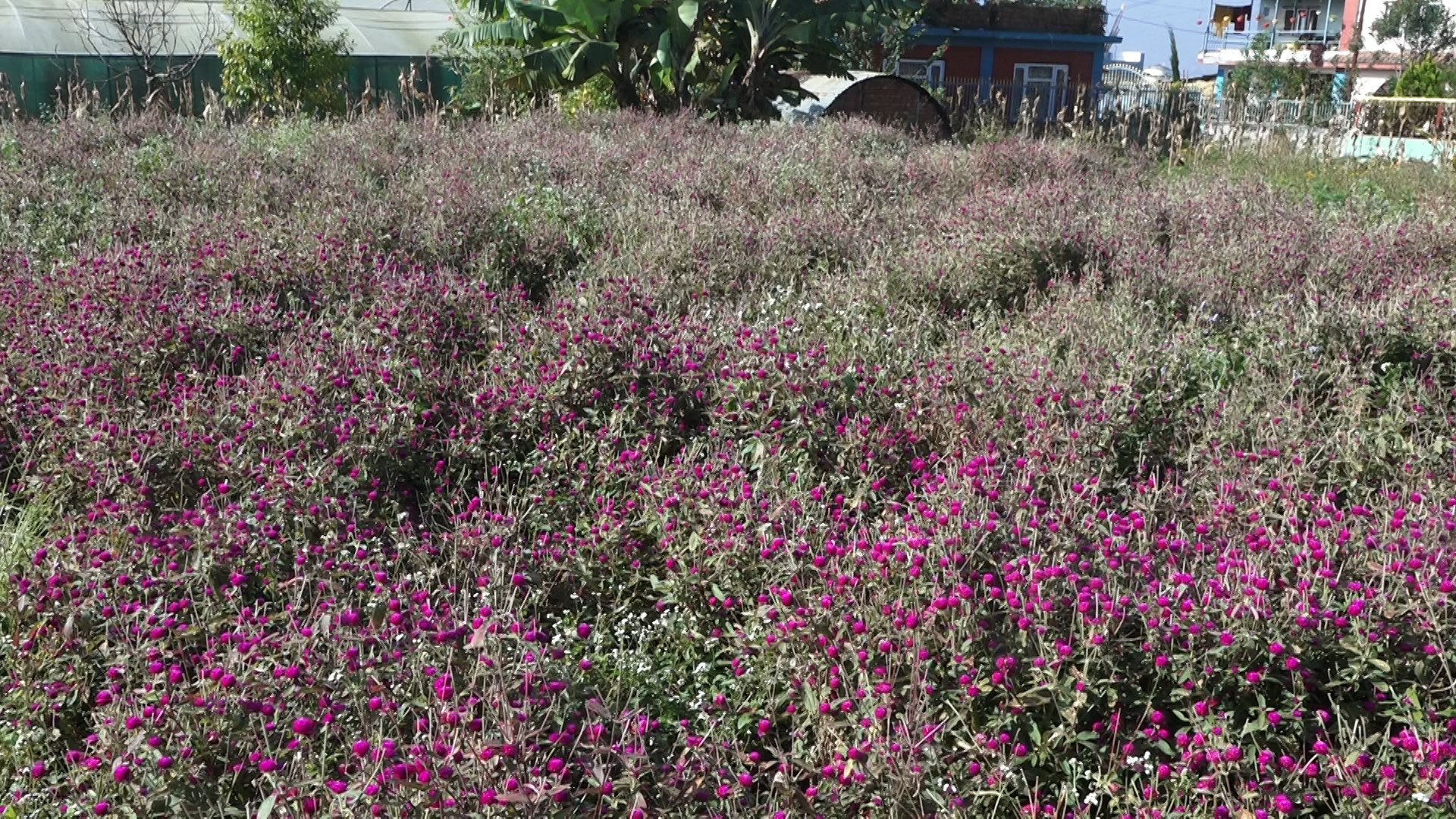
Bhaktapur. As the festival approaches, the business of flowers and garlands starts increasing in the market. The demand for marigold and velvet flowers is especially high during Tihar. Targeting the demand during the festivals, farmers of Kathmandu Valley are active in velvet and marigold flower cultivation. It has become a source of good income for the farmers who have been cultivating commercially for many years.
Gyanendra Thapa has been commercially cultivating velvet flowers for the past 12-13 years.
He has now planted velvet flowers in about two ropanis of land. He said that he used to plant flowers in the past as well but lately he has taken it forward as a regular business.
‘We have been planting flowers since last year. Now we have planted velvet flowers in about two ropanis. We will take it forward commercially. Every year, we cultivate the same area,” he said.
According to Thapa, the production of flowers has decreased this year compared to the previous year. He said that due to excessive rainfall and disease, the problem of drying up and burning of flower plants has been seen. He feels that attention should be paid to the quality of seeds to the use of pesticides and pesticides in flower farming.
‘This year many flowers have burned, the plant has become emaciated. It has finally sprouted again. There is a problem of the flower plant dying due to excessive rain. Therefore, this time the flowers have bloomed less than last year,” he said.
Despite the decrease in production, the price of flowers has increased in the market, according to the farmers. According to Thapa, the price of velvet flowers has reached Rs 30 to Rs 35 per garland this year. He had sold it at Rs 25 per garland only a few days ago.
Thapa picks flowers from mid-July and prepares them for sale. From the first and second week of July, the garlands are sent to the outside market. He said that Nepali velvet garlands are also reaching India, Australia and other countries.
According to him, traders who send 40,000 to 50,000 garlands abroad at a time buy them. He said that Nepali velvet garlands reach abroad by August and September. Apart from this, garlands are also sold in Kalimati, Imadol, Pokhara and Chitwan among other markets of Kathmandu.
Since the market of velvet flowers remains even after Tihar, it is easier for the farmers to sell. He said that even after Tihar, the remaining garlands are sold for Rs 10 to 15.
Thapa is hopeful that whether or not the government will ban the import of Indian flowers and garlands this year will affect the market price determination of Nepali farmers.
“Last year, there was a ban on bringing flowers from India. We got a good price. If we stop importing flowers from India this time too, we hope that Nepali farmers will get a good price,” he said.
Similarly, Radhika Thapa has also been cultivating velvet flowers for about 10 years. She started farming by planting flowers in the paddy fields, but now she has been planting flowers in her garden. She said that she has continued to do so after she started earning good income from floriculture.
According to Radhika, the price of velvet garland is now Rs 25 per piece. She says that the garland, which was sold at Rs 21 some time ago, is gradually becoming expensive as the Tihar is approaching.
“I have been doing floriculture for almost 10 years. Initially, we used to plant paddy in the fields. Now we have started planting it at home. We have continued it as the business is good. Now they are paying Rs 25 per garland. Hopefully, the price will increase further as the festival approaches,” she said.
According to Radhika, the velvet garland is not limited to Kathmandu. Since July-August, traders have been collecting garlands and sending them to countries including Australia, Japan and America. He said that the market for velvet garland has expanded as the Nepali community abroad also demands it.
The garlands she produces also reach Kalimati, Imadol, Pokhara and Chitwan and other markets. Although her income varies according to the production and sale of flowers, she said that this year she has earned between Rs 70,000 and Rs 80,000 from velvet flower farming.
According to him, the sale of Sayapatri flowers is mainly targeted at Tihar. The demand for Sayapatri flowers increases from the day of Kukur Tihar and the traders start ordering. According to her, the velvet garland is sent abroad before the Tihar festival and can be sold even after Tihar, so its market lasts for a comparatively long time.
Floriculture that started with a small area has now become a source of income for the farmers. The increasing demand for Nepali velvet garlands in foreign countries has shown the possibility of expanding floriculture commercially. However, the impact of weather on production, the outbreak of diseases, and competition with imported flowers are the challenges for the farmers.



 प्रतिक्रिया दिनुहोस्