

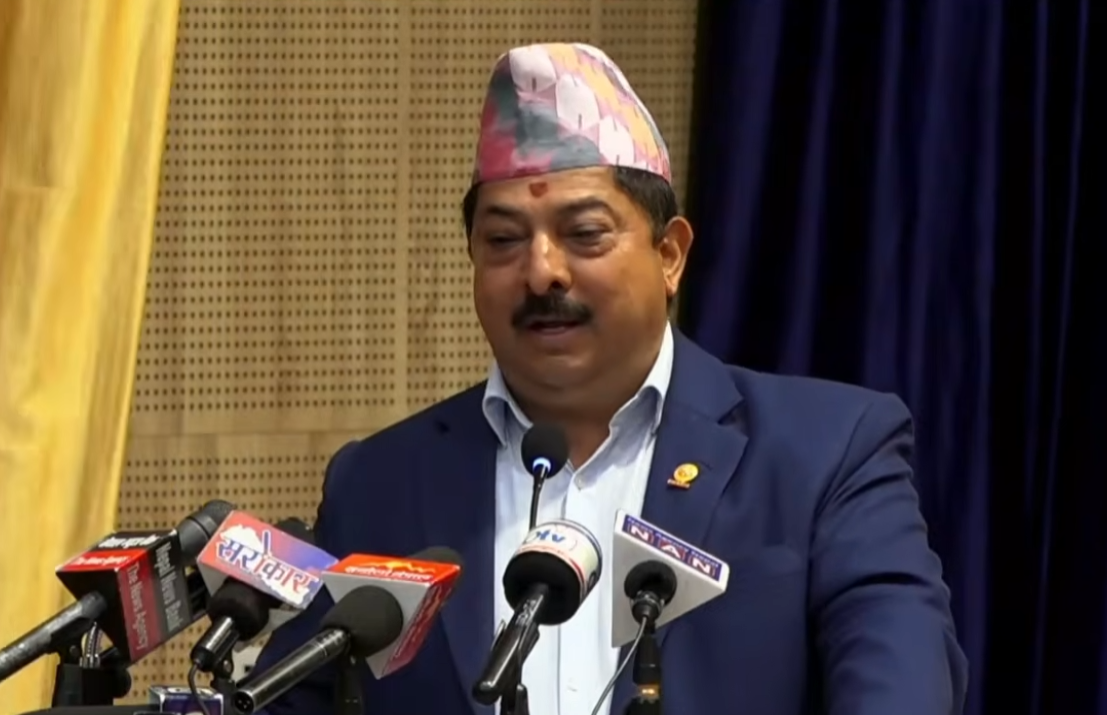
. Anjan Shrestha, president of Federation of Nepalese Chambers of Commerce and Industry (FNCCI), has said that Nepal’s automobile sector is not competitive due to the highest tax and customs rates in the world.
Addressing the inaugural ceremony of the Nepal Mobility Expo 2026 organized by Nepal Automobiles Importers and Manufacturers Association (NAIMA) here today, he said that the industry has been hampered as the government has not changed its attitude towards the automobile sector as a luxury item. He said that the automobile sector should not be seen only in terms of vehicle sales and imports, but it should be taken as a sector directly related to connectivity, infrastructure development, energy transition and economic activities.
‘Nepal has one of the highest customs and tax rates on automobiles in the world. The government continues to define this sector as a luxury item, which is discouraging the expansion and investment of the sector,” he said.
According to Shrestha, many countries of the world are adopting incentive policies considering transport and mobility as the basis of economic growth.
But in Nepal, high taxes, policy complexities and lack of infrastructure have limited the sector’s potential.
He said that economic activities would expand and energy, technology and investment sectors would take momentum if safe, sustainable and technology-friendly transportation system could be developed.
According to him, a long-term and stable policy environment is necessary especially for the expansion of electric vehicles and new technologies.
Shrestha said that although the number of vehicles has increased significantly in the last two decades, infrastructures like roads, parking, public transport and traffic management have not been expanded in the same proportion.
According to him, this has made the transport management more challenging, especially in the Kathmandu Valley.
He also said that there has not been enough investment in the field of road safety. Stating that the number of traffic police is almost the same despite the rapid increase in the number of vehicles, he said the lack of both human resources and technology has increased pressure on the traffic management.
Shrestha urged the government to consider the transport sector not only as a means of revenue collection but also as an infrastructure for economic development.
According to him, the automobile sector can contribute to employment, revenue, energy transition and overall economic development if the investment-friendly environment is created by reducing the high tax burden.
He stressed that the State should give priority to this sector as improvement in transport system would facilitate people’s mobility and also play important role in promoting trade, tourism, industry and investment.

 प्रतिक्रिया दिनुहोस्