

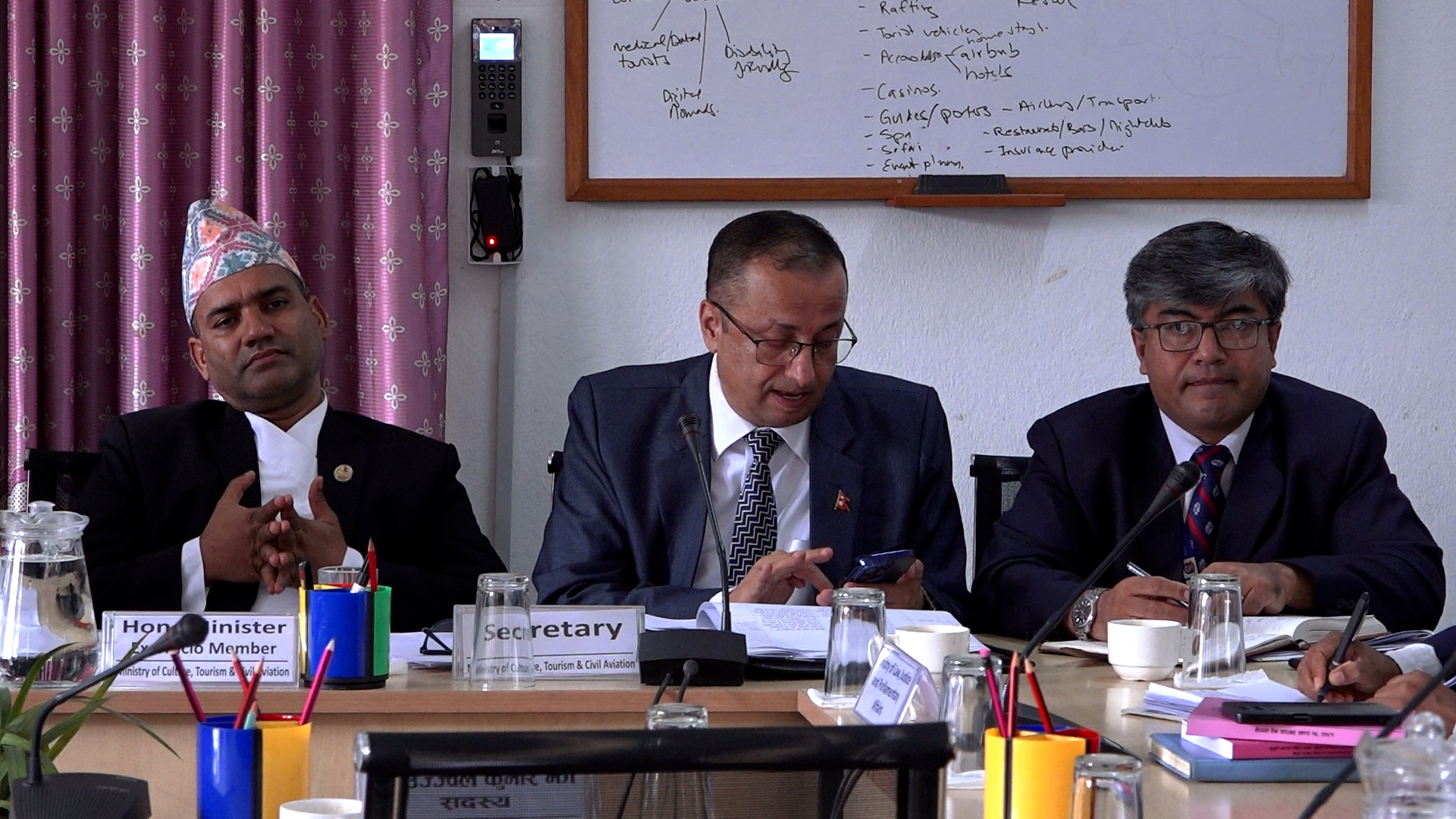
Emphasis on ensuring the rights of the community in the protection of intangible cultural heritage. KATHMANDU: The meeting of the International Relations and Tourism Committee of the House of Representatives (HoR) today discussed the amendments to the Non-Physical Cultural Heritage (Protection) Bill-2081.
In the meeting held on Thursday, Joint Secretary of the Ministry of Culture, Tourism and Civil Aviation, Dr.
Suresh Shrestha was of the view that laws related to the protection of intangible cultural heritage should be made protective and guardian rather than punitive.
He informed that after various discussions, the bill will be named ‘Protection of Intangible Cultural Heritage’ and the date for certification of the bill will be finalized. Shrestha said that among the laws enacted by the state, the penal laws that provide for punishment, fine and imprisonment and the laws related to intangible cultural heritage should be protective.
“During so many discussions, most of the votes were found that this law should be made in a protective manner, in such a way that the state should take guardianship,” he said, “Otherwise, we have seen that even when a good act like Guthi Act is introduced, the people have not accepted it.” “
intangible cultural heritage is a matter directly related to the daily life of the community and individuals and any provision made on this should take into consideration the sensitivity of the community,” he said. “Intangible cultural heritage is a matter related to the daily lives of communities and individuals. If there is even a slight fluctuation in this, the people will not tolerate it,” Shrestha said.
He also mentioned that the bill has also suggested that it should not be like the Guthi Act.
Shrestha said that the issue of independent consent with prior knowledge should be taken seriously while cataloguing the intangible cultural heritage and conducting the program.
According to him, detailed provisions will be made in the regulations by keeping the provisions related to FP in the Act.
He informed that the Ministry is still in the exercise of taking prior consent for the heritage listing.
“The issue of obtaining consent before using a person’s face or heritage in any event or listing is very sensitive,” he said, “We will put it in an indicative form in the Act and detail it in the regulations.” Shres tha was of the view that the community should be understood as the basis of the state rather than looking at the state and the community separately. According to him, no matter what the heritage is, whether physical or immaterial, it has no meaning without community.
‘The state is made up of the community. Whatever the heritage is, whether physical or non-physical, if there is no community, it has no meaning. As long as the community exists, the heritage will survive,” he said, adding, “The state should only play the role of guardian and help the citizens to exercise their fundamental rights without any fear.” “
Although economic benefits play a role in the disappearance of intangible cultural heritages, not all heritages are lost due to economic reasons. The bill has provisions allowing the communities to use their intangible cultural heritage for commercial and economic income.
However, he said that excessive commercialization could affect the originality and cultural importance of heritages.
Giving the example of ‘Yomari’, he questioned whether the special cultural significance of ‘Yomari Punhi’ has diminished as Yomari is available in restaurants on any given day.
In the meeting, the members of the committee expressed their views on the need to clearly ensure the participation of the community in the protection of intangible cultural heritage, prior consent, the process of listing and the guardianship role of the state in the bill.



 प्रतिक्रिया दिनुहोस्