

Police Challenge After Floods: From Dead Body Management to Crime Control
Another Challenge for Police After Floods: From Identification of Dead Bodies to Security of Empty Houses and Control of Misinformation
Kathmandu. Although the floods have stopped, the human pain and challenges left by them have not stopped. Along with the rescue and search campaign, the Nepal Police is now engaged in the difficult responsibility of managing unidentified bodies and human parts, searching for thousands of missing, protecting the vacant houses of the displaced people, and controlling crimes and misinformation in the name of disasters.
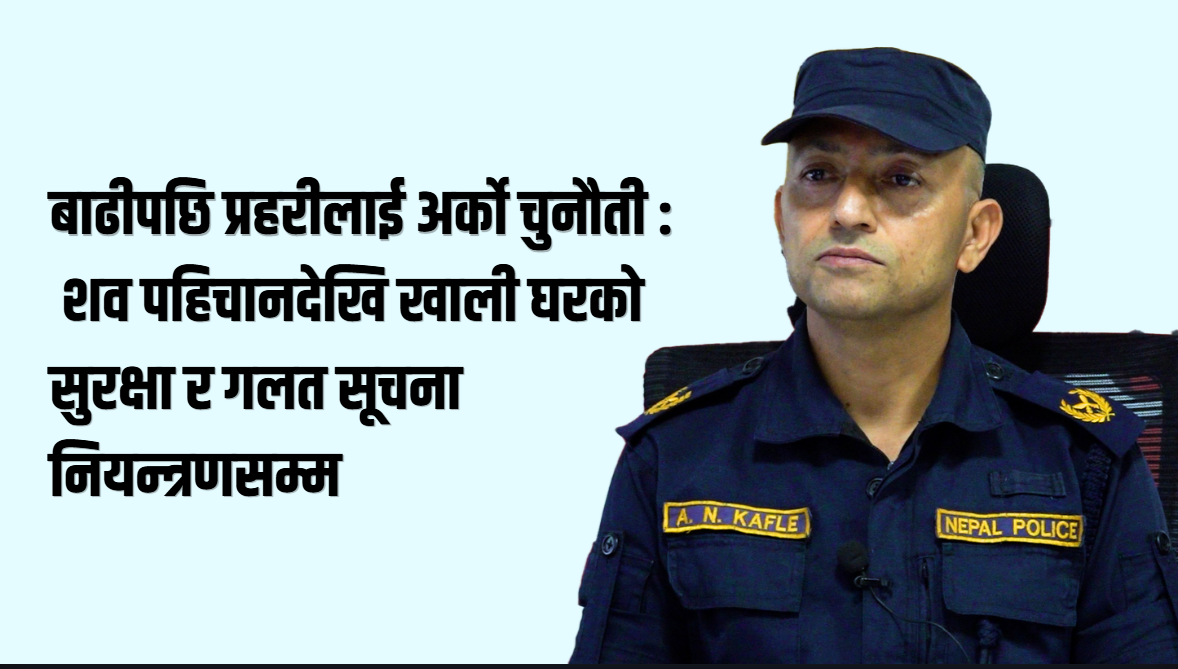
After the unprecedented floods, the management of unidentified dead bodies and human parts, identification of missing people, security of empty houses and structures and control of crime and misinformation in the name of disaster have added another big challenge for the Nepal Police. According to Deputy Inspector General (DIG) of Nepal Police, Abi Narayan Kafle, the central spokesperson of Nepal Police, there has been a huge loss of life in the floods. According to him, according to the latest information, more than a thousand bodies have been recovered and hundreds of human organs have been collected from different places. Since many bodies are in a mutilated state, it is not possible for the relatives to identify them directly.
In a conversation with Nepal News Bank, he said, “This flood came in a very unimaginable and tragic manner. People are missing and a large number of dead bodies and human organs are being found, Nepal Police expresses deep sorrow over this.” According to him, as soon as the initial information about the flood was received, the Nepal Police started a rescue and search operation through the local police unit. The impact of the disaster was widespread from Timure, Syafrubesi, Mailung, Haku of Rasuwa to Devighat of Nuwakot. Some police units were also out of contact.
After the communication communication was cut off, a special team was mobilized from the Communications Directorate of Nepal Police and the communication service was resumed in the affected areas.
According to him, dozens of police personnel were also missing in the initial phase. The bodies of some of them have been recovered and the search for 25 police personnel is still underway.
He said, “As soon as the information about the flood was received, the Nepal Police immediately started the rescue and search operation through the local police unit. The flood had a widespread impact from Timure, Syaphrubesi, Mailung, Haku of Rasuwa to Devighat of Nuwakot. Some police units were also incommunicado. After the communication was cut off, we deployed a special team and restored communication services in the affected areas. Dozens of police personnel were also missing in the initial phase, the bodies of some of them have been recovered and the search for some is still going on. “
The search for the missing continues
According to the police, thousands of people have been reported missing due to the floods. According to the latest data, more than 4,600 people have been reported missing.
An emergency meeting was held at the police headquarters and various teams were mobilized to make the rescue work effective. After that, a separate structure has been created for disaster rescue, information, coordination and management.
About
50 police personnel are working in shifts at the center formed under the leadership of DIG. A separate desk has been set up at the centre for the management of dead bodies, rescue, search, coordination, mobilization and monitoring of social networks.
He said, “We have collected the details of more than 4,600 people missing due to floods. We held an emergency meeting at the police headquarters and immediately mobilized various teams to make the rescue and search operation effective. At present, the Disaster Rescue, Information, Coordination and Management Center is in operation under the leadership of the DIG. About 50 police personnel are deployed on shifts and separate desks are working for the management of missing persons, dead bodies, rescue, search, coordination, mobilization and social media monitoring. He said that the rescue operation is being carried out by helicopter in coordination with the Nepal Army, Nepal Police and other security agencies.
Kafle said that the police have mobilized a communication team, drones, trained dogs, medical teams and separate human resources for road management.
Identification of mutilated bodies The most difficult task for the police
Many of the bodies swept away by the floods are in a very mutilated condition. In some cases, only one part of the body has been found. Even if only someone’s hands, feet, someone’s head or other parts of the body are found, the police have collected them and preserved them according to the legal process.
As soon as the body is found, the police have made arrangements to collect evidence such as the nature of the incident site, post-mortem records, photo and video archives, fingerprints, etc. Each body and human organs are recorded with a separate number and tag.
He said, “Many of the bodies swept away by the floods are in a very mutilated condition. In some cases, only a part of the body has been found. We are also collecting such human organs safely after completing the legal process. As soon as the body or body is found, we have made arrangements to record the incident site and post-mortem records, photo-videography and necessary evidence, by giving each one a separate number and tag. “
After that, DNA samples are being collected and profiled in coordination with forensic doctors and research officers.
According to the police, forensic doctors have been deployed in the flood-affected districts. Forensic experts have been deployed in Rasuwa, Nuwakot, Dhading, Gorkha, Tanahun, Chitwan, Nawalparasi, Pokhara and other areas to identify the dead bodies.
Police have started collecting DNA samples of the relatives of the first class in order to identify the unidentified dead bodies and human organs from the DNA of the relatives
Arrangements have been made for one of the parents or children to go to the Nepal Police Hospital and give a blood sample. According to the police, the process of identifying the DNA collected from the relatives is being done by matching the DNA profile obtained from the dead body.
After DNA matching, the body will be handed over to the concerned family after completing the legal process. After this, the family will be able to perform the last rites according to their religion, traditions, and rituals.
DNA profiling has also been arranged for relatives living abroad. According to the police, arrangements have been made for them to get a DNA test done from the concerned country and coordinate with the Nepal Police through the necessary details and DVI form.
He said, “We are collecting DNA samples of close relatives to identify the unidentified bodies and human organs. One of the parents or children can come to the Nepal Police Hospital and give a blood sample. The DNA profile of the sample received from the relatives will be matched with the DNA obtained from the dead body or human organs. After the DNA match, the body will be handed over to the concerned family after completing the necessary legal process. We have also made arrangements for the relatives living abroad to get the DNA test done from the concerned country and coordinate with the Nepal Police through the DVI form. “
Efforts to preserve both ‘respect’ and ‘identity’ in the management of the dead body
After the floods, a large number of dead bodies were collected more than the capacity of the hospital and mortuary. According to the police, there is a need to manage the dead bodies in Chitwan, Nawalparasi, Kapilvastu, Pokhara and other places.
Kafle said that the body was managed based on international practice, International Red Cross Committee (ICRC) standards and prevailing laws as the dead bodies could decompose and pose health and environmental risks if kept for a long time.
He said, “Due to the large number of bodies found after the floods, we had to manage more bodies than the capacity of hospitals and mortuaries. Bodies had to be kept in places like Chitwan, Nawalparasi, Kapilvastu and Pokhara. Since keeping dead bodies for a long time can cause decomposition and increase health and environmental risks, we are doing safe and respectful management of bodies based on international practice, ICRC standards and prevailing laws.” “
In some places, the bodies have been safely managed underground. For this, tagging, numbering, site plan and GPS details have also been preserved so that it can be confirmed where which bodies are kept if needed in the future.
According to the police, the main objective is to protect the identity proof and to create an environment in which the dead body can be handed over easily after completing the legal process if the relatives claim it in the future.
Two forensic laboratories are under pressure, new structure in Hetauda
Nepal Police Central Police Forensic Science Laboratory and National Forensic Science Laboratory Khumaltar are the main ones for DNA testing. Due to the large number of DNA profiling required, the workload in these laboratories has increased.
According to police, preparations are underway to set up a forensic structure at the Bagmati Province Police Office in Hetauda to facilitate this.
Kafle said that necessary equipment has been brought and the work of setup and resource management has been started.
He said, “At present, work is being done mainly in the Central Police Forensic Science Laboratory and the National Forensic Science Laboratory, Khumaltar, for DNA testing in Nepal.” Due to the large number of DNA profiling to be done, the workload in both the laboratories has increased. We are also preparing to set up a forensic structure at the Bagmati Provincial Police Office in Hetauda to facilitate this. The necessary equipment has been brought and the work of setup and resource management is moving forward. “
Preparations are being made to bring in experts from abroad as per the need along with the forensic experts available in Nepal to expedite the work of identifying the dead bodies.
Separate coordination from hospital to airport
DSP level officers of various hospitals have been appointed as focal persons to coordinate the management of dead bodies and the injured. According to the police, a help desk has also been set up at the airport under the leadership of SP.
Rescue and transportation of dead bodies has become challenging as roads and bridges have been washed away in the flood-affected areas. According to the police, dozens of bridges have been washed away and about 50 kilometers of roads have been damaged.
The bodies have been brought to Kathmandu and other places by helicopter and alternative route as there is no road connectivity in some areas.
Vacant house security is also a priority of the police
Houses and structures that have been displaced after the floods have now become another security challenge. According to the police, there is a risk of theft, robbery and other criminal activities in such houses.
For this reason, the search and security monitoring of the vacant houses has been started in coordination with the local level people’s representatives.
He said, “Many houses have been vacated after the floods. Keeping in mind the risk of theft, robbery and other criminal activities in such houses, we have increased security surveillance by coordinating with the local level and people’s representatives. We have also started searching and inspecting vacant houses. The Nepal Police is especially vigilant that no one should be allowed to commit criminal activities in the event of a disaster. “
Police have already arrested some people involved in theft and robbery taking advantage of the disaster. Police said that action has been taken against those involved in robbing gold from the dead bodies of the floods, controlling the person involved in bank theft and attempting to cheat in the name of relief.
The police have stated that they are assisting in the implementation of the government’s ‘one-door system’ in relief distribution and the control of misinformation
police. Police under the leadership of the Chief District Officer has been mobilized to identify the real victims and provide relief to them in coordination with the District Security Committee, local levels and people’s representatives. Arrangements have been made to send the relief materials collected at the central level to the concerned District Administration Office through the Nepal Disaster Risk Reduction and Management Authority. Meanwhile, the police have also increased surveillance against rumors, misinformation, misleading news and deepfake content spread through social media. The police have warned that action will be taken as per the law against those who create confusion among the citizens by spreading misinformation during disasters or obstructing relief and rescue operations. He said, “The police are assisting in coordination and security management to make the one-door system set by the government effective in relief distribution. Arrangements have been made to identify the real victims and provide relief to them by coordinating with the Chief District Officer, local level and people’s representatives.” There is an arrangement to send the centrally collected relief materials to the concerned District Administration Office through the Nepal Disaster Risk Reduction and Management Authority. In addition, we have also increased the surveillance of rumors, misinformation, misleading news and deepfake materials spread through social media. Action will be taken as per the law if any activities are found spreading misinformation or obstructing relief and rescue during a disaster. “
Challenges of health security in disaster
After the floods, the health risks have also increased with the rescue.
Police have urged people to pay special attention to sanitation and drinking water as the infection can spread through contaminated water, mud and materials swept away by floods.
Police have urged the public to drink boiled water, pay attention to personal hygiene and avoid using unusual food items found in flood-affected areas. Police at high risk amid limited resources
After the floods damaged roads, bridges and communication infrastructure, there has been a big challenge in police mobilization. However, Kafle said that the police are mobilized in rescue, search, security, dead body management, communication rehabilitation and relief coordination by making maximum use of available resources.
According to him, the risk of floods has not yet completely disappeared. In some areas, there is a large amount of mud, mud and stones, and there is also a risk of flooding again.
“Nepal Police is working day and night in the service of the citizens even in risky situations,” Kafle said, “Efforts are being made to complete the search, rescue and security management as soon as possible from DNA testing of unidentified bodies.””With the immediate phase of rescue caused by the floods, the affected families are now facing the challenge of identifying and handing over the bodies of their relatives, securing the displaced settlements and empty houses, reaching the relief to the real victims and preventing crimes in the name of disasters.”
For the police, this disaster is not just a matter of rescue but it has become a multi-dimensional challenge to take forward human sensitivity, legal process, forensic science, public safety and information management simultaneously.



 प्रतिक्रिया दिनुहोस्