

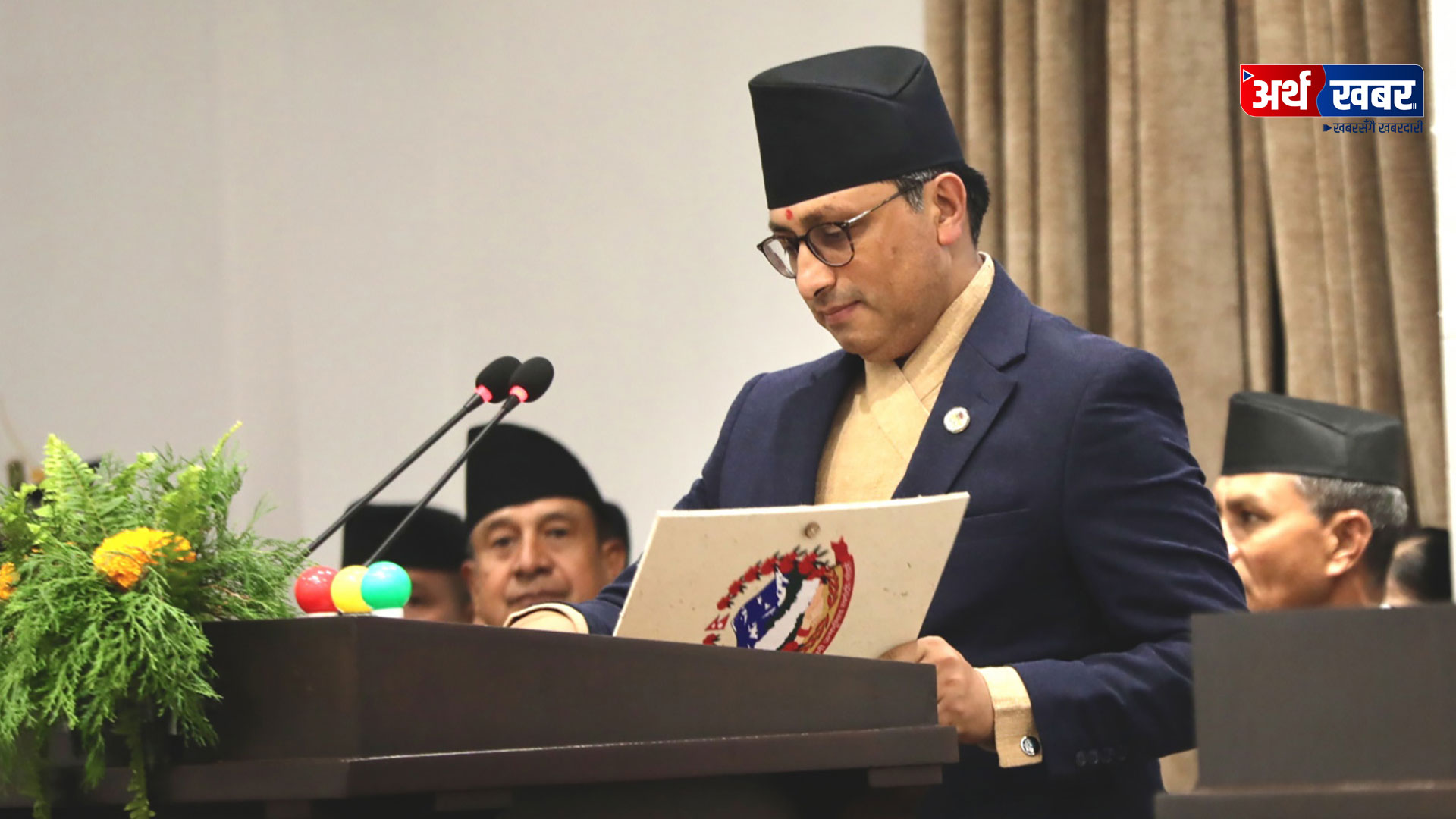
Kathmandu. The government, which has close to two-thirds political support, has been appointed as Finance Minister Dr. The budget for the fiscal year 2083/84 presented by Swarnim Wagle has been seen as the most reform-oriented budget in the last three decades. Announcing sweeping policy changes in the areas of taxation, administrative restructuring, energy, financial sector and private investment, the government has claimed that it has tried to create a new base for economic revival.
Out of the budget of Rs 2124.34 billion, Rs 1270 billion has been allocated for recurrent expenditure, Rs 431 billion for capital expenditure and Rs 422 billion for financial management. The government has set a target to achieve 7 per cent economic growth and limit inflation to 6 per cent in the coming fiscal year. Finance Minister Dr Wagle said the budget has prepared a basis for making the tax system simple, just, and production-oriented, making the public expenditure result-oriented, restoring the confidence of private sector and initiating a new economic cycle based on production, innovation and entrepreneurship.
The most important aspect of the budget is the reform of the tax system. The limit of personal income tax exemption has been doubled to Rs 10 lakh and the maximum income tax rate has been reduced by 10 percentage points. Limiting the customs system from 11 levels to seven levels, reducing customs duty on 273 industrial raw materials and removing excise duty on 360 goods are expected to provide relief to the industrialists and the private sector.
As part of administrative reforms, the government has announced to scrap 31 government bodies, merge six and restructure 18 government bodies. Digital governance, technology-friendly tax system and expansion of formal economy are expected to strengthen the state machinery. The budget has also given an important signal in the energy sector. The announcement of implementing the ‘Take or Pay’ policy again by removing the ‘take and pay’ system, restructuring the Nepal Electricity Authority and revoking the license of the projects that have not started construction despite the PPA has given a new message to the energy sector. A strategy has been put forward to connect the regional electricity market by allocating Rs 70 billion for the construction of transmission lines and substations.
However, energy sector experts say there are some policy ambiguities in the budget. Former Deputy General Secretary of Independent Power Producers’ Association of Nepal (IPPAN), Prakash Chandra Dulal, said that although the policy of immediately signing PPA, involving the private sector in power trade and expanding transmission infrastructure is positive.
According to him, although the arrangement of involving the private sector in the international electricity trade is welcome, the government needs a clear strategy to ensure the market for surplus electricity produced during the rainy season. According to him, more policy clarity is needed in this area as the budget has been silent on long-term energy targets. In order to attract foreign investment, the provision of allowing foreign investors to easily take back the profits earned in Nepal and allowing Non-Resident Nepalis to invest in the stock market has also given a positive message. Similarly, the announcement of setting up an asset management company to manage the bad loans of troubled cooperatives and banks is seen as an important step in the reform of the financial sector.
On the other hand, the announcement of 50 percent tax exemption on export earnings from the IT industry is expected to give a boost to the IT industry. It is believed that the morale of civil servants will also be boosted as the salary of civil servants has been increased after four years. But not all aspects of the budget are positive. Many economists have found it challenging to increase the size of the budget by more than 25 percent in a single year and collect more than Rs 1.405 trillion in revenue at a time when the economy has not yet fully come out of the recession. It is being analyzed that it will be difficult to meet the revenue target due to weak domestic demand and declining consumer purchasing power.
Experts in the agriculture sector have also said that the budget has not been able to meet the expectations. Youth farmer and agriculture activist Dipesh Nepal said although the policy and program has mentioned to give priority to organic farming, small farmers and youth farmers, the budget has not made adequate provisions to this effect.
He said that the budget has prioritized infrastructure development rather than agricultural production. According to him, the provision of subsidy to farmers with an income of more than two crore rupees will mainly benefit the big farmers and the small farmers will be overlooked. According to him, a large chunk of the agriculture budget is still spent on the management of chemical fertilizers and adequate budget has not been allocated for technology expansion, soil improvement and production-oriented programs at the local level.
Overall, Dr. The budget presented by Swarnim Wagle has given clear indications of structural changes through tax reforms, administrative restructuring, energy and financial sector reforms, and promotion of private investment. However, there are still challenges regarding agriculture, industrialization, digital infrastructure, long-term energy strategy and the reality of revenue targets.
In this sense, although the budget has drawn the initial line towards ‘Prosperous Nepal’, its success will depend more on implementation capacity, policy stability and restoring confidence in the private sector than on the announcement.

 प्रतिक्रिया दिनुहोस्