

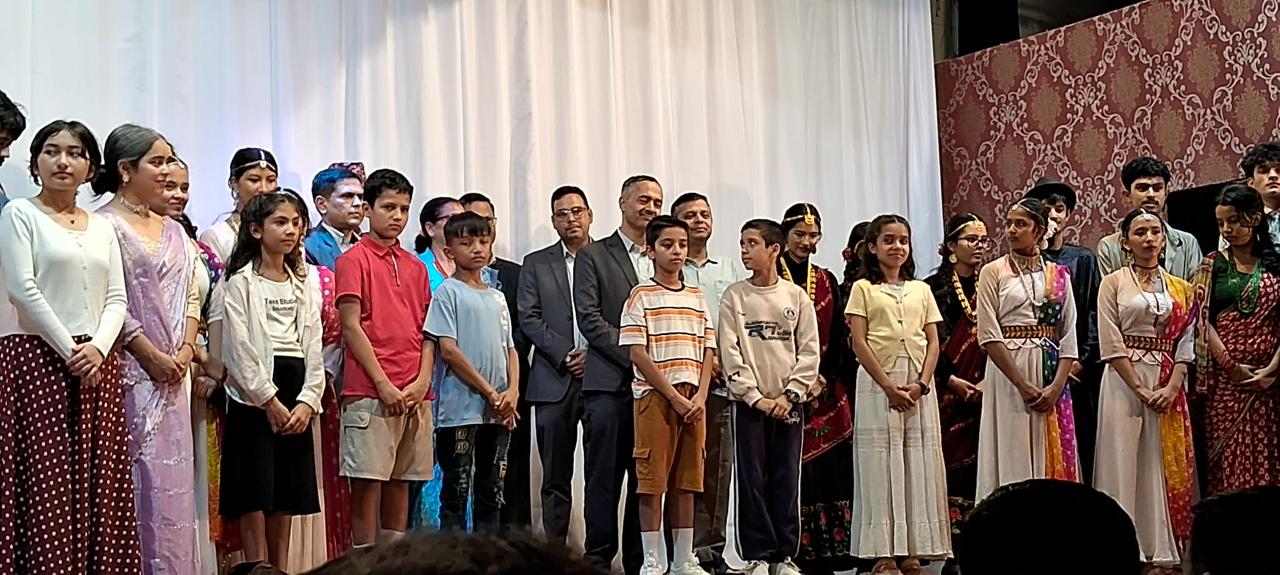
Kathmandu. A social realist and experimental play ‘Falame Gate’ has been staged at Budhanilkantha School.
On the concluding day of the play organized by the Nepali Department of the school from August 2
, writer and chief director Prem Narayan Bhusal was felicitated in recognition of his contribution in the field of education, psychology, literature and theater.
Bhusal was honored by handing over a letter of felicitation on behalf of the school.
Bhusal, who has been continuously studying, researching and writing in the field of education and psychology, was also praised for his literary and academic contributions.
Written by Bhusal, ‘Iron Gate’ has presented the journey from the innocent games of childhood and childlike intimacy to the existing class division, economic inequality, capitalist mentality, family relations and psychosocial conflict within the people.
The play raises the question of how people’s consciousness, relationships, and values change over time.
The opening scene of the play depicts the children’s non-discrimination play, intimacy and shared dreams. Aayush and Mahesh, who grew up together, stand on opposite sides of society as they grow up.
Ayush considers wealth, power and material prosperity as the basis of success.
Trying to prove himself superior to others through the display of expensive goods, cars and possessions, Ayush is presented as an outwardly successful character created by a consumerist society, but inwardly insecure and lonely.
On the other hand, Mahesh is seen as a representative of labor, intellectualism, morality and social responsibility.
For him, a person’s value is determined not by wealth, but by consciousness, character, and human sensitivity. This ideological and social distance between Ayush and Mahesh has become the main conflict of the play.
The ‘Iron Gate’ is not presented as a mere physical structure in the
play. The gate, which demarcates the boundaries of childhood sports, has become a symbol of class distance, prejudice, ego and mental wall that builds up between people over time.
Economic inequality and social discrimination are symbolically presented through the distance between the affluent world inside the gate and the social reality outside it. Another important aspect of the play is its experimental stage structure.
At the climax of the story, enlightened voices from the audience intervene on stage. It makes the viewer an active participant in the ideological journey of the play and not just a witness to the event. With the intervention of the audience, Ayush moves towards introspection and returns to the memory of the innocent world of childhood.
The play conveys the message that material prosperity alone cannot provide happiness, security and satisfaction to children. The play has raised the issue of providing expensive goods and facilities not only as a parental responsibility but also giving children time, love, good culture, education, morality, intimacy and human sensitivity.
The play was written and directed by Bhusal and co-directed by the Nepali department of the school.
Students from class 6 to 12, supporting artists and chorus participated in the play.
The first two days of the play were performed for the students, teachers and staff of the school.
On the third day, around 450 students and teachers from 14 schools of Kathmandu Valley watched the play.
On the last day, a play was performed for the parents, literature lovers and other invited audiences of the school.
Students, teachers, staff, parents and literature enthusiasts who watched the play responded to ‘Iron Gate’ as a contemporary, relevant and emotional drama.
Some viewers said they were emotional and in tears while watching the play. According to them, the drama has sensitively portrayed child psychology, parental role, economic inequality and complexities of social relations.
On the third day, students and teachers of various schools in the valley who came to observe the play said that the subject matter and presentation were very good, timely and relevant.
They said that such creative activities in the school would help the students to understand the real aspects of life along with the knowledge of books.
According to the school, although ‘Iron Gate’ was a school drama, its content, stage structure, acting and experimentation attracted a wide audience.
Along with entertainment, the play made the audience think about the psychology of children, parental responsibilities, social inequality and human relationships.
Bhusal’s stories, poems and essays have been taught in various classes at the school level.
One of his important works is ‘Contemporary Fiction in Psychology’ published by Nepal Academy.
He is also active in books and writings on how to deal with children and the role of parents and teachers in their psychological development.
Bhusal, who is also involved in textbook writing, has found a place in the school level for his various creative and educational writings.
Bhusal, who is active in study, research and writing, combining education, literature and psychology creatively, has also been presenting issues of social concern through the stage.
‘Iron Gate’ has given a theatrical look to his continuous study and writing on child psychology, parental role and social relations.
Speaking at the concluding ceremony, Bhusal said that school theater can not only be a medium of entertainment but also an effective medium to develop creativity, sensitivity and social awareness of students. He said that presenting the issues of social concern in an artistic way would help the students to understand different aspects of society and their own life from a different perspective.
The program expressed the view that the ‘Iron Gate’ should not be limited to schools only, but should be extended to the audience of different parts of the country and different classes and communities.
The organizers believe that if the drama can be performed in different parts of the country, the message will be broadened to make children understand the importance of good culture, education, conduct, love and human relationship rather than wealth. The participants said that Bhusal’s honor, which has been continuously active in the field of education, psychology, literature and theater, has encouraged creative writing and research in an institutional way.
The school has said that with the successful staging of ‘Iron Gate’, the relationship between education and literature can be further strengthened by connecting the tradition of honoring the creators.



 प्रतिक्रिया दिनुहोस्