

Discussion on various aspects of history, culture and social transformation in ‘Dear Karnali’
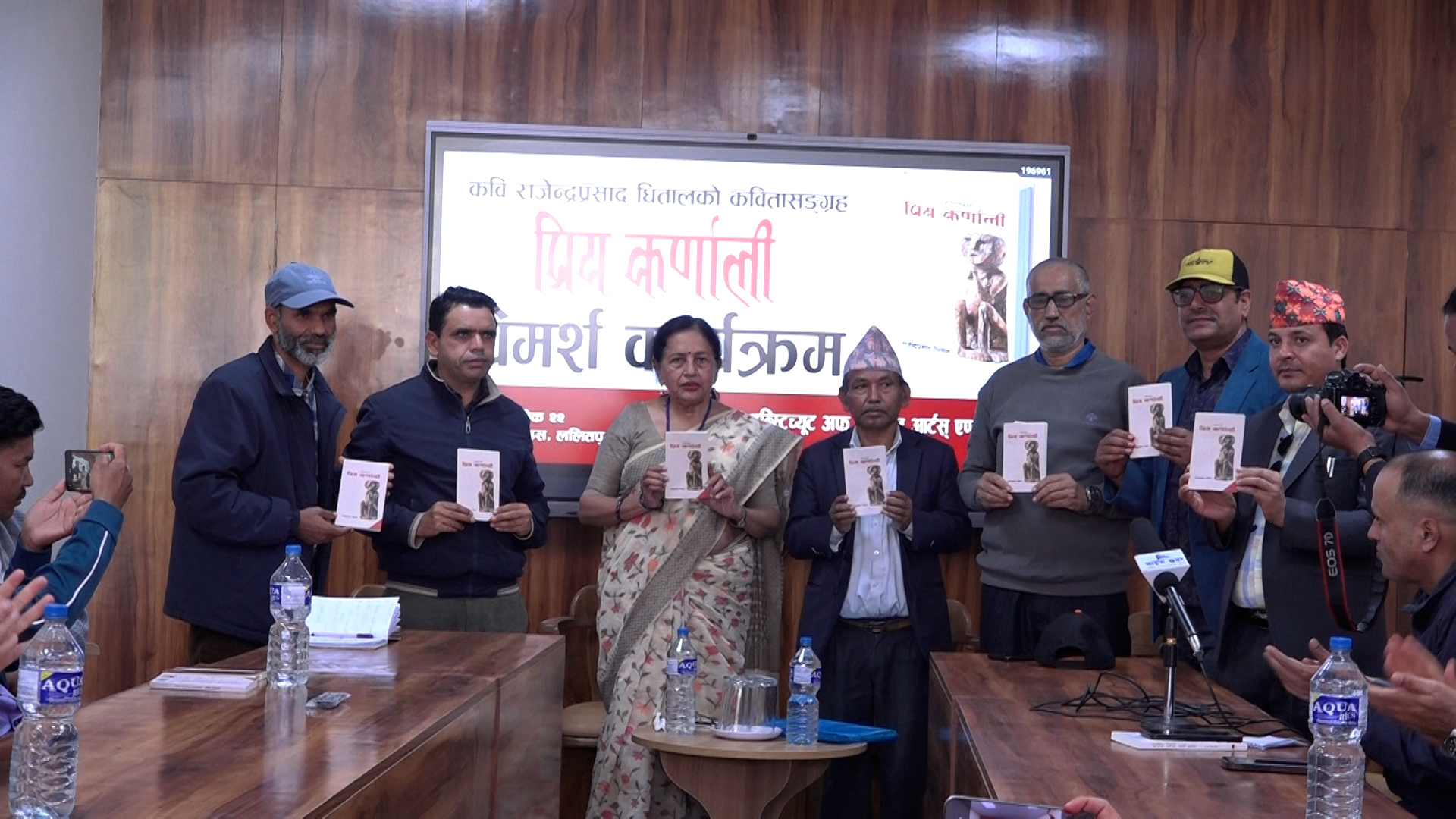
Lalitpur. A special dialogue and discussion program on poet Rajendra Prasad Dhital’s new poetry collection ‘Dear Karnali’ was held at Karnali House in Chakupat, Lalitpur. At a program organized by the Institute of Liberal Arts and Media, Kathmandu, the speakers stressed the need to highlight the historical civilization, cultural heritage, natural beauty and social reality of Karnali in a more powerful way through literature.
Professor Dr. Sudha Tripathi said that ‘Priya Karnali’ has included various aspects of nature, social reality, class discrimination, political consciousness and transformation. Stating that nature has been presented as the center of life and society in the poem, she said that many things can be expressed in few words through the use of imagery and symbols.
Stating that Marxist perspective, humanistic thought and social transformation have been included in the poems included in the collection, she said poets have raised questions on capitalist consumerist thinking, treatment of workers, character of power and social inequality. Referring to poems such as ‘Parvati’s Rebellion’, ‘Labor Day’, ‘Sagas of Struggle’, ‘Chapters of History’ and ‘Jhole’, she said that despite the change in the political system, the issues that have not changed in the condition of the common people should be raised more strongly in literature. She also said that mentioning the date of creation of the poem would make it easier for readers and researchers to understand its time and context. Editorial Advisor of Nepal News Bank and former Chairman of Rastriya Samachar Samiti and senior journalist Dharmendra Jha said that the anthology has expressed the social, cultural and historical situation of Karnali and the sufferings of the people there. Jha, who is also known as poet Dharmendra Vihwal, said that Rajendra’s poems reflect deep love, affection and social consciousness for Karnali. He said that he got an opportunity to understand Rajendra as a philosophical personality after reading the anthology. The anthology contains around 50 poems and out of them, six are specifically related to Karnali, he said, adding that apart from poverty and deprivation, the poems also reflect the Karnali civilization, culture, natural heritage, lifestyle and self-respect of the citizens. Referring to his experience of carrying salt from Chisapani to Jumla holding his father’s finger as a child, he said the situation in which he had to travel through the mountainous route in the past for salt and exchange salt with grains would help to understand the economic and social life of the then society.
Poetry expresses the subtle pains, events and feelings of the society that are difficult to cover in the form of news within the limited structure of journalism. Referring to the poem ‘Simal’, he compared the image of Simal that loses leaves and flowers in winter but blooms again in spring.
He said that the expectations of political and social changes from the people’s movement of 1990 to the movement of 2062/63 BS, the contribution of martyrs and unfulfilled dreams are also reflected in the poems of the collection. He stressed the need of further study and research on the history, language, culture, tradition and tangible and intangible heritage of Karnali.
Academician Dr. Madhusudan Giri said that Karnali should be understood not only as a geographical area but also as an important source of ancient civilization, history, culture and human experience. He said that the natural beauty, life and struggle of Karnali should be presented alive through literature and poetry.
Referring to the importance of imagery in poetry, he suggested incorporating the mountains, rocks, danphes, munal, musk, herbs, herbs and local lifestyle of Karnali in an effective way. Stating that Karnali was an important trade route between Tibet and central India in the past, he said that the trade of horses, sheep, wool, gold and herbs has enriched the region economically. He said that along with tangible heritages like rock art, temples, Dewal and Birkhamba, there is a need for a deep study of folk songs, folk culture, language, traditions and ethnic lifestyle. Umakanta Adhikari talked about poet Dhital’s multi-dimensional personality, literary consciousness and philosophical aspects.
Stating that there was a combination of coordination, collaboration and contemplation in the creations of Dhital, he said that love for the motherland, patriotism and respect for the martyrs were expressed. He also pointed out the need to write the cultural, social and linguistic history of Karnali.
Poets Narendra Acharya, Indira Shah, Chandra Prakash Baduwal, Yogendra Shahi and Bhim Bahadur Bharati recited poems on the occasion. The creator of the anthology, Rajendra Prasad Dhital, expressed respect for Marxism and tried to incorporate it into his poems. Stating that the collection has not been able to incorporate many topics, he said that he would create more in the coming days. He expressed gratitude for the affection, affection and emotional support received in the program. Litterateurs and speakers participated in the program expressed the belief that ‘Dear Karnali’ would make an important contribution to bring the unique identity, historical glory, cultural diversity and people’s lives in the literary discourse.



 प्रतिक्रिया दिनुहोस्