

Gagan has put forward the vision of ‘The Next Decade of National Renaissance and Prosperity’
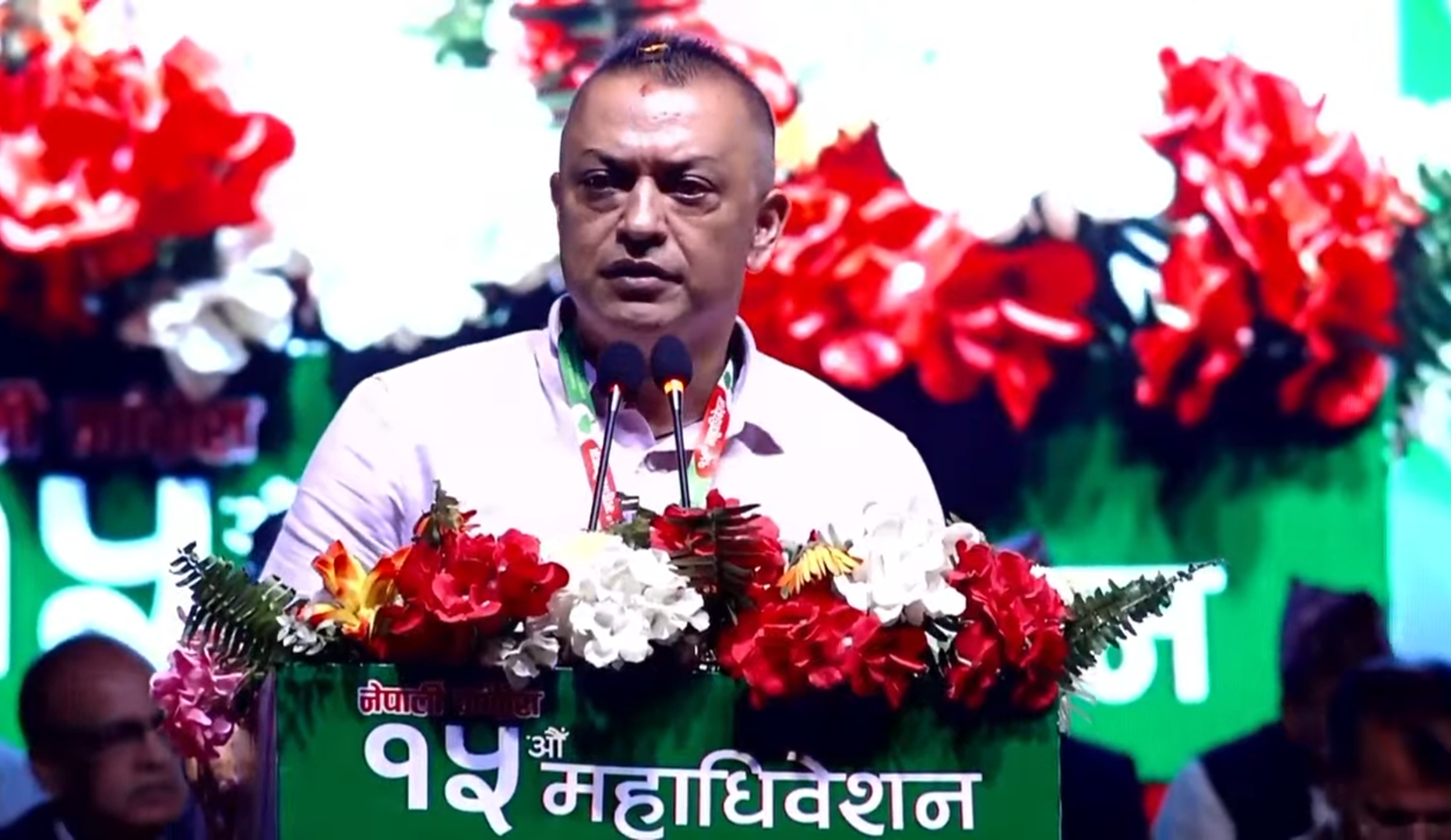
Kathmandu. Nepali Congress President Gagan Kumar Thapa has put forward the vision of ‘National Renaissance and Next Decade’ along with the party, democracy and the future direction of the country.
Presenting the political report in the closed session of the party’s 15th General Convention, Thapa presented the party’s ideological, political, organizational and national political line for the coming decade. Thapa’s report reviews the Congress’s historical journey, political achievements, past shortcomings and unfulfilled responsibilities. The power-centric politics, organizational weaknesses and growing distance with the younger generation in the party in recent years have also been made a subject of introspection. Reviewing the election defeat and the political practices of the last two decades, the report points out the need to identify the difference between the achievements made through change and the unfulfilled promises made to the people. Similarly, the political developments from the people’s uprising in August to the 15th Congress, the changing social psychology, the growing distance between the generations, the state of the economy, migration and the rapid changes taking place in the world have been presented as the major challenges in the present national context.
The report also warns of the risk that dissatisfaction with democracy may gradually lead to rejection of democracy. Stating that populism can lead to genuine public discontent to wrong political conclusions, it has stressed that the Congress should clearly fulfill its historical and contemporary responsibility in favor of democracy.
Thapa said that the Nepali Congress should be developed as a national force that is constantly present in the society during elections and not a political party that is active only during elections.
The report has proposed to develop a political system that listens to citizens’ complaints, draws conclusions based on facts and evidence, and presents solutions by playing the role of a responsible and clear opposition.
The role of the Congress should not be limited only to the opposition but should be established as the basis of national power and democratic balance. For this, priority has been given to institutionalize the message of social movements, to divert political energy to democratic institutionalization and to rebuild public trust.
Generational change, entry of new political leadership and leadership formation have been presented in the report as the next important task of the Congress.
New Interpretation of Nationalism, Democracy and Democratic Socialism
The report attempts to redefine the ideological basis of the Congress in the context of the changing context of the 21st century.
Keeping nationalism, democracy and democratic socialism as the permanent political ideals of the Nepali Congress, they are linked to the goal of a prosperous Nepal.
Nationalism has been defined as the independence of the nation and the collective self-government of the people, democracy with the ownership of public power by the citizen, and democratic socialism with political freedom and socio-economic freedom.
Presenting these three political ideals as the basis for building an independent nation, a sovereign citizen and a just society, national reconciliation has been put forward as a means to build a common national community in the midst of disagreements.
The concept of building a ‘prosperous Nepal’
Another important aspect of Thapa’s report is the concept of building a prosperous Nepal. The report has put forward the vision of building a prosperous Nepal on democratic, constitutional, socio-economic and humanitarian basis. It has been proposed that prosperity should not be limited only to economic growth but should be linked to the capability, opportunity, co-construction and accountability of the citizens. It has also stressed the need to create an environment where the fruits of development can be directly felt in the lives of the citizens by redefining the relationship between the state, citizens and institutions.
Answer to the question ‘What kind of Congress’
The report has concluded that the upcoming Congress should be developed as a party that is ‘clear in thought, vibrant in organization and accountable to the people’. For this, it has been proposed to increase citizen participation and a sense of ownership within the party along with the expansion of membership, strengthen hierarchical coordination and build an organization based on common strength.
Priority has been given to strengthening internal democracy, maintaining meaningful inclusion, increasing collaboration among different generations and building a Nepali Congress to lead social movements on issues of national concern.
The report also includes developing the party as a center for building ideas and leadership, setting high ethical standards and clear work commitments for the people’s representatives, and making the party’s financial system clean and transparent. Thapa has linked his leadership tenure in the next four years with clear workload and implementation and has put forward a political plan to achieve the goals of the next decade through continuous improvement.
The report has focused on fulfilling the aspirations of the citizens, taking the fruits of democracy in the lives of the people and maintaining a firm stance on the NC’s core political values.
Thapa’s political report presented at the party’s 15th General Convention has presented a comprehensive blueprint from the party’s past self-review to the next decade’s national renaissance, building prosperous Nepal and ideological and organizational transformation of the party.

 प्रतिक्रिया दिनुहोस्