

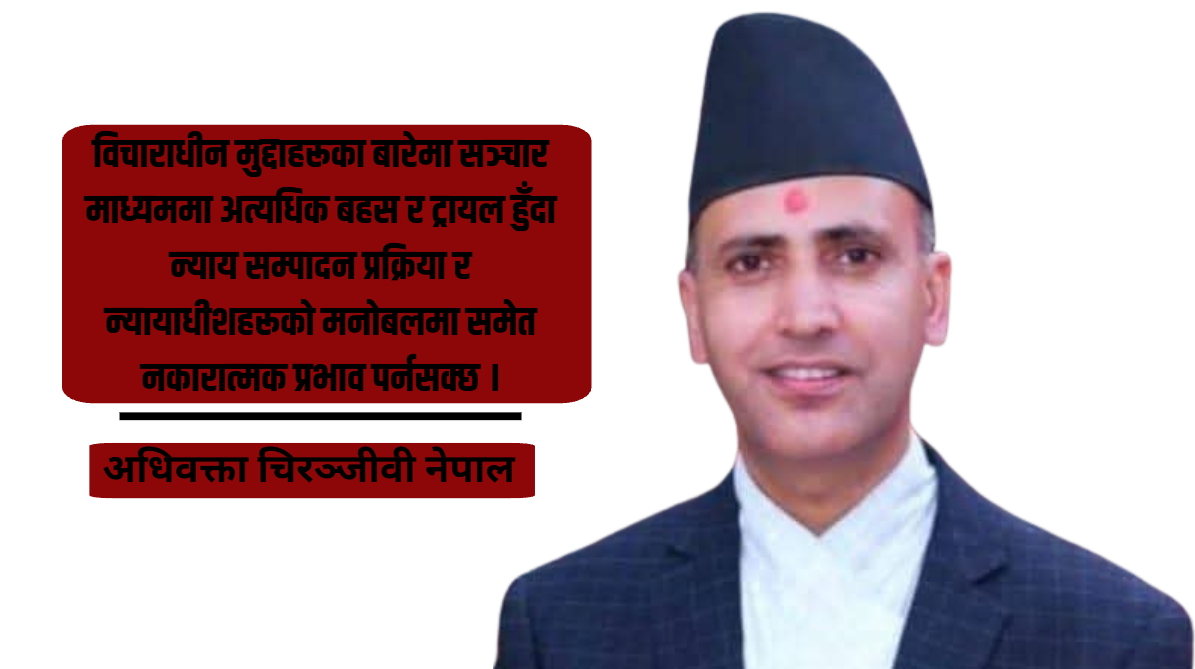
Advocate Chiranjibi Nepal
The judiciary, the legislature and the executive are the main organs of the state’s operation. The Inam Sapkota case has created a big storm within the judiciary, which is the most important of these three organs. The judiciary is said to be of the utmost importance here as it is also the temple of justice and the center of public faith. Not only in the judiciary, but it has also left a tremor in the entire security agencies and political circles. Who will be sidelined by this storm of the present and its aftershocks, or will this scandal cool down? Only the future will show that.
The conversations, photographs and details of financial transactions leaked from the mobile phone of Inam Sapkota, who was arrested on the charge of intermediary, have raised serious questions about the faith and respect of the citizens in the judiciary, the credibility of the court, the discipline, honesty and conduct of the judges sitting in the highest position and the relationship between the various organs of the state. Apart from this, senior officials of the police and the Armed Forces, MPs and high-ranking officials are also seen in touch with Sapkota. Although this is not the first time that such an incident has happened, but this current Inam case has been felt powerful and explosive.
Inam Sapkota, who can create such a big scandal or scandal, is known as a person who influences various cases, coordinates with judges and high-ranking officials, and acts as a middleman. It has been revealed that Sapkota had communicated with the judges of the Supreme Court to influence the case related to Rohit Gupta, the former director of Himalayan Reinsurance, and sent messages to pressure or influence the Prime Minister and other high-ranking people. He was in talks with all the high-level people including judges, politicians, police MPs and others about the case of Rohit Gupta. He was arrested on September 11, 2008 and was arrested by the police in connection with his suspicious connections with former Chief Justice Cholendra Shumsher Rana and other irregularities. He was arrested from Tribhuvan International Airport while fleeing. The police seized Sapkota’s mobile phone and during the forensic examination and investigation, he was exposed with people holding the most sensitive positions in the state. This has revealed the extent to which the network of brokers and middlemen is spread within the state machinery, including the judiciary.
The things mentioned
show that there is a feeling that the high officials of this country have become irreligious, immoral, undisciplined and irrational, otherwise how could such nakedness have been possible? When such things come to the surface, this issue should not be left at that, it should be left only after taking it to a conclusion. For this, first of all, a high-level investigation committee should be formed under the chairmanship of the judges of the Supreme Court, who are not involved in the dispute, including the Nepal Bar. A truthful, impartial, independent, credible and transparent process should be adopted while investigating such sensitive matters. During the investigation, if the act falls within the definition of corruption, then the matter will be subject to impeachment proceedings and its report will have to be sent to the Parliament. In any case, if it is proved that someone has done something contrary to the law, necessary action should be taken as per the prevailing law.
The creation of such a situation is due to the realization of the saying ‘law to the small and peace to the big’ and to increase impunity. Similarly, due to the inordinate delay in the hearing of cases, the situation of ‘getting justice is not getting justice’ is due to the situation of ‘justice is not getting justice’, the movement of middlemen would have been reduced if the automation system in the process of arraignment could be fully implemented. The influence of middlemen at various levels of the administration of justice, attempts to influence and this has raised questions on the impartiality of justice. If the judges or jurists had fully adhered to the code of conduct, maintained impartiality and neutrality, such a situation would not have arisen.
Huge money in the appointment and transfer of judges in the judiciary, political division or external pressure is a big challenge to judicial independence and good governance. If the judges were not appointed on the basis of merit, if the relatives and ‘quack’ workers were not appointed as judges without partisan division, then it can be guessed that such misfortunes would not have happened in the judicial world.
Some online and newspaper news items come in the form of rumors of the nature of personal character assassination or unsubstantiated rumors with the intention of sensationalizing and provoking rather than authentic facts, which can weaken the public faith in the court. The stakeholders need to pay attention to this as well.
Excessive debate and trial in the media about the pending cases can have a negative impact on the judicial process and the morale of the judges. Sometimes, such a situation arises that judicial decisions have to be taken by looking at the crowd outside, which is unfortunate for the justice system.
The way forward, the following steps should be taken to restore the dignity and public confidence of the judiciary by minimizing the anomalies and corruption seen in the judiciary. For this, the process of assigning the case should be fully automated in which there is no interference of any person.
High officials should maintain discipline and dignity and dignity of their office. The Judicial Council, Bar Council and related bodies should strictly monitor the conduct of judges and lawyers and adopt zero tolerance for corruption. The security and monitoring mechanism should be tightened to identify and break the network of middlemen who are active in the court premises and administrative sector.
In the rule of law and democracy, both press freedom and judicial independence must be respected. A culture of responsible journalism and truth-based news dissemination should be developed without contempt of court. Access to justice should be made easy for the general public so that no citizen has any resentment towards the judiciary and judges, respect and hope for the judiciary.
In conclusion, the storm of the Inam Sapkota case is not just the criminal or middlemen of one person, it is a frightening indication of the extent to which the access of brokers and middlemen has taken root to the inner layers of the Nepali state machinery, especially the judiciary. This case has seriously hurt the impartiality of the judiciary, the code of conduct of the judges and the faith of the common people in justice. Those who consider the court as the temple of justice have disappointed. The investigating agencies of the state should investigate it fairly and thoroughly and bring out the truth. The only option to bring the guilty to justice and punish the guilty according to the law is to restore the lost credibility of the judiciary. Let’s not delay, the stakeholders should be aware.


 प्रतिक्रिया दिनुहोस्