

{{}
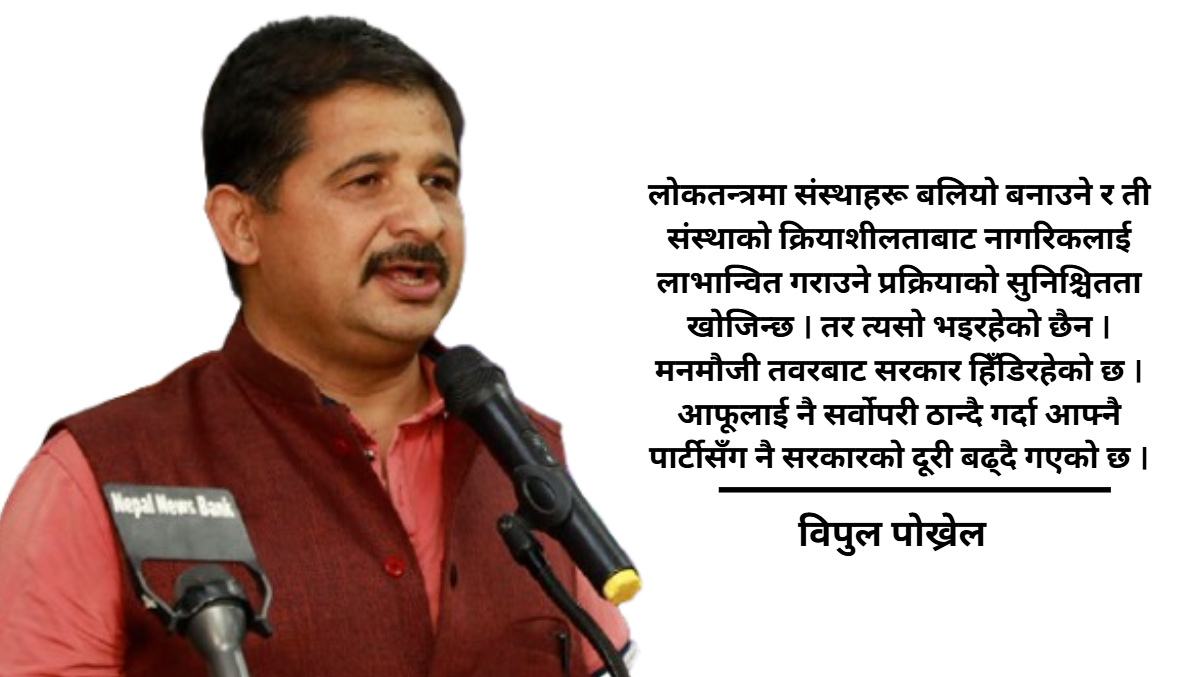
Vipul Pokhrel
Speaking at the convention of the Rastriya Swatantra Party, Prime Minister Balendra Shah (Balen) said, “This government is an express vehicle, it stops only when it reaches its destination.” In fact, he is running the government with this spirit. He does not seem to be in favor of stopping at a station, boarding and dropping passengers, or stopping at a garage and repairing the vehicle as needed. Like a whimsical driver, he does not want to take his foot off the accelerator, nor has he been able to tell the passengers sitting next to him where the destination is, and he has not been able to assure that he is safe with that destination.
Completely ignoring the things like taking feedback about the government, discussing the running of the government, taking his own party into full confidence, showing cordiality with the opposition through minimal dialogue, he did not even want to build a relationship with a smile when he met on the ‘road’. ‘Don’t talk to the driver in a moving vehicle’ used to be written on the back of the driver’s seat of the car when we were children. The opposition parties also seem to be remembering this ‘request’ behind the driver’s seat. After all, it would be even riskier to communicate with the driver who did not want to lift his feet from the accelerator. This may be the reason why the opposition did not allow the parliament to sit for a long time, demanding the presence of the prime minister in the parliament, agreed to resume the parliament session by saying that ‘even if the prime minister is irresponsible, we should be responsible’. They saw the danger of losing the prime minister.
On April 13, 1655, Louis XIV, the Emperor of France, addressed the Parliament of Paris with the message, “I am the state.”
The main implication of his repeated speeches was that he is the power, he is the lawmaker and he is the center of all power. He used to arrogate that all the organs, decisions and power of the state are in his personal will. Such arrogance comes to the rulers who do not want to constantly communicate with the structures created by the parliament, the structure, their own party, the constitution. It is necessary for the Prime Minister himself to understand that it is not only his desire that our Prime Minister should adopt the modern principle that the rulers should make themselves very democratic keeping in mind such references of history, but it will also be in the interest of the country and the last public opinion will also be highly respected.
In an interview, Nepal’s Prime Minister Shah had expressed his desire to ask him how to change everyone’s mind if he met Hitler.
He did not meet Hitler, but he was successful in the practice of being a maximum user of the algorithm and bringing everyone together in his favor. This popularity of his is only helpful for his desire to keep moving at an express pace, which is also a loss to the nation. This kind of popularity of the rulers who have come through the democratic process will make it easier to make necessary arrangements to establish order in the country, strengthen the structures and close all the doors of trouble. This is expected of the present Prime Minister and will continue to be expected throughout his tenure. But the Prime Minister does not seem to have paid attention to this aspect.
In the modern democratic era, a style of governance that is devoid of dialogue, solitary and full of arrogance cannot be considered appropriate at all. This style of running the government in a democracy is not suitable at all, it is not suitable even now. The decision of a few people sitting in the driver’s room with a smile does not reach the destination. The driver who drives the vehicle without the consent of the passenger will either meet with an accident or be punished. The present Prime Minister should understand the desire of the citizens in time to avoid both these challenges and run the government in a way that suits the democratic society.
Within a few days, even more recently, after Dashain (Tihar), the government was active. The journalist was imprisoned, he wanted to ask the source of the news from the journalist, locked the joint secretaries in the Prime Minister’s Office and fulfilled his ‘personal interest’ in the contract. A dangerous mafia was caught, but before the investigation, he kept his mobile phone in the house of the ‘crew member’ for two days and gave it to the police after getting the necessary treatment to suit him. The words expressed by the controlled mafia were brought out in part and those who wanted to suppress were suppressed. On the basis of the mafia’s words, the Prime Minister threatened him by writing a status. Taking advantage of the lack of trust in the court by coming out of the dangerous setting in the court, the IGP changed. He did not hear that there was a demand to convene a meeting of the parliament and recommended the introduction of two ordinances.
There is a conspiracy to create a negative narrative against the press, judiciary, parliament, police, authority, administration, all sectors at the same time, attacking and trying to keep them under their control by showing intimidation. The strategy of attacking the structures, institutions, agencies and individuals who question such activities of the government on one pretext or the other, creating a negative narrative against them and making them defensive is also clearly visible. Running the government in this way will not reach the right destination.
In a democracy, the process of strengthening the institutions and benefiting the citizens from the functioning of these institutions is sought to be ensured. But that is not happening. The government is running in an arbitrary manner. The distance of the government from its own party is increasing while considering itself as supreme. Regarding the decision to remove the IGP, there was a difference of opinion between the spokesperson of the government and the spokesperson of the party, but the tendency of the government to put the blame on the other and not take responsibility. It is not clear whether the government wanted to go on the path of weakening the institution. No one took responsibility. The government is not accepting its responsibility in any of the incidents since the arrest of journalists. The government is enjoying a whimsical journey by shifting the blame on others.
What are the priorities of the government? It is not clear yet. The ‘career’ built on the slogan of good governance is moving towards the practice of bad governance. It could neither win the hearts by opening the files of the past, nor did it try to win confidence by making arrangements for tomorrow. It was as if it was trying to do some work by making it happen, sleeping, and intimidating as it was said before the elections. They were even taken to the Prime Minister’s office and imprisoned. But that practice was also limited to the consequences for those around them. There was nothing that the nation could gain from that style.
Such a powerful government is expected to travel with a goal, and there is also a group that rejoices in sporadic decisions. The government should not be foolish to consider the reaction of this group as totality. At the same time, the citizens should also be able to think about how much and what to expect from the government which has a two-thirds majority in the parliament. It is also important to pay attention to the fact that many things may have been left behind while being engrossed in sporadic decisions.
In the political history of Nepal, it is not only the fault of geopolitics or the electoral system that has led to the fall of governments; the arbitrariness, arrogance and whims of the rulers have become the main factors. Even in the past, whenever the leadership disrespected the people’s mandate and considered only their whims as paramount, the governments with a large majority have also fallen like a house of cards. Forgetting this reality of history, the Balendra government also seems to be moving on the track of arrogance and autocracy, which is very worrisome.
The government should not delay in making up its mind to move ahead by leaving this wrong and unsafe path immediately. Keeping aside the pace of arrogance and whims, a culture should be created to continuously communicate and cooperate with the people within the party, in the parliamentary forum, with the media and directly with the people through the media. The Balen government needs to understand the fact that it is an indispensable need of today to improve this process of running the government to lead the country and democracy on the right path. (The writer is the outgoing central president of the Federation of Nepali Journalists)


 प्रतिक्रिया दिनुहोस्