

Let’s take a look. In our oriental philosophy, a judge is considered as a person who does not have prejudice, does not bargain with anyone and dispenses justice without any discrimination. Modern democratic norms and universal judicial principles also expect impartiality, independence and justice from judges.
Therefore, the judges are addressed with respectable words like ‘husband’ and ‘justice’. However, the Inam Sapkota case has seriously attacked these established values and values of justice. After this episode, the message has gone to the public that the judges are not dispensing justice and are influenced by other interests other than justice. The trust of the citizens in the court, which is considered to be the center of public faith and the temple of justice, has shaken. The increasing disgust towards the court is not a good sign for any democratic country and society.
The recent revelation of the entire state system and especially the judiciary has exposed the fact that the roots of brokerage, middlemen and setting are spread in the major organs of the state. It has also shown how our society has been affected by the influence of middlemen. This episode has increased the risk of making Nepal known as the country of brave and brave people in the international arena as a country run by corrupt and middlemen. This is a matter of international shame for us.
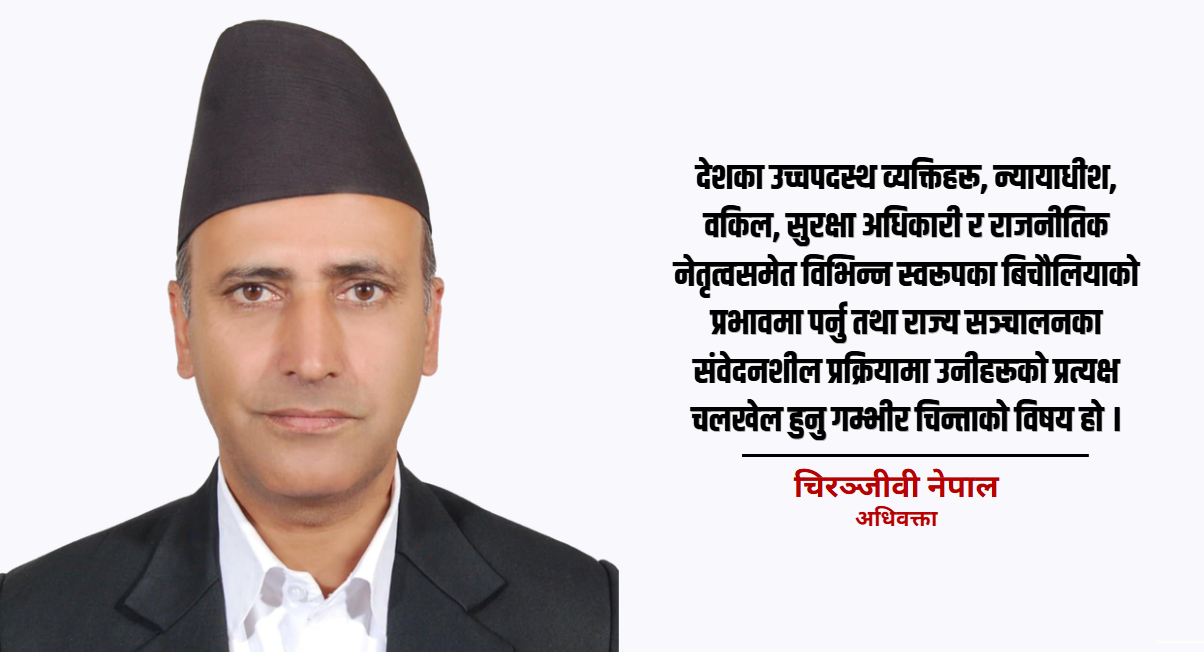
It is a matter of grave concern that the high ranking people of the country, judges, lawyers, security officials and the political leadership are also under the influence of various types of middlemen and their direct interference in the sensitive process of running the state. In fact, the Inam Sapkota case is a product of the greed, selfishness and unethical conduct of the people at the leadership level.
This case has raised serious questions about the impartiality and credibility of the judiciary. After the revelation of the details of the direct dialogue and close relationship between some judges of the Supreme Court and the middleman Sapkota, it is doubtful whether the judicial administration and judgments are being affected. This has put the judiciary, which is considered to be the center of public faith, under controversy and suspicion.
This case indicates that the influence of political leadership and middlemen in the security and administrative machinery is strong. This has further strengthened the suspicion that the role of middlemen is decisive in the process of transfers, promotions, big contracts and public procurement. The question has been raised whether the administrative and security machinery is run on the basis of setting rather than professional and lawful processes. The influence of outsiders in the transfers and promotions of senior police officers, judiciary and government officials is a serious challenge to the rule of law and good governance.
The questionable role of the political leadership, their relatives and personal secretaries has been a subject of question since the past. The current episode has brought back to the surface the possible nexus between the top leadership of political parties, the bureaucracy and the middlemen. Without political patronage, the middlemen will not be able to exert such influence over the sensitive agencies of the state. Therefore, there is a need for serious investigation into the role of the political leadership and the possible networks that will operate under their patronage.
The presence of middlemen with money laundering, banking frauds, big financial manipulations and corruption has raised questions about how policy corruption and broker tendencies have taken root in the country. It is natural for honest citizens to be disappointed when the influence of interest groups increases in the state agencies and decision-making process. It also weakens the investment climate, institutional governance and trust in the state.
Solving the problem: What to do now?
As the saying goes, ‘The broken walk of a broken house, the window everywhere you look’, it seems that the system of governance of the country has deteriorated and institutional distortions are flourishing. To end such distortions and anomalies, systemic reforms, effective monitoring, and strict implementation of laws are necessary.
In order to protect the dignity and public faith of the judiciary, there should be a fair, transparent and credible investigation against the judges, leaders and employees named in the Sapkota case. No one should be protected during the investigation and no one should be targeted with prejudice. Everyone should be brought under the ambit of equal legal process and a free and fair trial should be ensured. Strict action should be taken against those found guilty as per the law.
There is also a need for a thorough investigation into the relationship of the middlemen with the political leadership and the judges, and in what decision-making process they influenced. Whoever is involved in the high-ranking person, leader or bureaucracy, the truth should be investigated and the truth should be made public. The rule of law cannot be established until the network of middlemen with political patronage is broken.
Transfers and promotions in the police and civil administration should be freed from the pressure of political and middlemen. A system of management of employees should be developed on the basis of competence, efficiency, experience and performance. Public procurement, contracting and administrative decision-making process should be made transparent and unauthorized interference in it should be stopped. Action should be taken against those who weaken good governance and use the state machinery for personal interests.
The Commission for Investigation of Abuse of Authority, the Department of Money Laundering Investigation and the Central Investigation Bureau of Police should be exempted from political pressure and interference. An environment should be created where these bodies can conduct investigations in an independent, impartial and professional manner without any political influence. Investigative agencies should not be made centres for recruiting cadres of political parties. Those who acquire wealth illegally and misuse state resources should be investigated and confiscated according to the law should be effectively implemented.
The political leadership should keep an eye on the ethical conduct and activities of their personal secretaries, advisers and close associates around them. There is a need to launch a campaign of ideological and moral purification within the political parties to end the tendency of public office and political power to make personal gains. Political parties should ensure accountability for the conduct of their leaders and cadres.
The Inam Sapkota case has raised serious questions about the role, impartiality and credibility of the independent judiciary. It should not be seen as the activity of one person or a limited incident. It has also exposed the institutional distortions and the network of middlemen that are prevalent in various organs of the state. Therefore, the solution should also be found deeply.
In this context, the decision of the full court of the Supreme Court on October 1, 2008 has been made public. In a country where constitutional supremacy and independent judiciary are recognized, the first responsibility of ending the anomalies and anomalies within the court lies with the judiciary itself. The court should have formed an impartial investigation committee at its own level and brought out the facts, but the matter of investigation against the judges has been sent to the jurisdiction of the parliament. In such a situation, it seems that the constitutional and political process can move towards impeachment.
It is the common responsibility of all to maintain the trust of the citizens in democracy, the rule of law and the institutions of the state. The loss of public faith in the judiciary is not only a loss to one institution but also an attack on the entire democratic system. Therefore, this case should not be suppressed or limited, but should be used as a historic opportunity to reform the state system and judiciary by taking action against the culprits through an impartial investigation. This needs the serious attention of all the concerned stakeholders.

 प्रतिक्रिया दिनुहोस्