

Fruit prices rise due to non-operation of northern border points, people hit during festive season
Parbati Bhandari, Nepal News Bank
Kathmandu. Amar Baniya, president of Nepal Fruit Wholesalers Association, said that fruit traders have been hit hard due to the smooth operation of Tatopani border point with China.
According to him, fruits and other food items are compelled to be brought through Korala border point as the Tatopani border point has not been operated regularly. He said that the traders have suffered huge losses due to long distances, problem of roads, snowfall and increase in transportation cost.
Baniya said that not only the businessmen but also the general consumers have been affected due to the smooth operation of the Tatopani checkpoint. According to him, the transportation cost of transporting goods in a vehicle through Korala border point is up to Rs 4 lakh. He said that the same goods can be transported from Rs 50,000 to Rs 1 lakh if brought through Tatopani checkpoint.
“It is difficult to get containers now as hundreds of containers have been swept away in the floods,” he said, “Small investment entrepreneurs are not in a position to bring goods by taking risk due to problems of roads, snowfall and transportation.” According to him, the business of fruits has decreased by about 40 percent this year compared to last year’s festivals. He said that although there was an encouraging business during Dashain last year, this year we have to sell fruits like apples and oranges at a loss.
He said that even during Tihar, only about 60 percent of the business will be done compared to last year and the business is expected to decrease by 40 percent. He said that the business of fruits has also been affected due to the weak purchasing power of consumers in the market and the decline in the overall trade.
He said that the challenge for fruit traders now is to save their business rather than making profit. He said that there is a risk of incurring huge losses if the fruits are not sold while importing millions of rupees.
“At this time, instead of making profit, we have to think about how to survive,” Baniya said. If the condition of the road remains like this, there may be a loss of crores of rupees. “
It is difficult to compete with imported fruits as Nepali products are expensive
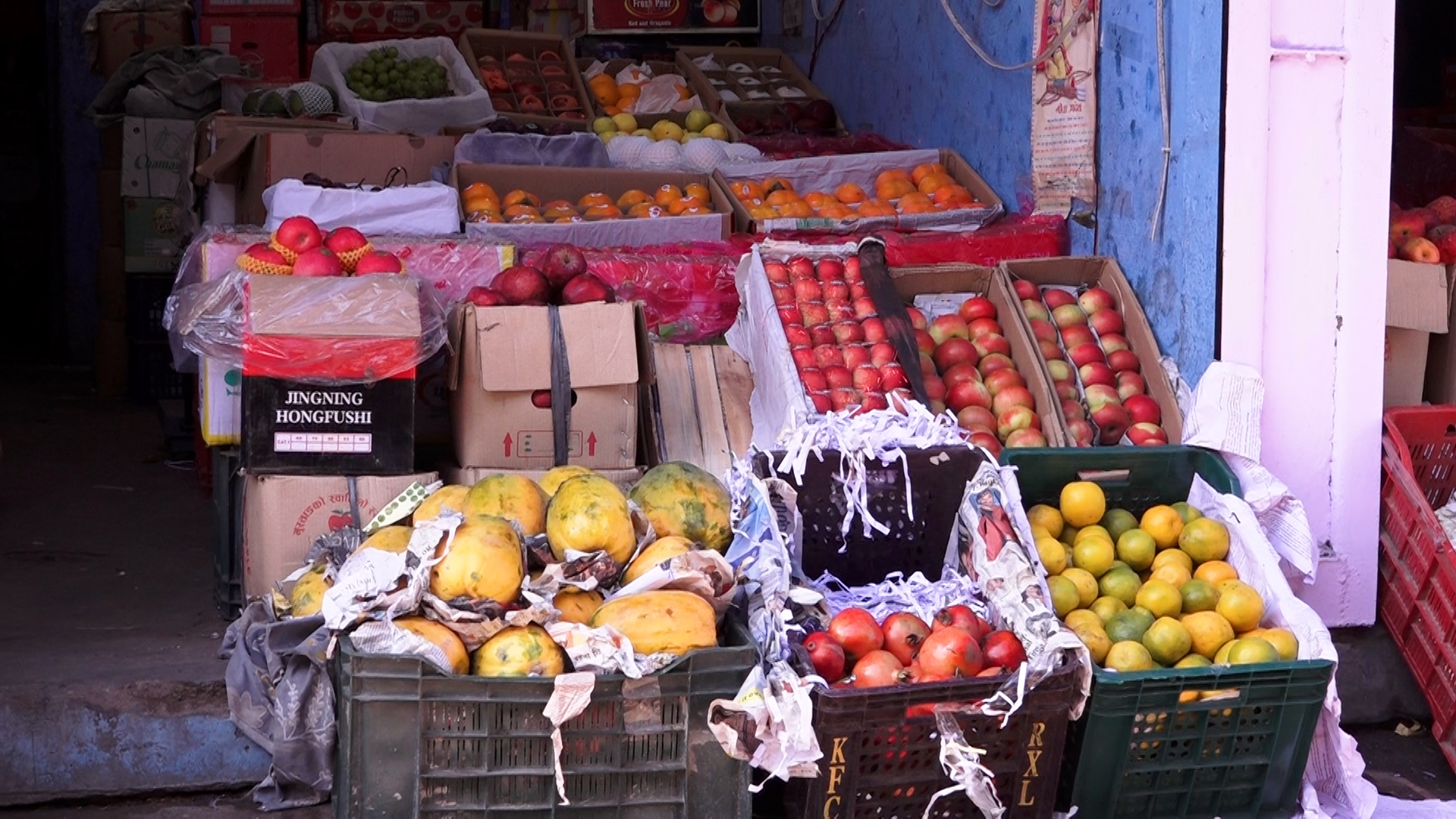
Baniya said that the fruits produced in Nepal have not been able to compete with foreign products in price. According to him, the apples imported from China are available in bulk at around Rs 250 per kilogram, but the wholesale price of good quality Fuji apples of Mustang ranges from Rs 350 to Rs 400.
He said that due to this, Nepali apples will become more expensive when they reach the consumers and the general consumers will not be able to buy them easily. Similarly, dragon fruit from China is available at a wholesale price of around Rs 300, but Nepali dragon fruit has to be sold at Rs 400 to Rs 450, he said. He said, “We should think about where we have gone wrong and where the state has gone wrong. Nepali products can compete with foreign products only if we can attract farmers towards commercial farming.” He said that the state should ensure encouragement, technology and market to the farmers to increase the commercial production of fruits like apple, avocado and dragon. He said that fruit farming should be developed as a business in the long term rather than the profit of one year.
Supply of fruits coming from India is easy
He said that the supply of fruits coming from India is less volatile than that of China. He said that if the price increases in India due to the open border, the price increases in Nepal and if it decreases in India, it will also decrease in Nepal.
He said that the wholesale price of good quality pomegranate has reached around Rs 375 in Nepal due to the increase in the price of pomegranate in India.
Fruits imported from China have been stopped at the border point for a long time, causing a big risk to the entrepreneurs, he said. According to him, there is a problem of not reaching the market on time as only two to three vehicles are left in the queue of 100 vehicles and the fruits are not able to reach the market on time.
He said that although the businessmen who arrive on time can take some profit, they have to throw some fruits on the way or sell them at a loss if they arrive late.
Baniya demanded the government to resume the Tatopani border point in a regular manner to facilitate the import of not only fruits but also garlic, ginger and other commodities that are not sufficiently produced in Nepal.
“The border point has been opened for three days. Now it can also be operated regularly,” he said, adding that the government should take necessary initiative with China to make the Tatopani border point easy. According to him, if the border point is easy, the transportation cost will be reduced, it will help in controlling the price of fruits and vegetables, and the consumers will get direct benefit from it.
He stressed the need of a policy to make Nepal self-reliant in fruit production in the long term along with making import easy immediately.
“It is not always necessary to be dependent,” Baniya said, “Commercial cultivation of fruits that we can produce on our own should be increased.” If the farmers are encouraged and the market is ensured, domestic production can sustain the market for some time even when the supply is disrupted. He said that the government should work together in the areas of roads, border points, transportation and agricultural production to provide fruits at affordable prices to the general consumers along with the interest of the businessmen.
According to the statistics of the Department of Customs, 40,000 metric tons of banana, apple and other fruits worth Rs 4.50 billion were imported till mid-October of the current fiscal year 2083/84.
In the same period of the last fiscal year, 38,000 metric tons of such items worth Rs 3.80 billion were imported. According to this, the import value of these items has increased in the first three months of the current fiscal year compared to the previous year.



 प्रतिक्रिया दिनुहोस्