

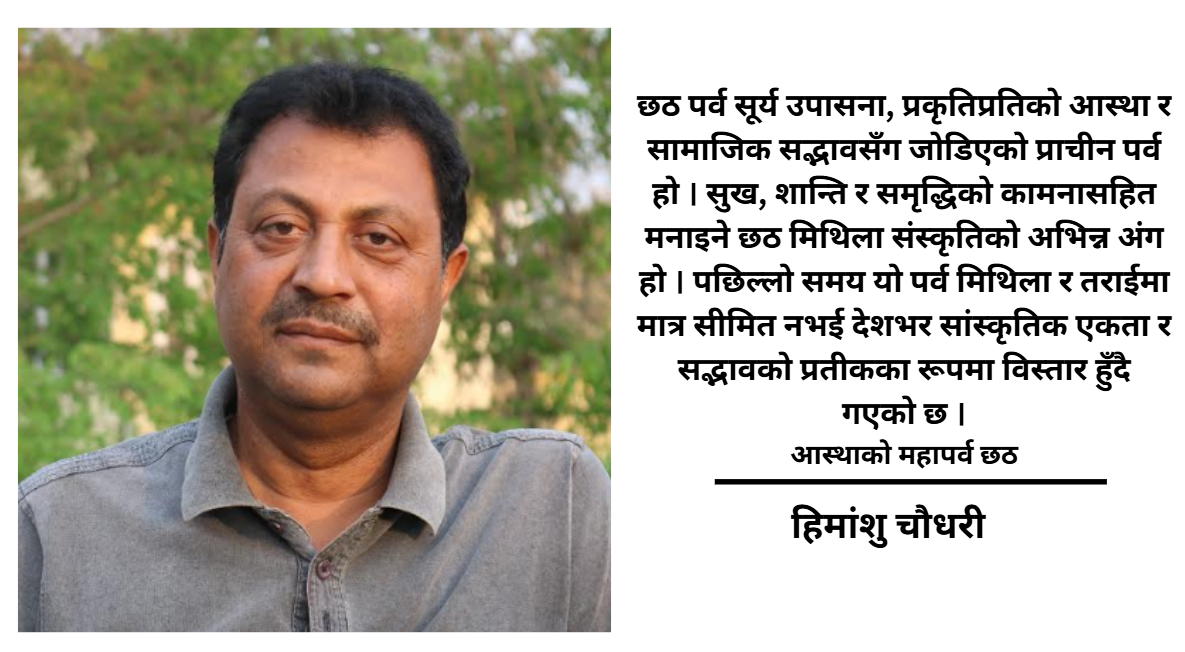
Himanshu Chaudhary
Chhath Maa Ailih Duariya Sajaola He
Pokhari Khuna Sajaola He
This song is resonating here and there. This song is giving the message that the construction of ghats and decorations in rivers and ponds for the Chhath festival, which signifies religious and scientific importance, sociality, cultural harmony, uniformity, economic and agricultural revolution, has reached the final stage.
According to the popular belief that the main ritual starts from Chaturthi and sets in the evening on the day of Shashthi and worships the rising sun on the day of Saptami, this festival was once prevalent only in the ancient Mithila region and has been expanding to different countries over time.
Although there are various examples of sun worship and worship, the fact that Yajnavalkya worshiped the sun in 5,000 BC is basically considered to be of Mithila. The sun idols of Kathmandu prove the origin of sun worship in Nepal from the Lichchhavi period. In this way, this festival, which has been celebrated since Vedic time immemorial, is found to have taken a faith and social form in the present.
The tradition of sun worship is found in all civilizations, religions, communities and eras, against the backdrop of the sun being a vast and important component of the universe. The inhabitants of Babylon consider the sun to be the goddess in Apollo, Germany, Lithynia, the sun as the goddess, the Japanese as izanagi and Izanami, and believe that the sun was born from these primordial men, primordial women, and in Egypt, the sun is worshiped as Atom or Ray. In a chapter of the Bible called The Book of Regulation, there is a mention of the primordial power sun. The origin of creation, the source of energy and life is proved to be the primordial energy sun. It is customary to worship it as a god and goddess. In the Vedas, the natural resources for the welfare of human beings are conceived as gods and goddesses. In the German language, the sun is called a goddess. In Mithilanchal, it is believed that the sun is worshiped as a god and goddess based on the context of the Puranas.
Since the sun is the first to give light to human beings, generate heat in the body, and protect them from diseases, it is believed that naturally humans are attracted to the sun and the process of worshipping the sun started. The practice of worshipping Chhath Mai in Chhath Puja is also considered to be a combination of tantric rituals in Vedic rituals. Since this festival is performed on the sixth day, its derivative form Chhath seems to have taken the place of a great festival in the public mind in the form of Goddess.
The glory of the sun is in all sects and scriptures. In the Rigveda, it is said, “O Usha, daughter of the sky, give me food, wealth, children, grant me a boon so that I may always get up from the bed in the morning and see the faces of the strong sons.” In the Surya Upanishad, the sun is described as the embodiment of Brahma. Not only this, in this text, the sun is also addressed as the husband of the world.
This festival is done according to the vow, this fast is not done without vowing. Vows are also made in many ways. Some people have made a vow to offer Arghdan from the hands of others, while some have made a vow to fast themselves. Similarly, vows are made to offer a pair of Arghyas and also to offer a full offering.
In this, two copies of everything like Kosiya, Kurbar, Chitta, Argh, etc. are required. Similarly, offerings of Arghya to clay elephants, Natua dance on the mantle in the courtyard and ghat, Arghdan by playing musical instruments, and Chhath by begging are also made. Similarly, vows like giving Arghya, standing in water, being punished from house to ghat, and standing in water are also seen. Such vows are made for one year and are also made for five years, ten years or even life.
The day on which the devotees take a bath to purify the body and stay hungry without food and water is called Kharna. On this day, the body is purified throughout the day, so it is called Kharna. Kheer is eaten by offering it to the deity at night. The family members accept it as prasad. The next day, the devotees fast without food and water and in the evening, after offering Arghya to the setting sun in the reservoir, return home and break the fast by offering Arghya to the rising sun in the morning, this is called Paran. Coincidentally, when there is a delay in sunrise due to fog, the devotees pray to the sun and sing:
On other days, O Dinanath, in the morning, O Dinanath, where is the time……
That is, O Dinanath, he used to wake up in the morning on other days, but why did he not wake up even after this time today? A long series of songs goes on. Basically, the Chhath song depicts the uniqueness, purity and devotion of the festival, while on the other hand, the pain of the barren women who are not able to perform the festival is also expressed.
In a song related to the sanctity of the Chhath festival, the parrot flying over the banana pot kept for Argha is rebuked and said:
Par parrot mardae
Suga gire murichaye{{TAG_CLOSE_p_ 29}
The Sugni who cried in separation
cannot bear it…………..
(Do not touch the banana, do not make it dirty.) Otherwise, we will kill you with bows and arrows, your Sugini will start writhing in separation, then she will cry out to the sun, “O Sun, help.” Similarly, a barren woman expresses her sorrow to Dinanath (Surya) for not being able to observe this fast:
Dinanath
Tarathiya gel khiaye
Incense who gives Dinanath
Chutukyo gel kataye
Yet Dinanath
………….. the chief .
(I was tired of worshiping in your temple, but I could not get rid of my barren position.) In this festival, the living entity and the world become one and the power of both is coming together to take a new shape. There is immense power in nature and perhaps this miracle is also due to the rigorous penance, purity and purity of the devotees. Therefore, this festival is also a powerful festival where the housewife transfers good power, peace, and good fortune from nature to her children, husbands, family members.
The third day of this festival, i. e. Shashthi, is considered as the main part of the festival.
On this day, rice and flour thekuwa, kasar, and other delicacies are cooked in the morning. The prepared dishes, five types of sweets, sugarcane, ginger, coconut, radish, suthani and other offerings, along with bamboo baskets, naklo and suppo, pure water and cow’s milk, the devotees go to the nearest water reservoir with their families and offer Arghya to the setting sun. The next day, on the day of Saptami, after the devotees offer Arghya to the rising sun, the great journey of this mountain festival is considered to have been completed.
From a scientific point of view, fasting, hygiene and special discipline under Chhath help in detoxification of the brain, standing half of the body submerged in water reduces the energy received from coming out and the energy is concentrated in the brain, cosmic energy enters the pituitary, hypothalamus and pineal glands through the retina and skin of the eye, cosmic energy activates the dormant tissue. Scientifically, it is believed that human beings can safely obtain solar energy during sunrise and sunset.
This festival, which is a festival of deep connection with agriculture and folk life, cultural coordination and social harmony, is also a festival of demonstration of industriousness, it has also done the work of religious coordination and tolerance. Therefore, it is also called a festival of health and prosperity. Both the sun and water worshipped in it are the primordial powers. Therefore, it is believed that the Chhath festival provides relief from health and especially skin diseases.
There are various stories related to the worship of Chhath Mata (Shashthi Devi) and the Sun in the Puranas. Priyavarta, the son of the first Manu Swayambhuva, and Queen Malini did not have any children for a long time. On the advice of Maharishi Kashyap, the king performed the Putreshti Yagya. Due to the effect of Yagyabo, the queen gave birth to a son, but the child was born dead. While the king and queen were weeping at the cremation ground with the dead child, Manasputri Shashti Devi appeared. The goddess touched the dead child and brought him back to life. It is believed that the tradition of Chhath Puja started from that time when the king started the joy of having children and protecting them.
According to the story of the Mahabharata, when the Pandavas were suffering in secret and exile, it is also believed that Draupadi was established as a strict fast festival of the Sun God and Chhathi Mata on the advice of Dhaumya Rishi to solve their troubles and to get back the lost kingdom. Similarly, Suryaputra Karna always used to stand in the river and worship the Sun and give prayers. He was a great devotee of the Sun and it is also believed that the tradition of worshiping the Sun was later established as Chhath in the world.
In the Ramayana period, after Lord Shri Ram returned to Ayodhya after completing 14 years of exile in Treta Yugam, it is found that on the advice of Muni Mugdal, on the advice of Muni Mugdal, he fasted and worshiped the Sun on the sixth day of Kartik Shukla Shashthi.
According to other religious texts and histories, the Chhath festival seems to have developed since the ancient Vedic period. In the first verse of the Rigveda, the sun and fire are prayed for. It is believed that the ancient Aryans worshipped the sun as the energy, heat and life-giving force of nature, later modified and developed into Chhath.
In the history of Magadha and Sakaldwipa Brahmanas, the first Chhath festival was limited to the ancient Magadha region. It is said that the Sakaldwipa Brahmins (who were also practitioners of Ayurveda) started this festival for the cure of serious skin diseases like leprosy and for the healing of the sun’s rays. It is said that in the Satya Yuga, Anasuya of Atri and Yajnavalkya of Mithila, worshipped the sun.
It is believed that at the end of the Dwapar era, Samba, the son of Lord Krishna, also worshipped the Sun to cure the skin disease. It is also believed that the worship of the Sun started from there because the famous poet Mayur Bhatta, who was suffering from curse, regained a beautiful body through the worship of the Sun.
In the Mithila region, it is customary to worship the five deities and Vishnu first after purification while performing any puja, rituals, etc. Surya is also one of the five deities. The Sun is also known as the Sunday God.
It is also believed that the Chhath festival started from the Aryans and non-Aryans. The first group of Aryans came here and ate wheat dishes in Iran. Which had no name, at that time it was named Godho. Which means to delight the senses. Go means Indriya and Dhau means Bliss, so it is called Godho. Later it is seen as an extended form of wheat. Since the Aryans and non-Aryans used to worship the sun together, wheat dishes are offered as offerings, so it is being offered till the present.
The word Chhath is a derived form of the word Shashthi. Since the goddess of Shashthi is worshipped on the day of Shashthi, the name of this festival has been changed to Shashthi, Chhathi, but in Apabhramsha, it is understood that it has been changed from Shashthi to Chhath. In the scriptures, the name of Chhath festival is mentioned as Shashthi Vrat, Surya Shashti Parva, Ravi Shashti Vrat and Chhath Parva.
While the main worship is of the sun, the goddess of Shashthi is also worshipped. The goddess of Shashthi is worshipped in a secondary way. Just as Radha Krishna, Sita Ram and Gaurishankar complement each other, Surya Shashti Puja is also performed. It is believed that the goddess of Shashthi and Chhath Mata are worshipped while worshipping the Sun God. It is believed that the goddess of Shashthi is worshipped as the power of joy. It is also argued that the Argha given to the setting sun is of Chhath Mata and the offering to the rising sun is of the Sun God.
The goddess of Shashthi is considered to be the wife of Kartikeya and the goddess of Shashthi is also called the sixth part of nature and Devasena. In the Puranic texts, six parts are considered to be the sixth part and one part is considered to be the sun, so the sixth is considered to be the sixth and the seventh is considered to be the sun. The number seven parts of the sixth and the sun are more important. The seven days of the week, the seven horses in the chariot of the Sun God, the seven seas, the seven Ajas, the seven notes of music, etc., are confirmed to be related to the sun.
This festival, which clarifies the relationship between human life and nature, is also preserving culture.
The Chhath festival, which carries the message of recognizing the priceless gifts provided by existence for free and spreading gratitude and love towards nature, as well as the identity of the soul in the form of consciousness within oneself, has taken the form of a people’s fast. Since the Chhath festival can be celebrated by the believers of any caste and religion, those who are financially constrained celebrate the Chhath festival even by begging. The main message of Chhath festival is coordination, inclusion and simplicity. It is an important aspect of making resolutions for the welfare of the society and family under the leadership of women. Along with this, greeting both the setting and rising sun means that happiness, sorrow, crying and laughter in life are considered equally and as a part of life. The planet Sun in the horoscope of any person is considered to be the father of the planet. Therefore, it is believed that offering water to the Sun brings peace.
Community harmony is the main mantra in this festival, it is considered to be a special feature of accepting the offerings of any Dalit even if the daughter-in-law of the so-called noble family offers offerings as a blessing of Chhath.

 प्रतिक्रिया दिनुहोस्