

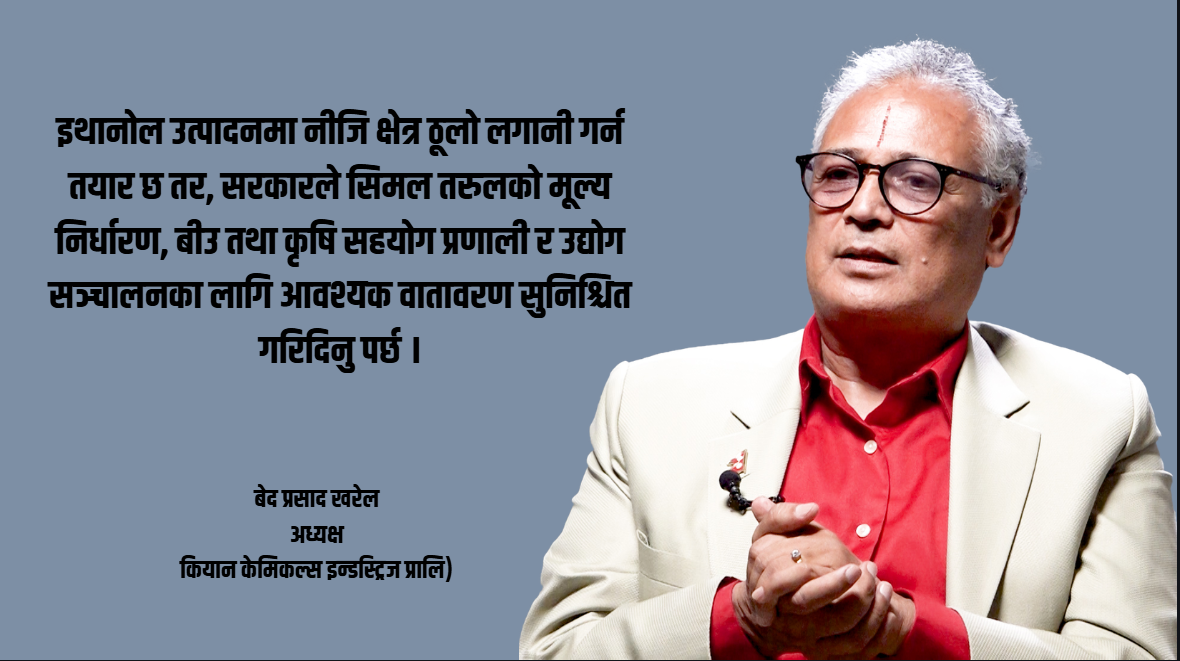
Ved Prasad Kharel
Chairman
Kian Chemicals Industries Pvt. Ltd.
Kian Chemicals’ 11 billion ethanol project at risk due to lack of government policy
Kian Chemicals’ 11 billion mega project: Goal of making the country self-reliant through ethanol
Kathmandu. KATHMANDU: Qian Chemicals Industries Pvt. Ltd. has put forward a big investment plan with the objective of industrializing the ethanol production and agriculture sector in Nepal. The company is preparing to bring in foreign direct investment (FDI) worth Rs 11 billion to produce ethanol by using sesame yam as a raw material.
According to Ved Prasad Kharel, chairman of Kian Chemicals Industries Pvt. Ltd., the concept of the company started in 2078 BS.
He said that the company was registered in 2079 BS and obtained production license from the Department of Industry after completing the necessary process.
“We have established two companies, Qian Chemicals and Qian Agriculture. Our plan is to produce ethanol by establishing one industry and produce raw materials through another company,” Kharel said. Talking to Nepal News Bank, Chairman Kharel shared that the company has completed all the preliminary preparations for operating the industry.
“If the government provides a letter of intent for production, we can immediately go for ethanol production.” We have already completed the land purchase and other preparations,” he said. Qian Chemicals plans to set up ethanol production plants in three provinces of Nepal. According to the company, three factories will be set up in Koshi, Madhesh and Gandaki provinces.
Kharel said that he has already purchased around
10 bigha of land in Katahariya Municipality of Rautahat. Preparations are underway to set up an industry in the area. “We have invested around Rs 26 crore so far. This investment has been made in land, study, research and preliminary preparation,” he said. Investors and experts from Nepal, USA, UK and Thailand are participating in the company.
Kharel, Khagendra GC and Kala Kharel’s group from the US, Bikash Chudal from the UK and Sanjaya Dhakal, president of the Non-Resident Nepali Association (NRNA) from Thailand, are participating in the meeting. He said that there is a group of engineers and chemists Baburam Gautam, Baburam Sharma, Manish Sapkota and Dinesh Poudel from Nepal.
Qian Group has also brought in experts from the fields of agriculture and administration to make the project effective. According to Kharel, former joint-secretary of the Department of Agriculture, Bishnu Aryal, has been working as an agriculture expert and assisting in the development of planning and production system related to farmers. Likewise, former secretary Baburam Acharya has been assisting in administrative and institutional management aspects.
Kharel said that Kian Agriculture has been established to ensure raw materials required for ethanol production.
According to him, the company plans to expand the farming of Simal yam in Nepal, provide training to farmers, provide seeds and develop a system to purchase the products.
“Our plan is to teach farmers how to farm, coordinate with the government and local governments for seeds and necessary materials and ensure market after production,” he said.
Qian Agriculture plans to set up processing plants in various provinces.
The cassava purchased from farmers will be supplied as raw material to Kian Chemicals’ factory through the processing centre.
The company aims to connect 20 lakh farmers by expanding silk yam farming in about 130,000 hectares of land in Nepal.
Why did you choose Simal Tarul?
According to Kharel, Simal yam has been selected as an appropriate alternative for Nepal after studying the practice of various countries of the world for ethanol production.
“The U. S. produces ethanol from corn. But it’s a special kind of high-starchy corn. We looked for alternative crops so that there would be no competition between food and industrial use in Nepal,” he said. He said that after studying Thailand’s cassava production system, the possibility of it has been found in Nepal.
‘Thailand has developed Simal Yamul as a commercial cultivation by importing seeds from outside. Currently, there are many yam-based industries operating there,” Kharel said. According to Kharel, Simal yam is a crop that grows with less effort and less care. “It can be grown in sandy soil, less fertile land and marginal land. It doesn’t require much irrigation and is less risky than other crops,” he said.
According to him, Simal yam, which has been traditionally used as yam in the villages of Nepal, can now be developed as an industrial raw material.
Farming can be done on barren and underutilized land without affecting the main land where food is produced,” he said.
Qian Chemicals has claimed that Simal yam farming can bring about a big change in the rural economy.
“Today, farmers are facing many challenges like monkeys, wild boars, shortage of fertilizer and water problems. Yam farming can solve many problems,” Kharel said. According to him, it has the potential to create rural employment, reduce the compulsion to go for foreign employment and increase the income of farmers.
Qian Agriculture has so far started the trial of Simal yam cultivation in collaboration with 36 rural municipalities and municipalities.
The company has been importing seeds from China, Thailand, India and Nepal.
“We have been providing information on seed distribution, training and farming techniques to farmers from Chitwan to Ilam via Sarlahi,” Kharel said. The company has been providing free training to the farmers and has been providing technical support to the farmers after production.
Qian Chemicals plans to bring in investment worth Rs 11 billion for ethanol production without a purchase agreement with the government.
However, Kharel said that they have demanded security as there have been instances in which industries have been in trouble due to lack of purchase agreement in the past.
Citing the example of an industry set up to produce ethanol in the past, he said, “In the past, a reputed group of industries had set up an ethanol plant alongside the sugar industry.
The machine was brought with a huge investment, but the plant is now lying idle due to lack of government procurement. According to him, it was because of this experience that Qian Chemicals demanded a purchase agreement or clear policy provisions from the government before the establishment of the factory.
‘We have already invested Rs 25-26 crore. We have been running for this policy for four years. It’s not just for business, it’s about doing something for the country,” he said.
Kharel urged the government to make clear policy and create conducive environment for the ethanol industry.
The government calls for investment but an environment conducive for investment should also be created,” he said. According to him, the private sector is ready to invest big if the government ensures necessary agreement for price determination of Simal yam, seed and agriculture support system and operation of the industry. “We don’t need grants. We bring in our own investment. The government should just ensure a clear policy and market,” Kharel said. He said that if the government’s decision is delayed, it may have to reconsider its big investment plan.
He said that foreign investors have started getting disappointed
Foreign investors have started getting disappointed as the government has not made a clear policy for ethanol production.
Kian Chemicals has investors and partners from the United States, the United Kingdom, Canada, and Thailand.
But due to the long process, even the foreign partners are getting frustrated, Kharel said.
Our UK team has now left. “If there is no environment to invest, we will go elsewhere,” he said. According to him, although it is natural for foreign investors to seek a profitable environment, he said that he is moving ahead with the intention of doing something by investing in Nepal.
‘I lived in America for many years. I also encouraged my friends to return to Nepal and invest. We had the idea to bring in Rs 8-10 billion to set up industries in the country,” he said. But they are also confused due to the delay in the government’s process ।



 प्रतिक्रिया दिनुहोस्