

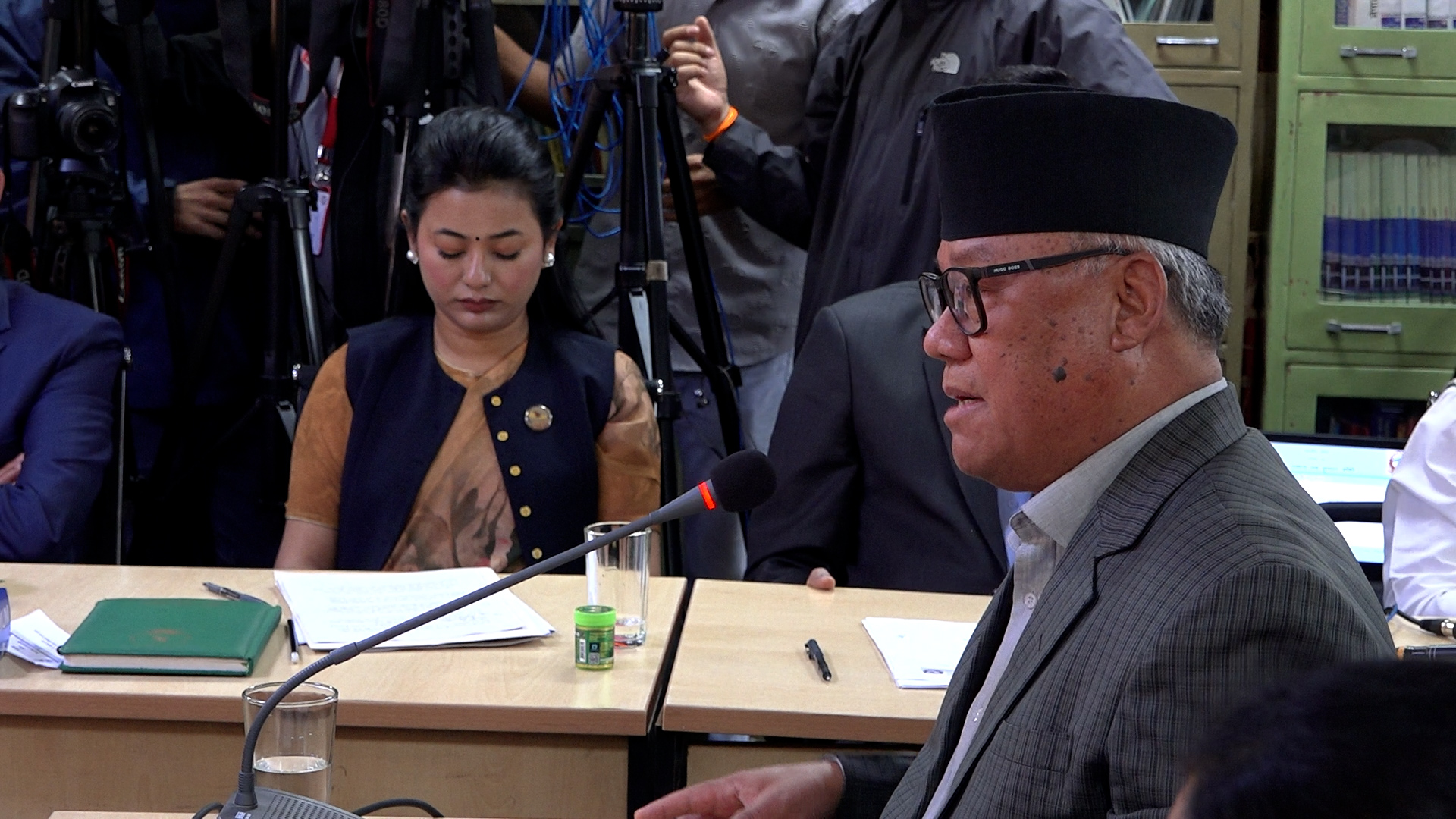
Angdembe urges to put national interest at the centre of the National Service Dal Bill
Kathmandu. Nepali Congress parliamentary party leader Bhishma Raj Angdembe has urged the parliamentarians to rise above the ruling and opposition parties and put national interest and nationality at the centre.
Speaking at a meeting of the State Affairs and Good Governance Committee of the House of Representatives on Thursday, he said the growing lack of communication between the executive and constitutional bodies was a very serious and sensitive issue.”The lack of communication between the executive and constitutional bodies that run our state is a very serious and sensitive issue.
We also have to look at our House from the perspective of this. We are working towards systematizing the functioning of the parliament, but there is no situation to move ahead forgetting the past developments. We should be more serious when such bills come up without concluding such statements. “
Angdembe commented that the statements of government ministers have become irresponsible in recent times.
“Members of the state authorities are making statements without bridging. There is no sense of accountability. Signs of compromise and agreement are being performed everywhere, but the sequence of events is getting more complicated,” he said.
He said that the country was politically fluid, there was a lack of communication among the constitutional bodies and the people and parliament were raising questions on the constitutional institutions.
He also said that there was a growing possibility that Nepal would become a ‘playground’ of international power competition.
‘At the same time, we are discussing in principle on the National Service Dal Bill, 2083. Such a sensitive issue can be linked to the existence and identity of the country. Therefore, we should rise above the ruling and opposition parties and make our views public keeping the nation and nationality in mind,” he urged.
Angdembe also said that the Rastriya Sewa Dal should not be an organization guided by any individual or political leadership.
‘If an institution is said to be controlled by the Prime Minister or any political leadership, then a lot of questions arise from there. If there is an institution that is guided only by a person or politics, what will be the status of that institution when there is no person or politics? In the future, if he intends to take over the person he leads or the politics he leads, what is the other body that will hold him accountable? It’s something to think about,” he said.
In today’s meeting, discussions were held in principle on the National Service Dal Bill-2083 as well as the presentation of an on-site monitoring report of the Commission for the Investigation of Abuse of Authority and prison offices.
It was.



 प्रतिक्रिया दिनुहोस्