

Dr. Vijayman Singh Katwal
Associate Professor & Senior Consultant
Urologist & Kidney Transplant Surgeon
, If blood is seen in the urine after 50 years, the risk of cancer increases after 50 years: Dr. Pushpa Kamal Dahal Katawal
The risk of recurrence of stones is 50 percent
Pramila Karki, Nepal News Bank
Kathmandu. Experts have said that if blood is seen in the urine of those above 50 years of age, it should not be taken lightly and should be consulted immediately.
Urologist and kidney transplant surgeon at Kathmandu Medical College (KMC) Hospital, Dr Bijaya Man Singh Katawal, said that the presence of blood in the urine could be a sign of cancer of the urinary bladder, kidney or urinary tract.
In a conversation with Nepal News Bank, Dr.
Dr. Katwal also said that the possibility of cancer should be taken seriously, especially if blood is seen in the urine of a smoker. According to him, people above 50 years of age should get their blood checked immediately even if blood is seen only once without urine burning or infection.
He said, “If people above 50 years of age have blood in their urine, it is very dangerous.
There is a chance of cancer of the urinary bladder or cancer of the kidney, urinary tract, urinary bladder. If you are a smoker, if you have blood in your urine, then the maximum chance is that it is cancer.”Urology will treat all the problems related to the formation of urine in the kidney, the urinary bladder through the urinary tract and the process of exiting it,” he said. According to him, kidney stones are the most common urology problems in Nepal and prostate problems seen in men with age.
Prostate problems can increase after 60 years
According to Dr. Katwal, with increasing age, especially after 60 years, the prostate gland can gradually become larger. When the prostate starts pressing on the urinary tract from all sides, the flow of urine may be weak, urine does not come out completely, frequent infections and the problem of getting up to urinate many times at night.
He also said that the problem of not being able to stop urinating, going to the toilet immediately and wetting clothes due to not reaching on time can also be related to the prostate. Although
there is no exact reason why the prostate enlarges, changes with age are the main reason, he said.
‘When the road becomes narrower, the flow of urine becomes smaller. All the urine was not drained. A little urine remains. People feel like I don’t have enough urine. And then there is a repeat infection in the urine,” he said.
Water plays an important role in kidney stones
Doctors recommend drinking enough water and fluids to prevent the formation of kidney stones. He said that the body should drink about one and a half liters of urine every day and for this, generally about two to three liters of water or liquid should be consumed in a day.
Tea, coffee, lentil soup and other liquids can also be included in it, he said. He said that if you do not drink enough water, various salts and minerals in the urine can accumulate and stones can form.
He said that adequate water keeps the body’s urinary system flush, which will help reduce the risk of stones.
He said, “We estimate that if we can consume two to three liters of water or liquid in a day, it will produce about one and
a half liters of urine.” Not only water, but also tea, coffee, lentil soup, if the round is about three liters, then it will flush at a minimum. “People who eat fast food and salty foods, reduce physical activity and do not drink enough water may be at a higher risk of stones,” he said.
Many of those who have had a stone may recur
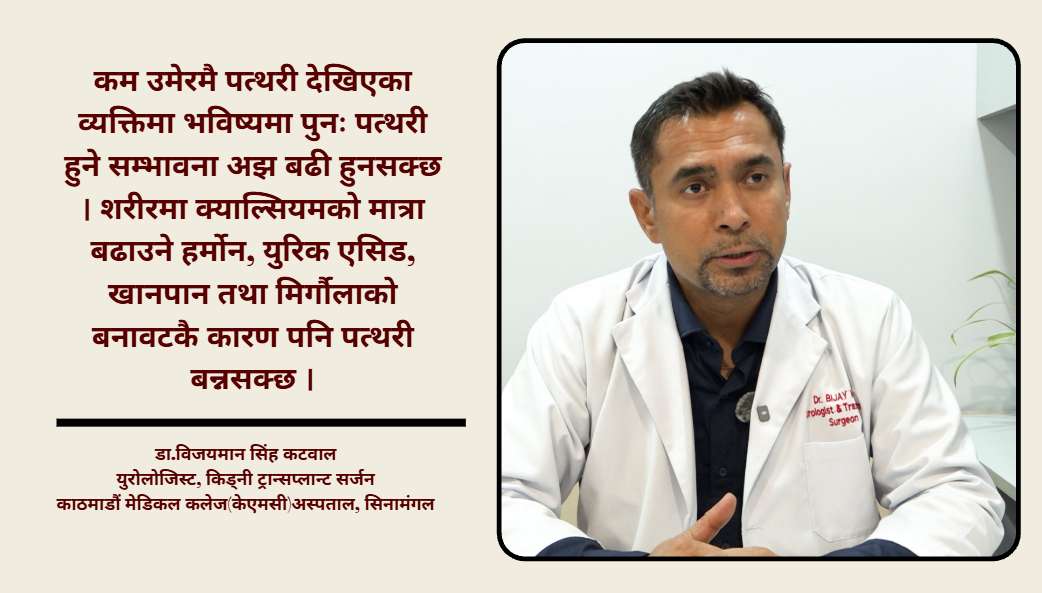
. According to Dr. Katawal, about 50 percent of people who have kidney stones once are likely to develop stones again at some point in their life. Some people may see the problem again in a few months, while some may have stones after eight to ten years.
He said that people who were diagnosed with stones at a young age were more likely to develop stones again in the future.
According to him, hormones that increase the amount of calcium in the body, uric acid, diet and kidney structure can also cause stones.
“A person who has been stoned once is likely to be stoned another time in his life,” he said. Out of 100 people, 50 get stones again. Some people get it in six to seven months, in one year, and some in eight to ten years. But there is a 50 percent chance of getting a recurrent stone.”It’s not just the size of the stone but also its structure and width that determines the possibility of coming out on its own,” he said. He said that although the long but narrow stone can be removed relatively easily, it is difficult to get out a stone as round and wide as a maize grain.
The main reason why urine infection is more common in women than men is the proximity of urination and defecation.
Katwal said.
He suggested that women should keep their genitals clean, drink enough water and not hold urine for too long.
‘In women, the defecation and urination area are very close. Maximum germs are also present in the urine from the germs that are seen in the faeces. As a result, there is a lot of urinary tract infection,” he said.
But he suggested developing the habit of urinating at normal intervals, saying that running to the toilet every few minutes after urinating is also not necessary.
Doctors say that if the urinary infection is frequent, the problem will not be solved by taking antibiotics alone.
He said that if there is a condition of urine left in the urinary bladder due to the prostate in men, it should be treated.
He said, “If it is due to the prostate, then the prostate should be treated.”
The prostate is normal, the flow of urine is good, if there is not much urine left after the change of urine, then we cure it by giving simple medicines, antibiotics. We give medicines only after looking at the culture, if there is cultural sensitivity, and accordingly we give medicines. “
Kidney infection also requires proper treatment. He said that in normal circumstances, the appropriate antibiotic will be selected on the basis of urine culture and sensitivity test.
He said that doctors can start the necessary antibiotics immediately because the patient has high fever, burning urine and serious condition cannot wait for 72 hours for the culture report.
He said that the medicine will be changed according to the culture report.
Dr. Dr. Katawal said that if there is a problem related to urine, one should not stay without treatment due to shame or hesitation. He urged the urologist to consult a urologist on time if you have symptoms like burning sensation, blood loss, repeated infections, weak urine flow or incomplete urine discharge.
He also said that urology-related problems are being identified more than ever before due to the expansion of access to health institutions and testing facilities in Nepal in recent times.
‘If there is any problem in urination, blood or urine burning, do not hesitate. We should visit the nearest urologist and get the treatment and necessary tests done on time,” he urged ।



 प्रतिक्रिया दिनुहोस्