

Ramchandra Parajuli
Secretary
Himalayan Cross-Himalayan Border Chamber of Commerce
Nepal-China trade crisis due to blockage of northern border point: Ramchandra Parajuli
Billions of investment of businessmen at risk due to the closure of Tatopani border point: Ramchandra Parajuli
Kathmandu The incessant rains, floods and landslides have hit the border trade between Nepal and China in serious crisis. Goods worth billions of rupees have been stranded in both China and Nepal due to the complete closure of the Tatopani border point, the main trade route with China, for the past two months.
This has not only put the investment of businessmen at risk but has also directly affected the revenue collection of the government.
Ram Chandra Parajuli, general secretary of Nepal Himalayan Trans-border Chamber of Commerce and Industry, said that the current situation of Nepal-China trade is not satisfactory.
According to him, although trade between Nepal and China takes place through three channels – land, water and air, most of the import and export is dependent on land route.
“Trade through the northern border points has been badly affected since the beginning of the rainy season. Goods coming from China have not been able to enter Nepal easily due to floods and landslides. This has stopped the investment of entrepreneurs and also affected the revenue collected by the state,” he said.
According to Parajuli, the Tatopani checkpoint, which operates via Araniko Highway, has been effectively closed since last June.
Import and export have come to a standstill due to landslides in Daklang and Eco areas. Goods worth billions of rupees have been stuck on the Chinese side, at the border areas and at the customs yards after the closure of the border points. “Some of the goods are in Chinese territory while some are stored in the godown on the Nepali side. Not a single drop of goods have entered Nepal from Tatopani,” he said.
With the closure of Tatopani border point, a large part of the import trade has been diverted to Rasuwagadhi border point.
Although Rasuwagadhi has not been completely closed, the road has been disrupted from time to time due to poor condition.
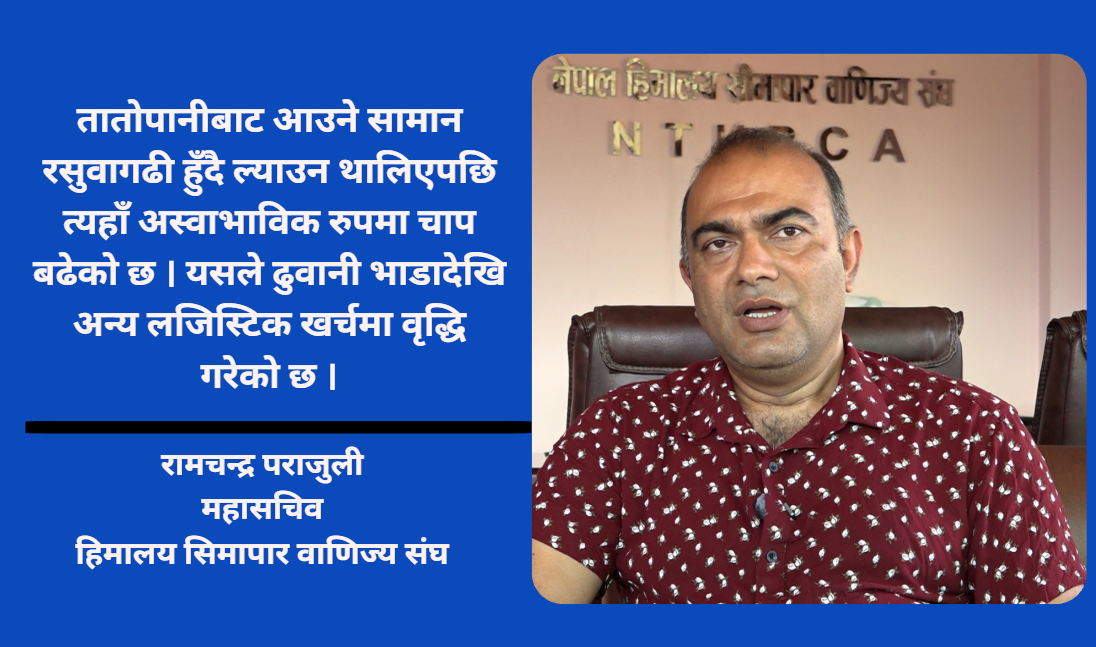
According to him, the pressure has increased unusually after the goods coming from Tatopani started being brought through Rasuwagadhi.
This has led to an increase in transportation and other logistical costs. “Goods are being brought from Rasuwa, but we are facing problems of increasing the freight charge, delay in transportation and cost increase as the pressure of hot water reaches there,” he said.
According to Parajuli, the problem has been compounded by the lack of adequate parking and storage infrastructure in the Tatopani area.
Many containers have been stranded on the way due to the landslide and the ICD area of the customs has also been at risk.
Stating that some containers have been damaged in the recent dry landslide, he said there is a risk that the containers that have been stuck in some places could be swept away in the landslide at any time.
“We haven’t even got a place to store containers. The contents inside the containers are also at risk. We are worried about when the landslide will sweep away,” he said.
Businessmen worried as goods targeted for Dashain and Tihar are stopped
Most of the goods imported from China in Nepal are festival-oriented and fashionable in nature. Parajuli said that most of the goods currently stranded on the way are targeted for Dashain, Tihar and Teej.
‘The businessmen have brought the goods for the season. But after being stuck on the road for two months, the investment has been frozen. Entrepreneurs have to bear huge losses if the goods are not brought to the market on time,” he said.
This will also affect the consumer, he said. He said that the pressure of price hike may increase with the shortage of materials available in the market during the festivals. “Detention, demurrage, transportation and other additional expenses are added when the goods arrive late. Since all those costs will ultimately pass on to the consumers, there will be some percentage increase in prices,” he said.
Parajuli pointed out the need to operate more border points to make Nepal-China trade safe in the long run.
Although Tatopani, Rasuwagadhi and Korola border points are in operation at present, the government should be serious about the development of other possible border points, he said.
Entrepreneurs have been demanding for a long time to reopen the border points of Dolakha, Lamabagar, Gorkha and Humla areas.
He said the feasibility of operation of Lamabagar checkpoint is being carried out. “If one is closed as we depend on only three border points, the entire trade will be affected. Therefore, opening more border points is the need of the hour,” he said.
General Secretary Parajuli said that Nepal-China trade could not be sustainable without improving roads, customs yards, ICDs, parking and logistics infrastructure.
According to him, the Association has been holding discussions with various ministries, departments, lawmakers and government bodies from time to time.
He said that the office bearers of the association recently reached Tatopani and inspected the site.
“The situation is very complicated. We had to cross the landslide and carry out a risky field study,” he said.
According to Parajuli, China has given subsidies to more than 8,000 goods that can be imported from Nepal.
But due to the weak production capacity of Nepal, it has not been able to take adequate advantage of it.
He said that meat products, citrus fruits, agricultural products, tea and handicraft goods are areas with great potential in China.
But lack of international standard laboratory, quality production and export infrastructure have hampered export expansion, he said. “China has a huge market. If we are able to produce quality products, we can significantly increase the export of Nepali agricultural and handicraft products,” he said.
According to him, tea and handicraft goods, copper utensils, stools and some food items are being exported from Nepal to China at present.
He pointed out that Nepal needs to pay special attention to expansion of production capacity and export infrastructure to maintain trade balance ।



 प्रतिक्रिया दिनुहोस्