

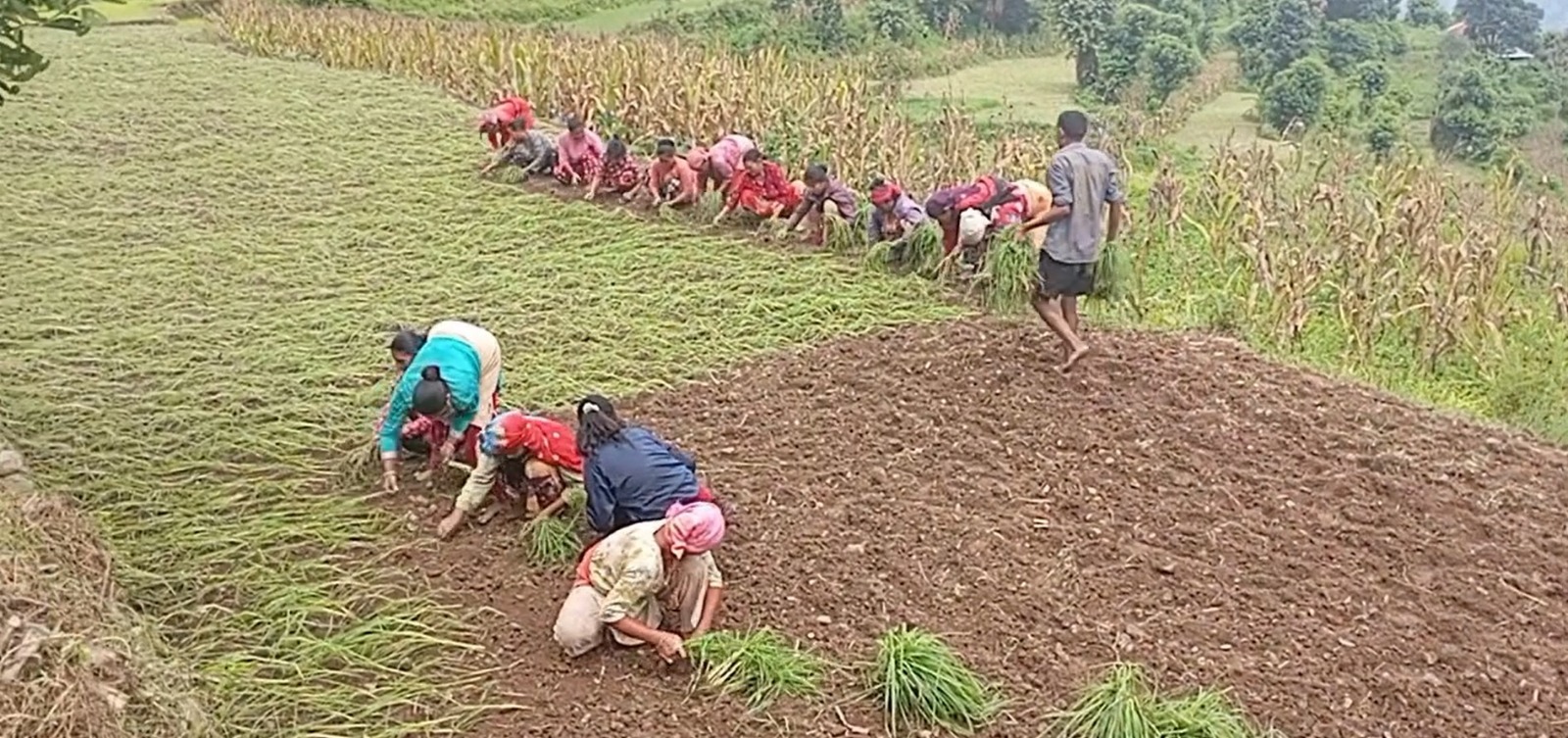
Ramechhap. The farms of Ramechhap are becoming barren with the increasing number of migrant workers and migration to cities from rural areas. As labour shortage is increasing even in arable land, agricultural production has decreased and traditional indigenous crops are also in crisis.
Indigenous crops in Ramechhap district are on the verge of extinction after farmers started cultivating new and improved varieties of hybrid crops instead of traditional crops.
Although some of the indigenous crops have disappeared, farmers have continued to cultivate millet.
Millet, which was despised as a ‘crop eaten by the poor’, has lately established itself as a highly nutritious and nutritious food. According to farmers, although the importance of millet is increasing from the health point of view, its production and cultivation area is shrinking continuously.
Agriculture sector is not in the priority of the state, educated youths do not see agriculture as an attractive field of employment, impact on production due to climate change, lack of manpower to work in agriculture and not getting proper price for the produce. Balakaji Shrestha, a ward member of Manthali Municipality-2 and a longtime farmer, said that farmers have started leaving their agricultural land barren due to lack of income as per the investment.
“In traditional farming, sometimes even the wages of the farmers are not collected,” he said.
According to Shrestha, the state needs to come up with a special plan to protect and promote millet farming.
He said that millet should not be limited to just bread and dhindo, but industries should be operated to produce various dishes from it.
He also said that farmers can get a good price for their produce if the local liquor produced from millet is branded as per the standard and supplied to the national and international markets.
“If the market for millet can be expanded, farmers can be attracted towards farming. Agriculture and local crop-based industries can be a good source of employment for those who say there is nothing in Nepal, there is no employment,” Shrestha said.
If the state can invest in production, processing, marketing and branding along with the protection of indigenous crops, there is a possibility of reviving the farming of the barren fields. For this, farmers have demanded that millet should be developed not only as a traditional food grain but also as a base for local economy and employment generation ।



 प्रतिक्रिया दिनुहोस्