

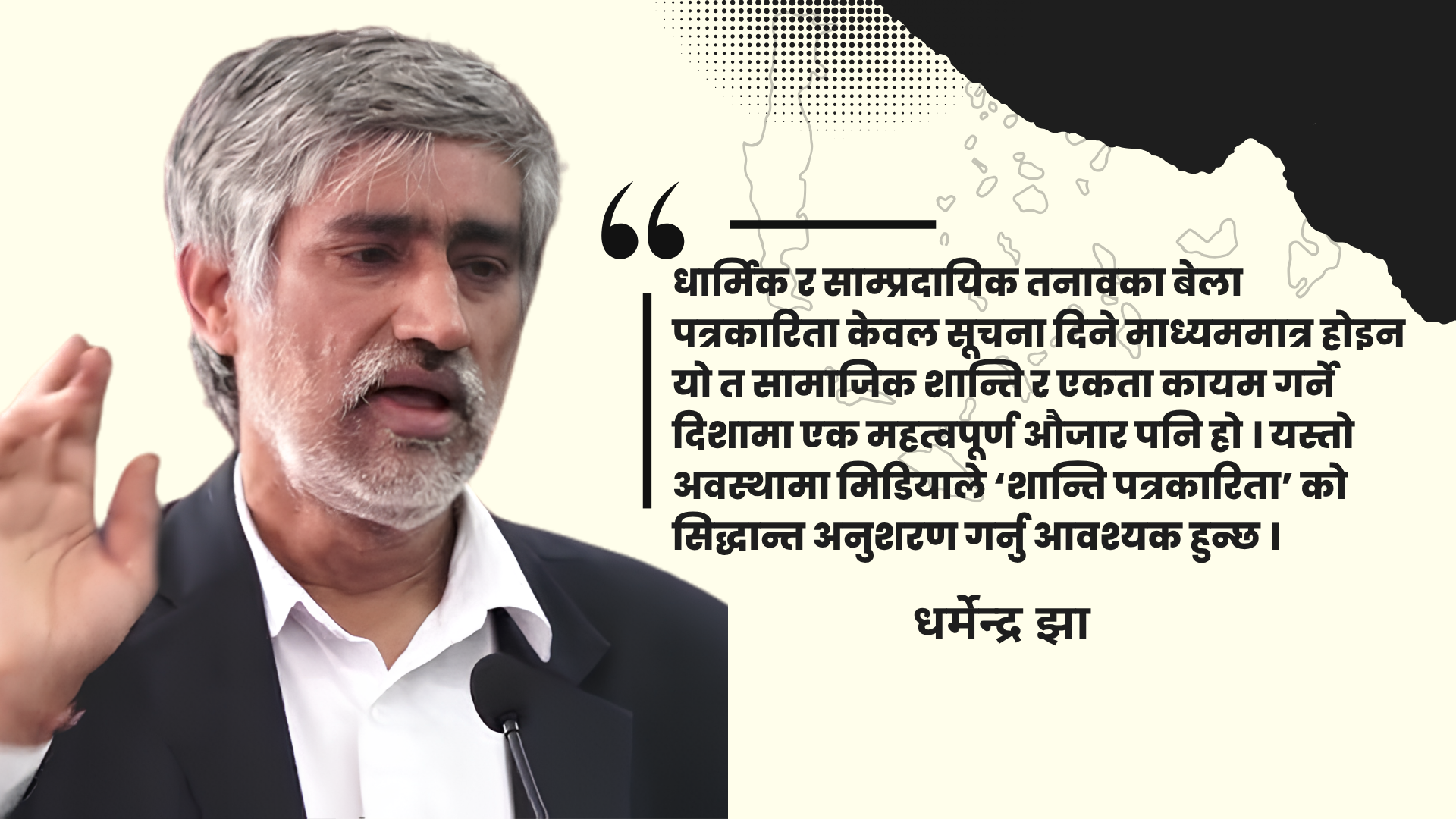
Journalism is not only a medium of information during religious and communal tensions, but it is also an important tool towards maintaining social peace and unity.In such a situation, it is necessary for the media to follow the principle of ‘peace journalism’.
Dharmendra Jha
Enhancement of Social Harmony: Questions on the Honest Role of Media
Dharmendra Jha
Background
Nepali Society Multi-Ethnic, It is a multilingual and multi-religious society. On this basis, Nepal has long been known for social harmony and cultural coexistence. However, the situation in recent times is not satisfactory. Sunsari in eastern Nepal and then in various parts of the country, especially Morang, Saptari, Siraha, Dhanusha, Mahottari and Parsa, some tense situations have been created in the name of religion and sect. A simple dispute that starts in the name of religious processions, pujas or festivals of a community has taken a violent turn to the extent of imposition of curfew, which exposes the sensitivity of our social fabric. The situation has gone so far that three youths have lost their lives in this name. By the time this material is ready, the situation has already started to improve. In the places where curfew was imposed in the past, the curfew has either been lifted or it has been converted into a prohibitory order.
This article attempts to discuss the role of journalism and media (including social media) in promoting sensitivity and social harmony. In fact, communication plays a crucial role in any kind of social conflict. Communication can play an important role in both the expansion and mitigation of conflict. There are many such examples in the history of the world where the systematic, impractical, insistent, unprincipled, unprofessional use of the communication sector has led to the expansion of conflict on a large scale and has helped to create a situation of genocide.
The Rwandan genocide and the role of radio
can be taken as an example in the context of the above. In Rwanda, state radio is also believed to have caused the genocide. The 1994 genocide in Rwanda has been accepted as one of the most tragic and horrific events in human history. It is estimated that more than 800,000 people were brutally murdered in a short period of about 100 days from April to July 1994.
The genocide was the result of a conflict between the two ethnic communities that existed in Rwanda at the time, the Hutu, who were in the majority, and the Tutsi, who were the minority. During the colonial period in France and Belgium, the Tutsi were given high status, which caused deep discontent among the Hutu community. After France and Belgium left power, the majority Hutu came to power, and tensions between the two sides increased.
On April 6,
1994, Rwanda’s then-President Juvenal Habyarimana (Hutu) was shot down and killed, bringing the conflict between the two groups to a crescendo. The murder was blamed on Tutsi rebels, and the next day (April 7), Hutu extremists began systematically killing Tutsi and peace-loving Hutu.
It is accepted that radio played a major role in fueling the massacre there. According to analysts, there were open calls from state-run radio stations to kill the Tutsi, calling them “chains”.
The genocide ended in July 1994 when the Rwandan Patriotic Front (RPF), a Tutsi rebel group led by Paul Kagame, took control of the capital, Kigali.
Some 2 million Hutu are believed to have fled to neighbouring countries for fear of retaliation after the genocide stopped. After this incident in Rwanda, the United Nations has acknowledged that “sensitivity” is also important in the context of conflict and has started emphasizing its publicity around the world.
Rwanda seems to have resurrected itself in a remarkable way even after suffering such a huge tragedy.
Ethnic segregation is now legally banned in Rwanda and everyone is referred to simply as ‘Rwandan’. Today, Rwanda is considered one of the safest, cleanest and fastest growing countries in Africa.
What is the role of social media and media in Nepal?
In recent times, incidents of ethnic and communal tension seem to be developing in Nepal from time to time. Unlike in Rwanda÷ there are no media here. Some media here have also played a role in connecting the society by adopting social sensitivity. But the role of some digital-focused media and the use of social media needs to be seriously considered. It would not be wrong to say that the media that originated in Nepal and are active in Nepal, the media that originate abroad but are also influential in Nepal, the provocative rhetoric expressed using the media from foreign land and the media materials made public through social networks have played a role in increasing social conflict. In this too, the role of some new (new) media based on the Internet i. e. digital media can be questioned from many angles. It is alleged that some ‘digital platforms’ have not presented responsibly, which has made the situation unpleasant. The perception that such media is not following business religion and values has increased in size. When the media disseminates content without following the editorial process of confirmation, reaffirmation, verification, balance, adherence to the concepts of human rights and social justice, adherence to legal boundaries, fact checking, use of dignified language, etc., then it certainly means that it is deliberately inviting negative consequences.
Who’s responsible?
In the context of the latest conflict, many media in Nepal have been accused of playing an irresponsible role, and the majority of them are digital platform-centered. It is not possible to talk about the content disseminated through social media. In such a situation, the question arises, who is responsible for the confession? Who will take responsibility for the content made public not only through social media but also through any ‘media outlet’? In the race to get likes, comments and views, keeping the immediate popularity at the center, there is a need to hold the media responsible for working against the values of journalism and spreading social disharmony. In the name of press freedom and freedom of expression, such acts of spreading social disharmony, violating the values of human rights and social justice and inciting unrest in the country cannot be justified under any circumstances. Of course, “freedom of the press” cannot be interpreted as a license to commit such wrongdoings.
In this context, it is imperative for the Federation of Nepali Journalists, Press Council Nepal and other stakeholders to come together.
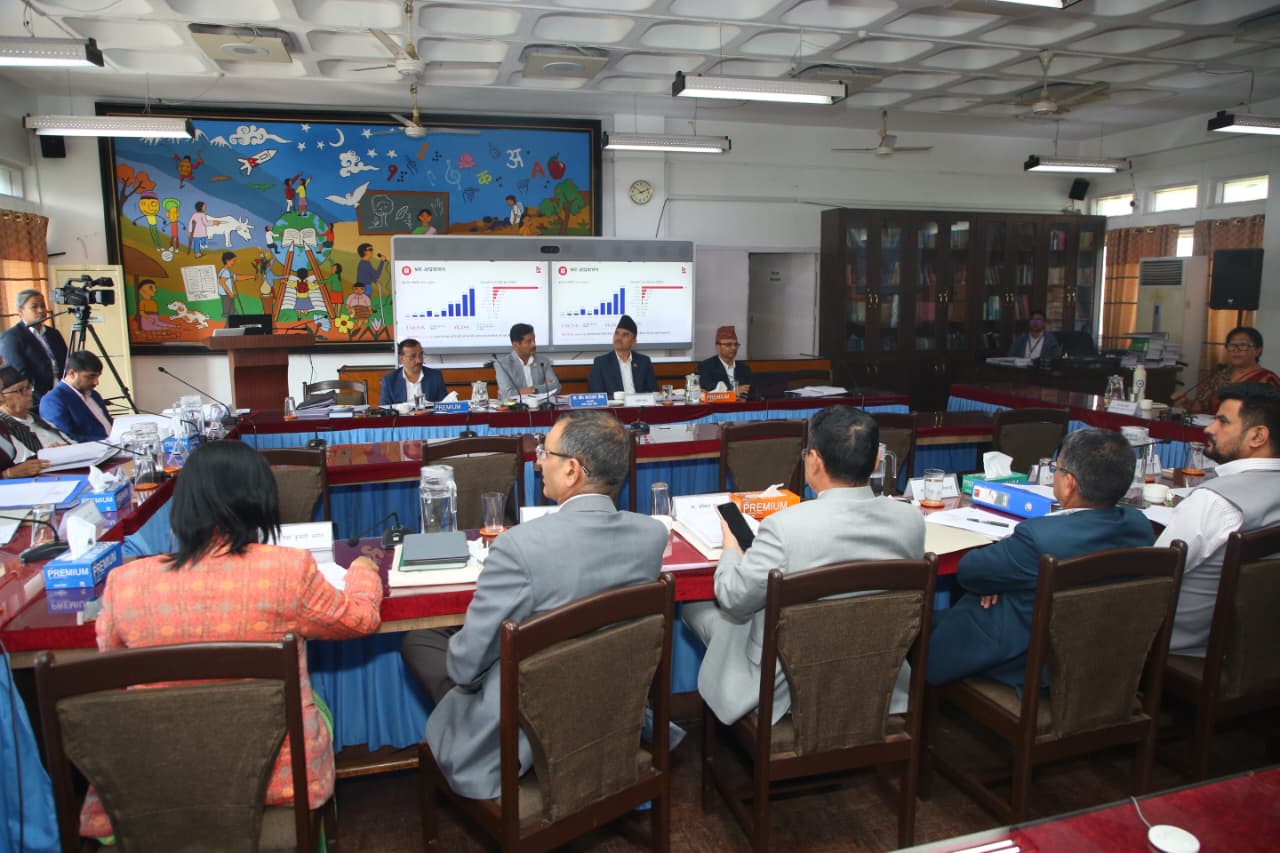
It seems that the Press Council has been trying to make some efforts in recent times, which is worth mentioning. The Council has recently studied 207 media items in the context developed after the Sunsari incident and found 90 of them to be inadvertent. Based on this number, about 45 percent of the content is found to be defective. According to the Council, during the monitoring, 59 articles of 34 media were found to have violated the code of conduct, which is a matter of great concern÷.
In this situation, the attention of all the concerned stakeholders needs to be drawn to the following issues,
Role of Journalism and Social Media
a) Role of Mainstream Journalism
Newspapers, Television, radio and online portals, commonly referred to as mainstream media, have all been affected. These media, which should have played a role in pacifying the society during conflicts, are sometimes used to create sensationalism.
Traditional media has its own limitations, but due to the competition to get views and clicks among the online media, there is a problem in fact-checking the incident. Social harmony has been negatively affected due to the increasing trend of disseminating news with provocative headlines without conducting the necessary verification test of the content. There are many examples of the atmosphere that had been peaceful again tarnished due to lack of attention in the choice of language and words used while writing news about socio-communal conflicts.
By giving space to the sentiments of only one side without including the views of both sides of the conflict or neutral analysts, the media has been accused of bias and this has led to a crisis of credibility.
b) The role of social media
In recent times, platforms such as Facebook, Instagram, Tiktok, X (Twitter), and YouTube have been used not only as places to exchange information but also as the main medium of spreading negative provocation. In the context of the Sunsari incident, some people from within the country and belonging to the two communities have added fuel to the fire by staying outside the country and they have used such social networks. It would be appropriate for the government of Nepal and organizations like the Press Council to monitor and bring such people under the ambit of action.
An analysis of social media and digital platforms in recent times shows that such mediums have contributed to the rapid spread of hate speech. Hate words, misleading videos and provocative captions have been used to create a sense of anger against religion and community among ordinary citizens by posting a small dispute or dissatisfaction in a small dispute or dissatisfaction on social media in an exaggerated manner.
Not only this, users of new media have also been found misleading the public by presenting old or other country’s videos and photos in the wrong context for their selfish interests.
Such algorithms can also be considered to help social media users to play a negative role. It shows people by repeating things that they like or are offended. As a result, people develop the feeling that only their own and their community’s point of view is right and that others are wrong, and that feeling becomes helpful in provoking conflict.
So what to do?
Journalism is not only a medium of information during religious and communal tensions, but it is also an important tool towards maintaining social peace and unity.
In such a situation, it is necessary for the media to follow the principle of ‘peace journalism’.
Communal tensions divide the society and have the potential to cause long-term damage to the physical and social structure of the country, so everyone needs to be aware of this possibility and play the necessary role.
Jha is the former central president of the Federation of Nepali Journalists (FNJ) and former alternate advisor of the International Federation of Nepali Journalists (IFJ). )

 प्रतिक्रिया दिनुहोस्