

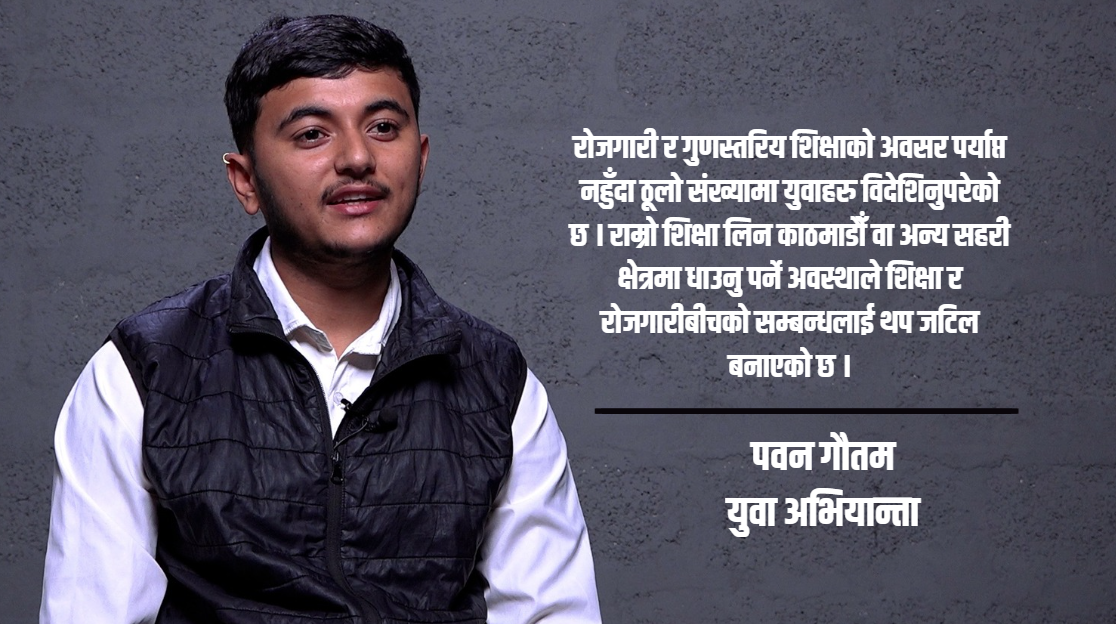
Nepali youths facing challenges due to lack of access to demographic dividend: Pawan Gautam
Lack of employment, quality education and digital access has led to an increase in youth migration: Pawan Gautam
Manisha Basnet,Nepal News Bank
Kathmandu. Although the state should use the youth human resources in the country as an important asset for development, this has not been possible in Nepal. Although the government has been implementing various youth-targeted programmes, they are not enough.
In an interview with Nepal News Bank, youth activist Pawan Gautam said that considering the demographic structure of Nepal, the youth population is large and the state should take this as an opportunity.
“The situation of youth in Nepal is very important in terms of demographic dividend. The large youth age group is a great asset for the state,” he said, adding, “This is a golden opportunity for Nepal in view of the current situation of youths reaching various state structures and leadership levels.” However, despite having a large youth population, lack of employment, unequal access to quality education, digital divide and problems caused by climate change are the major challenges for youths, he said.
According to Gautam, a large number of Nepali youths are compelled to go abroad due to lack of employment.
According to the government data, around 2,02 to 2,300 youths leave the country every day for foreign employment.
‘The main challenge faced by the youth is employment. A large number of youths have to go abroad due to lack of employment opportunities,” he said, “On the other hand, quality education is another big question.” The compulsion to go to Kathmandu or other urban areas for a better education has further complicated the relationship between education and employment. “Youths are finding it difficult to find their future in the country even after completing their studies due to lack of coordination between education and employment,” he said. According to him, youth migration could be minimized if policies were formulated linking education with skills and employment.
Inequality in digital access is another important challenge for youths, Gautam said.
According to him, youths living in urban areas have easy access to internet, technology and digital services, but youths from rural and backward communities are not able to get equal opportunities.
‘Young people living in urban areas have access to networks and digital. But not all youths are getting the same level of services and facilities,” he said, adding, “The state should take this digital divide as a serious challenge.” “Likewise, the direct impact of climate change is also on the youth,” he said. According to him, the impact of climate change is more on the economically and socially weaker communities and it is affecting the education, employment and livelihood of the youth.
Gautam said that although political participation has increased, meaningful role is necessary
Gautam said that increasing participation of youths in politics in recent period is a positive aspect.According to him, the number of youths below 40 years of age reaching the parliament has increased. But the presence of young people in parliament is not enough, he said.
‘Coming into youth politics is not just an achievement. How to drive the country effectively is important,” he said, adding that youths should work on policy formulation, development, employment generation and creating opportunities for the new generation in the country. According to him, youths should be meaningfully involved in the decision-making process rather than defining them only as human resources and involving them in various programs.
“The main question now is not only about participation, but how to ensure effective and meaningful participation, the main agenda should be to give hope to the new generation and create an environment where the future can be built in Nepal,” Gautam said.
Gautam said that the brain drain should be turned into an opportunity
Gautam said that the youth should not only be seen as a challenge but should be turned into an opportunity.According to him, foreign migration can be converted into a ‘brain drain’ if the knowledge, skills and resources acquired by the youths going abroad for studies, skills and employment are created in Nepal.
He said that there was a need for a clear policy to bring back the youths who have acquired skills by studying and working abroad.
He also stressed on linking education, employment and entrepreneurship with each other.
According to Gautam, the legal provisions related to age have also created some obstacles in the political and public participation of youths .
Stating that the definition of youth in Nepal is 18 to 35 years of age, he said there are different age limits for contesting elections at different levels and taking up public responsibilities. According to him, the provision of 21 years of age to become a candidate at the local level and 25 years to be a candidate at the federal level will affect the participation of youths.
He also pointed out the need of reconsidering the 35 years age limit in some constitutional bodies and 45 years in some bodies.
“If we have elected the youth, then their participation in the National Assembly and other constitutional structures should not be prevented by the age barrier,” he said.
He is of the view that the constitution, policies and laws should ensure an environment for youths to have faith in leadership.
He stressed on the need for the government to create an environment where all youths can get quality education within the next five years.
‘There should be an environment in which all the youth can stay in Nepal and study. It should not be limited only to education, it should be linked to employment,” he said. But an environment should be created where they can stay in Nepal and raise their families. “
youth-centric programs need to be reformed
Although the government has been implementing various programs targeting the youths, these programs are not adequate and effective, Gautam said. He underscored the need for providing adequate resources to youth organisations including the National Youth Council. According to him, youth-friendly structures should be built in such institutions by minimizing the obstacles of political influence and bureaucracy.
He said, “The National Youth Council is the official body for the youth.
But in recent times, there have been complaints of politicization and bureaucratic hurdles, it should be further refined and developed as a place to connect the social youth. He said that the loan system provided by the self-employment fund should be made more transparent and digital. According to him, a system should be developed to ensure that youths get information and opportunities on the basis of their merit.
He also said that the government’
s programs have not reached the target groups adequately. According to Gautam, programmes should be formulated focusing especially on youths from the low-income and marginalized communities who have been deprived of state structures for a long time.
Gautam said that youths can use social media not only as a means of entertainment but also for social accountability and good governance.
Gautam said that the youth should focus on the long-term agenda rather than the short-term popularity
.He said that although the popularity of helping to solve social problems is positive, activities done just to get into the limelight can lead the society towards more problems.
‘Populism is transient. Youths should focus on making their identity through their work, skills and contributions,” he said, adding that the youths should focus on the agenda of what to give to the family, what to give to the society and what to contribute to the nation. Gautam said that the state should also give priority to the mental health of the youths and the mental health of the youths. According to him, unemployment, poverty, education, social pressure and increasing influence of the digital world are increasing mental stress among the youth.
He said that the startup loan and other programmes being provided by the government to connect youths to entrepreneurship should be made more effective.
He also suggested expanding employment and entrepreneurship opportunities for youths through collaboration among private sector, non-government organisations and government bodies.
Gautam said that the program to be organized on the occasion of International Youth Day should not be limited to a one-day program
and should be linked to the year-round campaign.He stressed on the need of providing equal opportunity to youths of all castes, classes, communities and regions by maintaining unity in diversity.
‘Youth Day should not be for just one day. We should work in a way to link the issues of youths with the policies and programmes of the government within 365 days,” he said.
He said that various bodies of the government should identify the needs of the youths and take forward education, employment, entrepreneurship, digital access, social security and leadership development in an integrated manner
।



 प्रतिक्रिया दिनुहोस्