

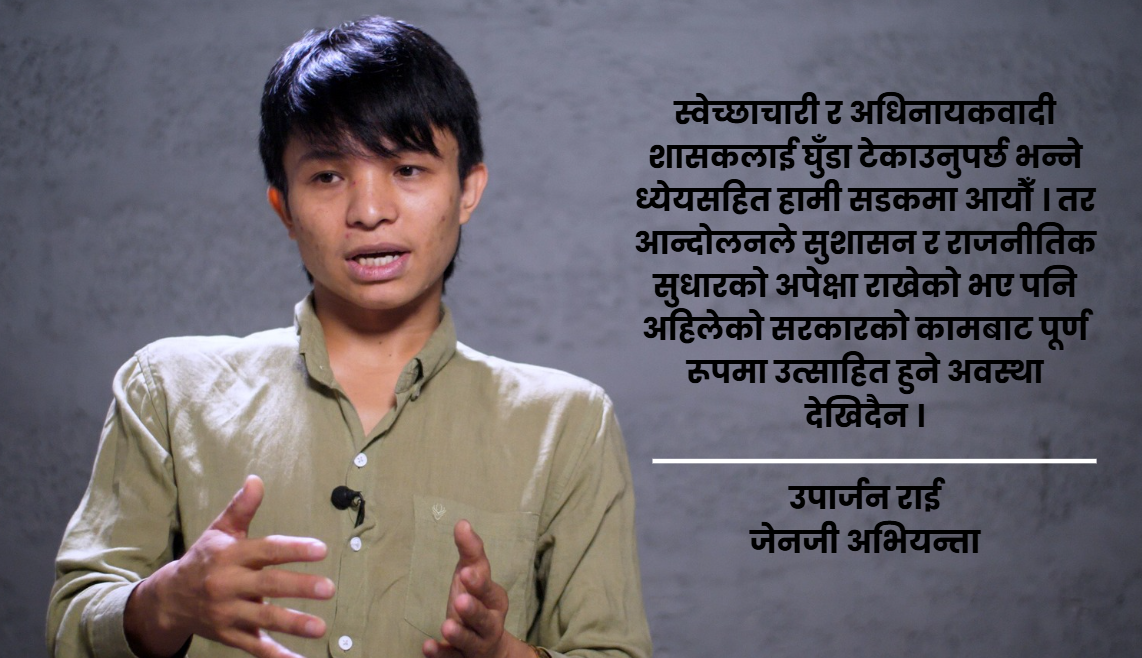
Uparjan Rai
Genji Activist
The issue of Jenji is not only the whole issue of the country, the state should be in dialogue with all the communities:
One year of the Jenji movement: ‘We are still in the test, the government’s activities determine the pass or failure of the movement’
Chamling’s mixed reaction to the government after the Jenji movement: Akanksha Dhami, Nepal News Bank
{{}Kathmandu. On the completion of one year of the Jenji movement, the issues raised by the movement, the subsequent political situation and the working style of the government have been reviewed within the Genji generation.
According to Uparjan Chamling, coordinator of Jenji Koshi (Province 1), a year after the agitation has become a time for the new generation to be honest and responsible towards the ideals, issues and commitments raised by themselves. In an exclusive conversation with Nepal News Bank on the occasion of Genji Day, Chamling said that the Genji generation is still in the testing phase.
“The past year has been like a big test,” he said, “After the Genji Movement, the generation that came to the streets with questions, criticisms and issues gave new directions, new ideals and new messages to the country. After that, it was as if we had tested ourselves how honest and responsible we were to our own instructions, ideals and orders.” According to him , the Genji generation is now in a position to review its activities and boost its self-confidence where necessary. He said that some of his friends are working in the field for post-movement rehabilitation and relief work.
‘We are discussing how we can contribute to the restoration of our ability. Some friends are also working in the field. There is work going on to get information, give it and do what it can. There is nothing more happening than that,” he said.
According to Chamling, the street presence of the Genji generation did not only begin on September 23 last year. Even before that, the youths of the Genji generation had been participating in various movements for the issues of democracy, social justice, identity and freedom of expression.
He said that the Genji generation took to the streets under his own leadership as the forums for criticism were shrinking as dissatisfaction with the government’s decisions and working style was increasing.
“The people, fed up with the decisions, attitude and attitudes of the previous government, were criticizing the government. Many friends of our generation did not like it when the government was shrinking the platforms to criticise,” he said.
After that, there was a voice to seek answers from the streets. He said that they have come out on the streets against the tendency of seeking an account of the governance system of the past decade and trying to curtail democracy and freedom of expression.
“We came out on the streets with the intention of bringing down the autocratic and authoritarian rulers,” Chamling said.
Chamling said that although the Genji movement expects honesty, good governance and political reform, it is not in a situation to be fully encouraged by the work of the current government.
“To be honest, honesty is the identity of our generation. We have come to the streets because the representatives of the past parties and parties were not honest. But now that the government has been formed, the situation is not encouraging,” he said.
He, however, clarified that they have not reached the conclusion that an alternative to the government should be sought immediately.
“We need to find an alternative to this government, we are not in a position to assert that the government has not been able to meet the needs of the society, including the Genji movement. But what the government is doing is not in line with our ideals,” he said.
According to him, the reaction of the Genji generation to the government is now mixed. He suggested that the government should be reformed and move forward.
Chamling said that the issue of withdrawal and release of cases against those involved in the Genji movement is still their main concern. He recalled that the agreement reached after the agitation made provisions for withdrawal of charges and release of those in custody or imprisonment except those involved in organized and organized crime. According to him, it was said that the screening would be done within 15 days for the implementation of the issue. He said that the responsibility of this has come to the present government after the then Karki Commission said that the issue did not fall under its jurisdiction and the next government should address it.
“After the Balen government came to power, we had to keep a warning time and again. We are aware that a committee has been formed. We have come to know that it is screening who should be charged,” he said.
He said that even though he was informed about the release of his friends who were in jail for participating in the movement, the work has not been fully implemented yet.
‘Friends who have gone on the streets have been martyred, many friends are in Parliament, some are in the Cabinet. Some of us are openly questioning the government eye to eye. Some are in the cell. It pains us that this justice has not been done,” Chamling said.
According to him, they have a special focus on the innocent people who are in jail only because they participated in the movement. Chamling said that although the issues of all the youths of the Genji generation are not the same, there are some common fundamental issues of the movement.
According to him, ending corruption, good governance, freedom of expression, reform of old political parties and reform of various organs of government and state are the main common issues of the Genji movement.
“It would be unfair if it is said that whatever I have been involved in is all the issues of Jenji. Different Genji friends may have different issues,” he said, “But ending corruption, good governance, freedom of expression, reforms in the old parties and reforms of various organs of the state are our basic issues.” Chamling said that the process of amending the constitution is one of the dissatisfaction of the Genji generation with the present government. He said that they have raised questions about the responsibility given to the advisor to the Prime Minister as the coordinator of the task force to prepare the debate paper on constitution amendment.
“It is a matter of sorrow for us that the issue of constitution amendment has been handed over without clarifying the purpose, method, process, limitations and morality of the constitution,” he said.
He said that he was of the view that the process of constitution amendment should be forwarded only after collecting suggestions from all classes, genders, languages and regions from the local level to the federal level. According to him, the issue of appointing coordinators by forming a task force before that shows that the government has failed on the issue of transparency. Chamling is of the view that although the private sector and entrepreneurs should be regulated, the state should not create fear, intimidation or intimidation.
“Businessmen should be regulated. The private sector should also be regulated. But they should not be intimidated, intimidated or threatened in any country,” he said.
He said that although regulation of the private sector is necessary, the established processes and systems should not be ignored. He said that changes in impulse can sometimes violate the process.
“The state cannot move forward by discouraging the private sector. The state should also understand this,” he said.
Chamling stressed the need for the government to continuously hold dialogue with various sections of the society, including the families of those who attained martyrdom in the Jenji movement, the injured, the representatives who played a role in the agreement signed with the then government after the movement.
“The government did not keep distance. The government should not hesitate to stay in communication and take advice,” he said.
Stating that Jenji’s issues were not the only issues of the country, he said the state should hold dialogue with all communities, classes and regions.
“The country is not only about Jenji. The issues raised by Jenji at that time are not the only issues of the country. There are other issues as well. The state should take continuous consultations with all regions, communities and sections, keeping all the issues at the centre,” he said.
He said that increasing the distance of dialogue between the government and the citizens would affect good governance and development as well. He believes that one of the weaknesses of the current government is the increasing distance from different regions, communities and classes and the lack of adequate dialogue with the representatives of the Genji movement. He urged the government to widen the scope of dialogue.
Otherwise, the old political parties or unnecessary issues will be restored and the country may have to face another agitation, he warned.
Chamling described the Genji movement as a generation that went through a ‘testing period’ in a year’s time.
‘This was a time of examination for us. We are still almost in the exam. How many friends may have failed, how many friends may have passed, some friends are in a situation where they are taking the re-examination,” he said.
But he concludes that the Genji generation should ‘pass’ itself and the government’s decisions and activities will also play an important role in this.
‘Genji friends should get themselves passed. The government’s decisions are also responsible for this, the government’s activities are also responsible,” he said, “I believe that the government’s actions will determine whether the Genji movement passes or fails.” “
He also expressed confidence that the government will not work towards making the Genji generation a failure.



 प्रतिक्रिया दिनुहोस्