

The government and the family that did not recognize the Jenji martyrs
Santoshi Rawal, Nepal News Bank
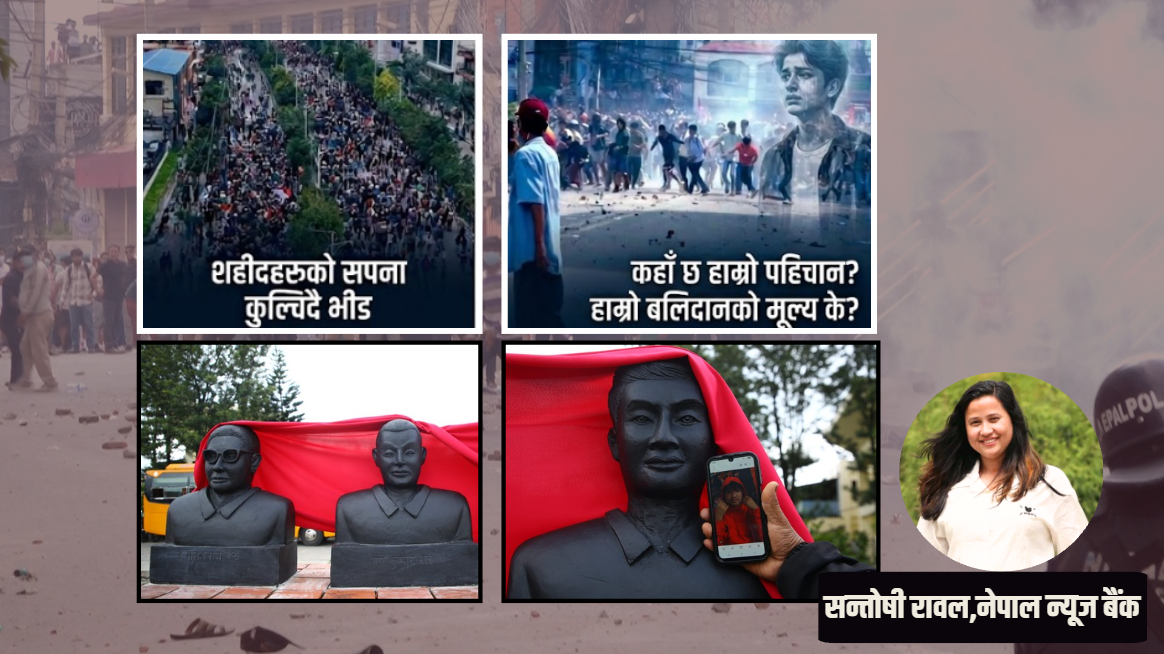
The statue in memory of the youth or agitators of the Genji generation who lost their lives during the Genji movement had instilled hope in their parents. Perhaps they could see the faces of their children in the statue, perhaps their memories would remain alive before their eyes to some extent. But after seeing the statue, the remaining hope of the parents has also turned into disappointment. The statue should have become a reflection of the deceased Genji, a symbol of their identity and memory. But after the face did not match in the statue, it was no longer a statue for the victim’s family, it has once again become a means of reminding them of the pain of losing their children.
MPs, parents of the deceased and other stakeholders had reached for the inauguration of the statue. However, the inauguration had to be stopped as the faces of the deceased protesters of Jenji and Jenji did not match in the statue. This is not only a minor technical error, but also a serious issue related to the feelings of the deceased family. It is natural to question how the process of building the statue proceeded when the faces of those in whose memory the statue was being built could not be identified. Serious investigation is now needed to find out who oversaw the design, who monitored it and who gave the final approval during the construction.
The government is being criticized by the opposition and various quarters regarding this issue. There are comments that the government, which is said to have come from the Jenji movement, has not even recognized the deceased. Some have even called it a game on the sensitivity of the deceased. In the movement, the young people were squeezed. Their sacrifice was a symbol of change. But looking at the statue made in their memory, it is ironic that it seems that a small plant is being reminiscent of a small plant in the shade of an old tree. It is more painful for the family that the symbol made for the memory does not match the real identity of the deceased.
Another serious question in this is the government budget and monitoring. If the state has allocated budget for the construction of the statue, where and how was that money spent? Was the quality and artistic aspect of the construction monitored or not? Did the concerned authorities not see the statue under construction or ignored it? The government should answer these questions. Since the monument was built with public budget, its expenditure, construction process, artist selection and monitoring should be transparent. No one should be allowed to construct a structure built in the memory of the deceased in a ‘makeover’ style.
There are many statues in the history of Nepal that show the excellence of art and craft. In the statues of historical personalities like Bhimsen Thapa and Prithvi Narayan Shah, an attempt has been made to reflect the form, identity and personality of the individual. Therefore, this incident has also raised the question of how much such art and skill is left in today’s generation. The statue is not a structure made of stone, metal or clay; it is a visual document of history, emotion and identity. Especially in the statue made in the memory of deceased children, along with the skill of the artist, sensitivity is equally important.
Therefore, the government should not dismiss this incident as a simple mistake. There should be a thorough study and investigation into why the statue was not found, who made it, on what basis it was approved and why there was no monitoring during the construction. The statue should be rebuilt if necessary, respecting the sentiments of the deceased family. The young people who lost their lives during the Genji movement are not only the characters of any political slogan, they were the children of somebody, they were the dreams of somebody. The statue made in their memory should be able to identify them. If the monument itself becomes unrecognizable, it will not be a reminder of history, but a monument of the state’s negligence.



 प्रतिक्रिया दिनुहोस्