

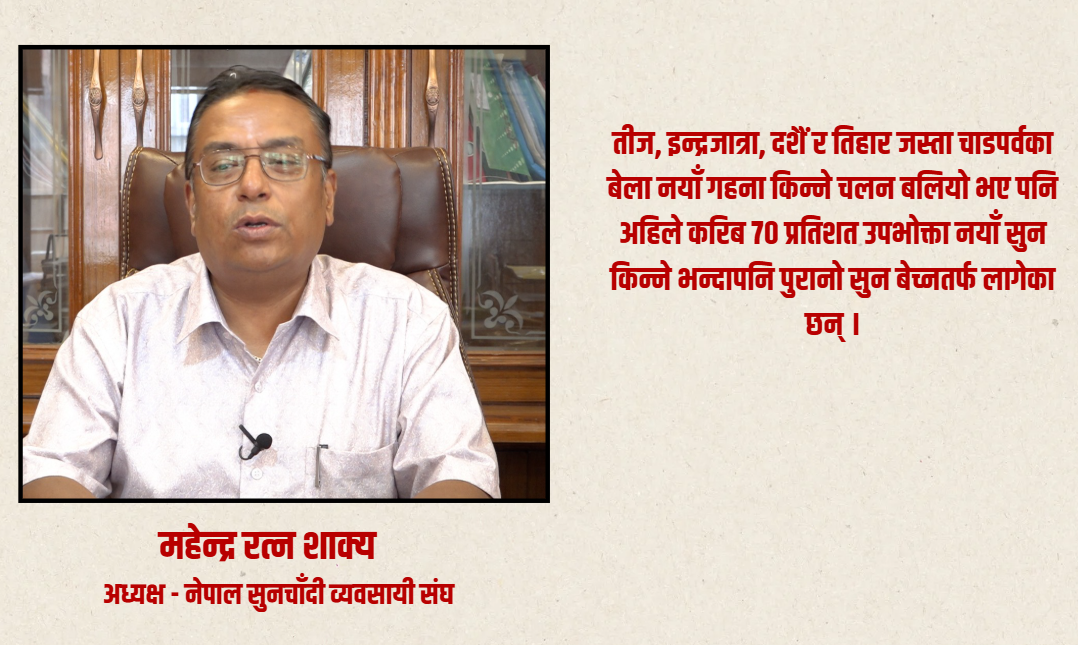
Mahendra Ratna Shakya
President
Nepal Gold and Silver Dealers Association
As the festival approaches, the number of people selling old jewelry has increased rather than buying new jewelry: Mahendra Ratna Shakya
Kathmandu. KATHMANDU: The number of customers coming to the Nepali gold and silver market has increased on the eve of festivals like Teej, Indra Jatra, Dashain and Tihar.
Mahendra
Ratna Shakya, president of the Federation of Nepal Gold and Silver Dealers’ Association, said that high prices, weak purchasing power and global uncertainty have contributed to the change in consumer behavior.
According to Shakya, the trend of buying new jewelry during such festivals was strong in the past, but now about 70 percent of consumers are buying old gold instead of buying new gold. The remaining 30 percent of consumers are buying new jewelry only due to marriage, social rituals and family needs.
“From Teej to Dashain-Tihar, the main time for the sale of jewelry, make-up and beauty items is the main time. But now that the purchasing power of Nepalis is weak, many people are thinking of selling old gold to make ends meet,” he said.
According to him, the historical rise in the price of gold now has been influenced by the atmosphere of global war, economic uncertainty and the situation where the central banks of various countries are increasing the gold reserves. This is the reason why the price of gold is expected to remain high in the coming days as well.
“In my estimation, the price of gold is unlikely to come down to below three lakh rupees per tola. If the situation becomes more complicated, it can go up to four lakh rupees,” he said.
Shakya also said that it is not appropriate for consumers to sell gold in panic at present. According to him, consumers may lose potential profit by selling gold when the price is continuously increasing.
He urged the government to review the customs rate to reduce the difference in the price of gold between Nepal and India. He said that there is a risk of increasing informal transactions through the open border as gold is expensive in Nepal compared to India.
He also said that it is difficult for the businessmen to provide cash immediately to the customers who come to sell old gold. Most of the traders are now adopting the system of paying the old gold through cheque within a period of 15 to 20 days.
“It takes time as the old gold has to be melted down, purified and reused,” he said.
According to Shakya, old jewelry is now collected in sufficient quantities in the market. Earlier, about half of the market’s needs were met through imports, but now about 80 percent of the raw materials are being managed by reprocessing old gold. He said that along with gold, the demand for silver is also increasing due to industrial use. He said that the price of silver is likely to increase further as the use of silver has increased in the field of electrical equipment and solar technology. However, he said the diamond market is stable.
He argues that although the demand for natural diamonds has been affected by the expansion of lab-grown diamonds produced in the laboratory, alternatives to gold have not yet been developed. “Gold is not only jewelry, it is also a means of social security and savings for Nepali families. This is the time to save it as a long-term investment, not to sell it in panic as much as possible,” Shakya said.
Shakya said that there is a need to fix a separate price of ‘Tejabi gold’ that has been traditionally refined in Nepal
to fix a separate price of Nepal’s refined oily gold. He said that it is necessary to fix the price of such gold as before, as the trading of such gold has increased significantly in the market.
According to Shakya, Nepal has a traditional system of refining gold using acid since the past. Earlier, there was a provision to fix the price of ‘Print Gold’ which is hallmarked by foreign companies and ‘Acid Gold’ refined in Nepal in the market.
He said that in the last few years, only the price of acid gold has been fixed. According to him, the quantity of acid gold is increasing in the market at present. “There is a lot of gold in the market now. Therefore, we are demanding that a separate price of acid gold should also be fixed,” he said. Shakya said that since Nepal has the capacity to refine gold, the evaluation of refined gold in the country should also be done accordingly.
He believes that this will increase transparency in the market and provide a clear price system to the consumers.
He suggested that in the gold trade, consumers should also take a decision only after analyzing the market situation without selling or buying in a hurry when the price has increased. He said that it is not appropriate to sell or buy all the jewelry at once except for special needs.



 प्रतिक्रिया दिनुहोस्