

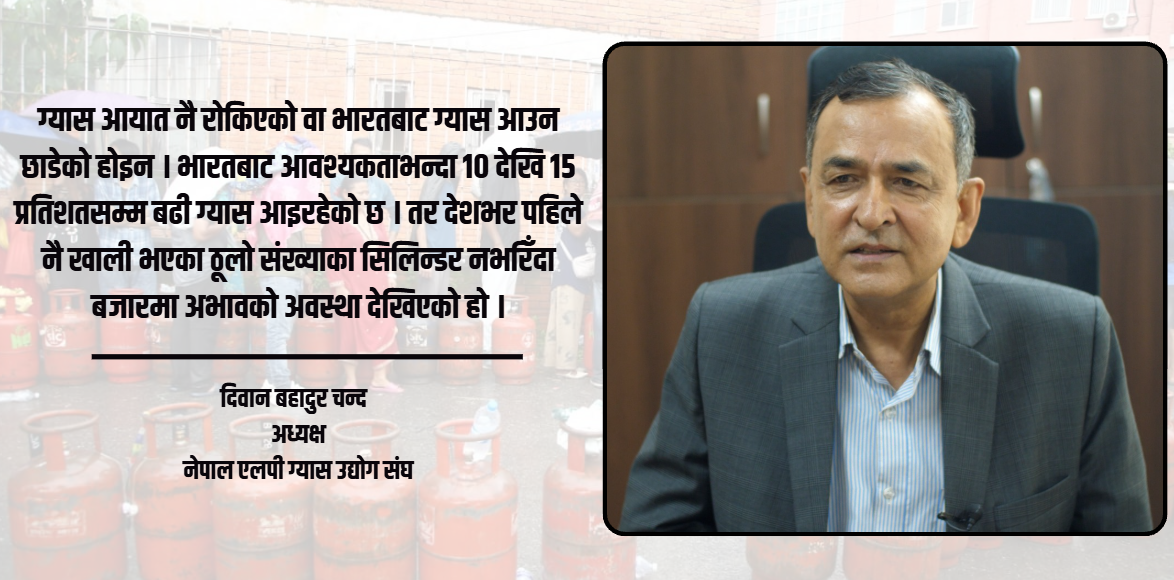
LP gas will not be easy in a day, the role of the government should be clear: Diwan Bahadur Chand
If the gas comes by locking up the businessmen, we will be imprisoned:
The role of the government to reduce the gas crisis should be at the ‘macro’ level, not micro:
Kathmandu. Consumers have been compelled to stand in queue for hours in search of cooking gas and pay high price in some places due to shortage of LP Gas across the country including in the Kathmandu Valley.
At a time when questions are being raised on the government over the lack of easy supply of gas, the accusations and counter-accusations between the industrialists and the government have increased. Meanwhile, Minister for Industry and Supplies Gauri Kumari Yadav also resigned on Thursday.
Nepal News Bank has talked to Diwan Bahadur Chand, President of Nepal LP Gas Industry Association, about the real situation of gas supply, reasons for the shortage, problems seen in transportation and the way forward. According to Chand, the current problem is not due to the halt in the import of gas or the stopping of the import of gas from India. According to him, 10 to 15 percent more gas is coming from India. But there is a shortage in the market as a large number of cylinders that are already empty across the country are not filled. Chand said that about
40,000 cylinders of gas are consumed daily in Kathmandu alone. He said that efforts are being made to bring around 50,000 cylinders to Kathmandu daily.
However, he said that the market cannot return to normal immediately if new supply is added as a large number of empty cylinders have been piled up in the previous houses. According to Chand, the main challenge at present is not only to bring new gas but also to fill the cylinders that are already empty. He said, “Normally, 40,000 cylinders are consumed. Now about 50,000 cylinders are coming. But the cylinders that were empty earlier are on hold. Until 1.75 crore cylinders of Nepal are filled, gas will not be easy in Nepal. It will be filled only by the arrival of gas, by increasing imports.
According to him, Nepal used to need around 50,000 metric tons of gas monthly in the past, but now it has reached 60,000 metric tons. But even that has not been able to meet the demand, he said.
According to Chand, the main reason for the current chaos is not the shortage of gas but the disruption in the supply and distribution system. According to him, it is taking time to refill and send a large number of empty cylinders to the market at once.
Expensive transportation system
Gas industries are now adopting alternative transportation system to bring gas to Kathmandu Valley. According to Chand, gas bullets from India cannot be brought to Kathmandu and gas is being brought to Kathmandu by unloading gas in the Terai districts.
According to him, 10-wheeler trucks are being used on the way to Kathmandu. In normal circumstances, it can carry up to 21 tons, but due to the condition of roads and old bridges, only 15 tons have to be carried at present.
According to Chand, 12 or 14 wheelers are not able to go on some roads and the old bridges are not able to handle the load, so they have to be transported by 10-wheeler trucks. This has increased the cost of transportation.
He also said that another problem is that the gas industries in Kathmandu do not have big trucks. He said that there is a problem in the entry of big trucks in the city, so gas has to be distributed only through small vehicles.
Chairman Chand clarified that the main price of gas will not be fixed by the industrialists. According to him, the Nepal Oil Corporation has the right to determine the price of gas. But now, in extraordinary circumstances, the additional transportation cost has to be managed, he said.
“We have not increased the price of gas, nor have the industrialists increased the price of gas. It is a matter of the oil corporation to determine. But there is extra transportation, it has to be paid for somewhere,” he said.
According to him, the industrialists get only about Rs 32 for selling a cylinder. He said that if they have to bear the additional transportation cost from the same amount, the industrialists will also face problems.
He said that the distance from Hetauda to Kathmandu is about 131 kilometers and the Nepal Oil Corporation has adjusted the transportation cost up to 50 kilometers. He said that the transportation cost for the remaining distance has been determined on the basis of the related decision. According to him, based on the Rs 57.
57 paid by the corporation for 50 kilometres, the cost of the remaining 81 kilometres has been calculated at Rs 105 including VAT. “We have stuck to the law, we have not gone beyond the law,” he said.
sold at a higher price ‘black market’
In some places, consumers are complaining that they have to pay more than the fixed price during the shortage of gas. Chand said that the industry association has already instructed all the industries and dealers to fix the maximum selling price.
According to him, the Industry Association has written to the industrialists and dealers not to sell LPG at the price fixed by the general assembly.
“At present, the price of gas in Kathmandu is not more than Rs 2165. It should be sold and distributed in such a way that it does not go beyond this. It should also be written to its dealers. If it does more than that, it is black marketing,” he said.
Chand said that if the price is sold at more than the fixed price, it will be black marketing. However, he clarified that the industry association does not have the power to monitor, fine or punish the market. According to him, the industries have been providing the details of how much gas has been given to which dealer to the Oil Corporation on a daily basis. He said that the address, phone number and VAT number of the dealer are also provided. He said that the concerned agencies should monitor the market on the basis of these details.
According to Chand, it has been decided to stop some dealers themselves from going to the industries in the Terai to buy gas and bring it to Kathmandu. He said that the industry association has directed to stop such business from today as it fears that black marketing may increase in the market.
He said that although the cost of transportation is included in the price of the gas sold by the industry, there is a problem that small entrepreneurs can increase the fare if they bring gas by looking for a separate truck.
Instead of facilitating, he threatened to shut down
Chand said that he has been threatened by the government when he was taking risks in difficult circumstances to maintain the supply of LP gas in the Kathmandu Valley. Stating that there have been statements in the ministry and parliamentary committees to stigmatize the industrialists, he complained that instead of facilitating the state, they have been threatened.
Chand said, “In Monday’s meeting, he (the minister) said, ‘Gas will come only after locking you up’. In the presence of the secretary in the ministry, the matter of detaining the industrialists came up. I said, “If gas comes by locking, then lock us up.” Make sure to bring gas first, we will be imprisoned. What is wrong if we are detained for two to four days? But that is not the way. Such threats have come to a place where they should have been asked to solve the problem and bring gas by any means. Chand said that the industrialists have sought the help of the government machinery to ease the supply system in the valley, but the government has shown helplessness.
‘We told the minister that we will give you 50,000 to 60,000 cylinders a day in Hetauda and Chitwan, make arrangements for the transportation from there, bring it yourself. We don’t have to increase the price, we will give it at the same rate. But they said that the Food Corporation has only one truck, we cannot do anything else. After that, we were compelled to go to the trucks and bring gas by paying double the fare, taking the risk,” he said.
According to Chand, the entire network of import, transportation, storage and supply to the consumers is on the shoulders of the industrialists. Chand said that after the non-cooperation of the ministry, the industrialists reached the Prime Minister’s Secretariat and drew attention for cooperation. He has demanded the traffic police and the district administration to create an environment for easy movement of gas vehicles on the Tribhuvan Highway to Kathmandu even at night. Efforts to reach 50,000 cylinders per day
According to Chairman Chand, the supply of gas has been increased in Kathmandu in the last few days. He said that about 44,000 cylinders arrived in Kathmandu the previous day, but today around 52,000 cylinders are expected to arrive.
He said that efforts are also being made to increase the number of trucks transporting gas. He said that about
100 trucks are currently operating in gas transportation and preparations are being made to mobilize more trucks.
According to him, the government has been requested to make arrangements to send gas-laden vehicles from Hetauda to two to three times a day by coordinating with truck entrepreneurs. He also demanded that vehicles carrying empty cylinders should be allowed to operate even at night.
Chand suggested that the government should not only focus on monitoring the industries and dealers but also take diplomatic initiative to import more gas from India to resolve the gas crisis. According to him, the gas industrialists are importing gas from India to the best of their capacity. But for more imports, initiative is needed from the highest level of the government.
“It is not fair for the minister to go around the factories, pick up the phone and say, ‘Come, I will give you gas’. Instead of doing that, the minister should talk to the ambassador or the first secretary, the foreign affairs ministry and work on how to import gas at the macro level, not at the micro level,” he said.
According to him, India is importing 10-15 percent more cooking gas than the requirement.
However, he said that the problem will not be completely solved until more cylinders are imported as the number of empty cylinders is already large in Nepal.
Chand claimed that there is no situation where the gas industrialists are reluctant to import gas, the transporters have refused to supply them or the import has been stopped.
“We have not said that the gas has not been brought, the transporter has not tried to bring it, the transporter has not been on strike or the transporter should not be brought,” he said.
According to him, the amount of gas that is coming now is being sent to the market. But due to the large number of empty cylinders in every household, more gas has to be imported according to the demand.
He added, “At present, the daily consumption in Kathmandu is 40,000 cylinders. Now even one lakh cylinders are sold. If one lakh cylinders are given in a month, who will go? But it will not be easy until the empty cylinders in your house are filled.” “
The problem will not be solved in a day
According to Chairman Chand, the current inconvenience will gradually decrease. He said that although transportation has been hampered due to the obstruction of the road at Krishnabhir, works are being carried out to increase the supply through alternative routes and mobilization of additional trucks.
He expressed hope that the situation would improve further if the roadway became easier within a week.
“This problem has not come all at once, the solution will not be solved all at once,” he said, “But it keeps getting minimized and the discomfort decreases.” According to him, gas is now coming smoothly from India. He claims that there has been no major disruption in the supply of gas in recent times and every month 10-15 percent more gas is coming than the required quantity.
The main reasons behind the gas shortage are the stoppage of gas imports, the reluctance of the industries to bring it or the large number of cylinders that were empty even before the transporters’ strike, the increased cost of alternative transportation, the problems of road and transportation, the imbalance in distribution and the lack of high-level initiatives required for more imports as per the demand.



 प्रतिक्रिया दिनुहोस्