

Demonstration demanding climate justice Demonstration in Kathmandu
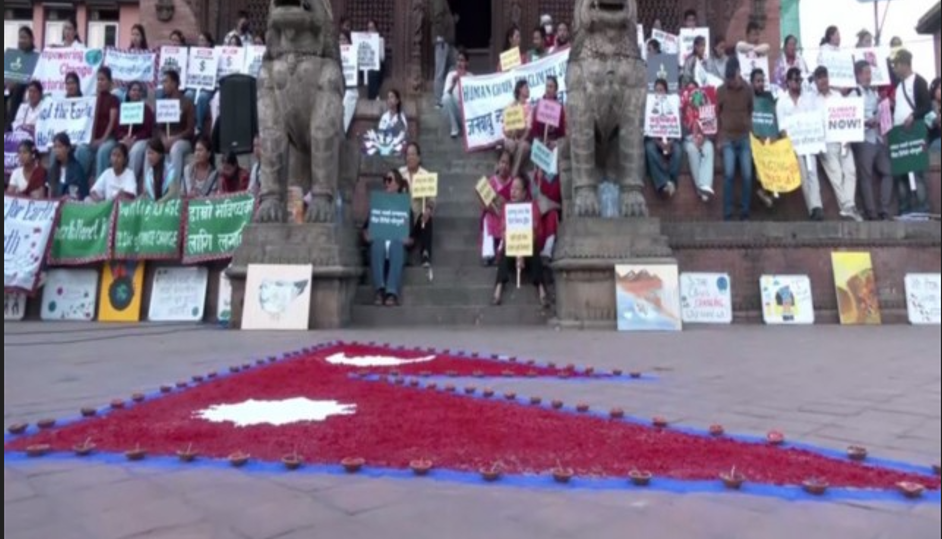
Kathmandu. Climate activists have staged a demonstration in Kathmandu demanding climate justice after the Bhotekoshi floods in Rasuwa. Activists gathered at Kathmandu Durbar Square on Friday and displayed placards and drew the attention of the international community to the impact of climate change on Himalayan countries like Nepal.
After the demonstration, the activists formed a human chain and observed a minute’s silence. After that, they also lit lamps in memory of those who lost their lives in the floods. The Bhotekoshi floods in Rasuwa on August 26 had caused huge loss of life and property in Rasuwa, Nuwakot, Dhading and other areas. According to the latest government data, more than 1,450 people have died in the floods and more than 5,000 people are still missing. Thousands of people have been displaced.
Climate activist Purnika, who participated in the demonstration, said that the climate crisis is not limited to Nepal and the world community should reduce greenhouse gas emissions. “The international community needs to understand what is happening in Nepal now. Along with Nepal, other countries are also facing the climate crisis. If there is a delay in reducing carbon emissions, other countries may also face the same situation in the coming year,” she said. Another activist, Sunisha Gurung, said that the Bhotekoshi floods have had a huge impact on the human and economic sectors and that immediate steps should be taken to mitigate the climate crisis. According to her, the demonstration was organized to express solidarity with the families affected by the floods and to remind the world community of the need for climate justice. She said that if the climate crisis is not addressed in time, more serious things can happen in the coming days.
The Bhotekoshi floods caused extensive damage to human settlements as well as roads, bridges, hydropower projects and other infrastructure. According to the United Nations Office in Nepal, 13 hydropower projects were affected by the floods and the transport, trade and tourism sectors were also severely affected. According to preliminary estimates, the overall damage and damage is equivalent to about 4 to 5 percent of Nepal’s GDP.
The floods affected the settlements on the banks of the rivers of Rasuwa, Nuwakot and Dhading. The floods had caused huge damage in Timure and Syafrubesi areas of Rasuwa. The incident has also increased the debate on the risks related to climate change in the Himalayan region, the changes in glacial lakes and glaciers, and the risk of disasters arising from it.
Recently, Nepal has announced a plan to forward preparatory programs to reduce the risk of future floods from the risky glacial lakes located in the high mountainous region.
Climate activists, however, have been demanding that the international community take more responsibility on climate finance, risk mitigation and compensation for countries like Nepal that are most affected by the climate crisis but contribute less to emissions. ANI

 प्रतिक्रिया दिनुहोस्