

State operation or protection of the interests of middlemen?
Expectations for change and the real test of the government
Badri Aryal
People are not just looking for new faces, new speeches and new commitments from the new government. They are expecting a change in the style of working, an improvement in administrative behavior, an improvement in the effectiveness of public services and a restoration of trust in the state. Once in government, the citizens should see results different from the old style of governance. But running the country requires great political and institutional preparation. The operation of the state is not a laboratory where decisions are taken without adequate preparation and the people have to face the consequences. For this, political experience, administrative knowledge, understanding of economic realities, coordination with national institutions, respect for the legal process and public accountability are essential.
Sacrifice, penance and contribution are required to run the country. This means to rise above personal interests and give priority to the public good. It is to consider power as a responsibility, not an opportunity. It is not to mobilize the institutions of the state to suit oneself, but to make them impartial, competent and accountable. If these basic political culture and institutional preparations are reached in the government, then the reality of power will gradually be exposed. The distance between the expectations of the people in the name of change and the style of functioning of the government in practice increases. The government needs to be evaluated by the services, facilities, security and opportunities provided to the citizens rather than by the speeches it makes.
Interrelationship (Setting): The Institutional Crisis of the State
In Nepal’s politics, the justification for a change of government should always be linked to the welfare of the people, good governance and political stability. But the recent developments have raised a serious question—are Nepal’s state power being run by people’s elected representatives or under the influence of middlemen, economic interest groups, smugglers and mafia operating behind the scenes? Some of the recent incidents have made this question more serious. The Inam Sapkota case, which is being investigated for allegedly extending contacts from court judges to senior officials of security agencies and political leadership, has necessitated a serious debate on the autonomy and credibility of state institutions. In a democracy, the judiciary is the last institution of trust of the citizens. The political leadership may fail, the government may change, the administrative machinery may be weak; but the citizen’s trust that the judiciary is impartial should be maintained. Questioning this trust, a WhatsApp conversation between Supreme Court Justice Hari Prasad Phuyal and Inam Sapkota, who is under investigation on charges of middlemen, has been made public. According to the information published in Kantipur and Kathmandu Post, Sapkota sent a screenshot of the habeas corpus petition of businessman Rohit Gupta, stating that the Prime Minister was concerned and asked for the dismissal of the petition. In response, it has been revealed that Justice Phuyal has asked for a bail of Rs 2 crore and also sent a court order. After this, it has been revealed that there was a proposal to meet him at Hotel Himalaya. Justice Phuyal has admitted that he had a conversation and meeting with Sapkota. However, he clarified that there was no financial transaction or improper understanding and that the decision of the case was on legal basis. The fact that the verdict was not given as per Sapkota’s request also appears in the public statement. However, the key question here is not only in whose favour the verdict came, but also why the sitting judge communicated with someone with a controversial background on the sub-judice case and why there was a need for a meeting.
Claiming that a judge did not give a verdict at the request of a person is one aspect, while the question of judicial conduct and institutional decorum is another. It is equally necessary to not only be impartial but also to appear impartial. Therefore, it is necessary to conduct an independent investigation into this case and also examine the context of the dialogue and the conduct of the judiciary. Another name that makes this case more serious is the then Additional Inspector General of the Armed Police Force, Banshi Raj Dahal. According to the public news, Dahal and Inam Sapkota used to have regular conversations. It has also been published that Dahal admitted to talking to him on the basis of his acquaintance and being a resident of the district. The allegation of sharing sensitive information related to the Prime Minister was also a subject of investigation. The incident of Dahal visiting the police office without permission when former Chief Justice Cholendra Shumsher JBR was taken into custody by the police also became the basis of the investigation. It has been revealed that he was removed from service on October 23, 2008 after the Home Ministry received the investigation report. It is not enough to understand this incident as a departmental action against a police officer alone. It raises the question of how clear is the boundary between personal contact, information sharing and institutional responsibility of officials at the highest levels of the security agencies. State security and sensitive information cannot be a means of personal relationship or access to any person. But the departmental action against Dahal cannot be taken as a conclusion that all other financial allegations have been proved. It needs a separate investigation.
Extraordinary person or network link?
The most investigative aspect of the Inam Sapkota case is the contact details said to have been obtained from his mobile and electronic devices. According to the public news, his contacts spread to incumbent and former judges, top police officers, politicians, MPs, lawyers and influential business people. He is being investigated on suspicion that he played the role of a mediator with the intention of promoting government officials and getting favorable decisions from the courts. Another report made public by Kantipur discusses the records of the accounts of Chief Justice Manoj Kumar Sharma, MP and former police officer Bishwa Raj Pokhrel and police officer Banshiraj Dahal to deposit the money. The material also states that an amount of 1,98,333 was deposited during the three months and an additional $7,500 was sought. However, the entire authenticity of these records, the identity of the currency, the real purpose of the money and the involvement of the persons concerned have not been independently verified. It has also been revealed that Chief Justice Sharma has said that he has no direct or indirect contact with Sapkota.
This is where the real
importance of the investigation lies. Who sent the money? To whose account did it reach? For what purpose was it sent? Is there any connection between the money and the government decision? The answer to these questions should be found not on the basis of conjecture, but through banking records, digital forensic examinations and legal investigations. This case demands a debate about a broader political and economic structure. In Nepal, there is a risk that the influence of middlemen can reach contracts, public procurement, revenue, land transactions, appointments, transfers, promotions and political patronage. Allegations of financial support to win elections, collusion to create power equations and influence government decisions should also be investigated on the basis of evidence. If a group with access to various institutions of the state can influence decisions according to its economic and political interests, then it is a serious problem than ordinary corruption. This can gradually weaken the institutions of the state and lead to the influence of a limited interest group. Such a situation can be analysed in the language of political economy as a risk of state capture. The question of whether the short life span of the government in Nepal is only due to the instability of the coalition or the interest groups that are trying to influence the decision making process of the state should be a matter of investigation. The government changes, the ministers change, but if the network of contacts influencing the decisions is maintained, the change that the people want will not be possible.
The justification of the present government should also be tested on this criterion. The purpose of the formation of the government is to run the country, increase economic output, create employment, good governance and institutional reform. If there is a suspicion that the government’s priorities are focused on the management of a limited interest group, then it should be answered through facts, performance and transparency. Nepal now needs a change in the character of the state, not just a change of government. The independence of the judiciary, the professionalism of the security agencies, the transparency of political appointments, the audit of election expenses and the examination of the assets and interests of public officials should become mandatory. If the influence of middlemen, smugglers and mafia is proved, action should be taken according to the law without protection of political access or position. For this, there is a need for change-oriented citizen pressure and a peaceful democratic movement. The purpose of the movement should not be just to remove one government and bring in another. Its purpose should be to make the state accountable to the people, to free the institutions from the influence of interest groups, and to make politics a means of public service.
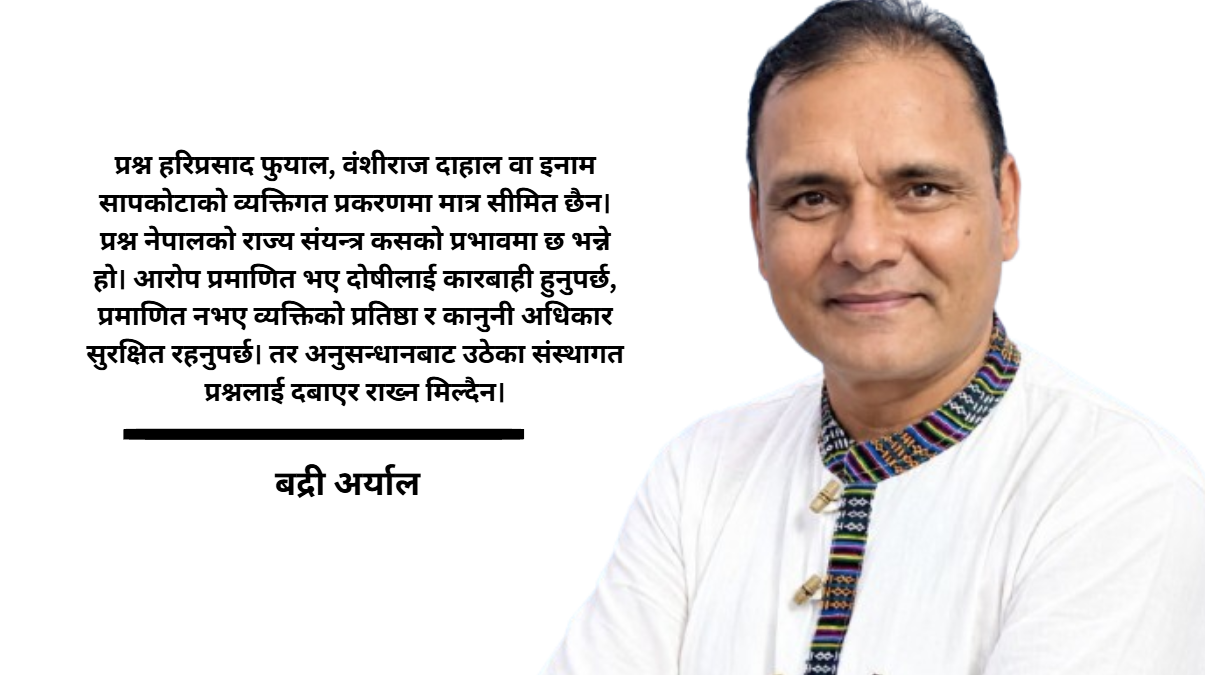
Ultimately, the question is not limited to the individual cases of Hari Prasad Phuyal, Banshiraj Dahal or Inam Sapkota. The question is under whose influence is the state machinery of Nepal. If the allegations are proved, the culprits should be punished, and if not proven, the person’s reputation and legal rights should be protected. But the institutional questions raised by the investigation cannot be suppressed. The government should be run by the people’s mandate, the judiciary should be guided by the law and the security agencies should be accountable to the constitution. The state is not the private property of any middleman. Now the country should not change the government, but choose the path of political consciousness and institutional reform to change the character of governance. Otherwise, the government will continue to change, but the state will not be free from the influence of middlemen.


 प्रतिक्रिया दिनुहोस्