

Dilkumar Limbu÷Nepal News Bank
Taplejung. ‘Mang Ningware Mang Abong, Hang Ningware Hang Abong, Yok Ningware Ameklo’ (If we think of God, we become God. Good thoughts make a good person. Bad thoughts can happen on their own. Philosopher of thought and philosophy, guru of Kirant philosophy, great social reformer and national luminary of Nepal, Falgunanda Lingden, has completed 141 years of birth and has entered 142 years from November 10.
In this context, the 142nd Phalgunanda Jayanti is being celebrated today in various places including Taplejung, Panchthar, Ilam, Jhapa, Sunsari, Tehrathum districts, where the Limbu community lives. The Phalgunanda Jayanti is being celebrated with various programs in the United Kingdom, Hong Kong and other countries.
On Wednesday morning (today), 142 lamps and urns were worshipped at the statue of Phalgunanda. Bouquets of flowers have been offered to honor the contribution of Phalgunanda to the statue. Peace and harmony rallies have also been taken out in various market areas. Greetings exchange programs have also been scheduled.
Falgunanda Lingden was born in the Kirant community to revive the philosophy, language, script, rites and culture of the Kirant religion, which was on the verge of extinction at that time, and to guide the Kirant community which was reveling in evil practices and bad rituals. The philosophy of truth, peace and non-violence of Mahaguru Phalgunanda, who preached that one should eat good food, satvihara and good deeds, has started to be followed in the world in recent times. He is revered by all as the facilitator of truth, peace and non-violence. The Kirant religion expresses their faith and reverence to him as Muhinggum Angsimang.
Social reformer Phalgunanda
Mahaguru had prepared the Satyadharma Muchalka by convening a gathering of the then dignitaries, Subangis, businessmen and intellectuals of Limbuwan in Labrekuti of Panchthar on Baisakh 24, 1988. Mahaguru, who was involved in the social reform campaign, was arrested by the state all his life, accusing him of being a traitor, traitor and trying to become the king of former Limbuwan. However, 61 years after his death, on December 1, 2006, the Government of Nepal honored him as a national luminary.
Phalgunanda’s childhood
According to Phalgunanda’s biography, he was born on November 9, 1942 in Chukchinamba village of Mangsebung Rural Municipality-2 in Ilam district. Born in a simple peasant family, Mahaguru Phalgunanda remarried after his mother died in childhood. After that, he grew up under the care of his aunt. His childhood was spent herding cows and goats, roaming the forests, streams and hills. In his childhood, he was quiet, reclusive, and of a low speaking nature.
For a few years, he lived with his uncle and aunt. Later, he made a small bowl in the Lechebung field and started living separately. Due to his poor financial condition, he started earning a living by digging babblers and yams. When he was eight years old, when he was asleep, a divine man called him with a signal, so the great master got up and followed the divine man. The divine man made him take a bath in the Maikhola. Then he took him to the river of Khatrakpa a little higher and made him stand at the foot of the tree of Lampate. The same seed sprouted and became a vine as if he had planted beans on the ground beans beans. The wave tied the Mahaguru so that he could not move. When the divine man pointed to Maikhola and asked him to apologize to his mother, he disappeared there. After that, Mahaguru’s body became lighter and the wrapper disappeared, according to his biography.
Mahaguru Phalgunanda lived as a celibate all his life. He used to walk around dressed in women’s attire and jewelry. He was a man of few words and a soft voice, who used to eat vegetarian food, always walk, and share words of knowledge. Phalgunanda lived a simple life all his life. The rabbit slippers, hair, tongs, trident and khurmi used by him are still preserved in the Manghims of Mahaguru’s time.
Mahaguru Phalgunanda’s Navaran was named Nardhoj. But because the children died at birth, due to the popular belief that wearing an iron bangle to save life after the birth of the great guru would lead to longevity, he was given an iron bangle. Because of this, his name became Falamsingh.
Mahaguru gathered the Kirant community of 10 Limbuwan-17 Thum on Baisakh 24, 1988 and passed a seven-point Satyadharma Muchalka with the objective of removing the distortions and anomalies in the then Kirant society. Mahaguru is also known by nicknames such as Dhyani, Tapasi, Satyahangma, Mahaguru, Falamsingh and Muhinggum Angsimang and national luminaries. Satyadharma Muchulka, which is an important and historic work of Mahaguru Phalgunanda, became the formula to introduce him as a social reformer and make him a national luminary.
Falgunanda established the Kumbhakarna mountain range in the Faktanglung Rural Municipality of Taplejung as a pilgrimage, muktibhoomi and pilgrimage site for the Kirant religion. In 1993, he made the first pilgrimage to the Senchei Phaktanglung (Kumbhakarna) Mountain and opened the door. It is mentioned in his biography that during his first Faktanglung journey, Mahaguru reached the foothills of Faktanglung and returned after doing great service. In 1995 B. S., when he went to Faktanglung, he also built a dharamshala in Parungtembe. Every year, the Kirantis have been making pilgrimages to Faktanglung. Phaktanglung Mountain is located at an altitude of 7,710 meters above sea level.
Mahaguru Phalgunanda built Mamanghim (Kirat temple) in various Thum (different districts). In 1985 B. S., he established District Manghim at Chowkmagu-3 Labrekuti of Panchthar. Kirant Sangsen Barak Chotlung Manghim and in 1988 B. S., Sarathum Goshwari Yuma Manghim built in Labrekuti. In 1986, he established Kiranteshwar Hangsam Manghim (Kirant Hangsam Phalgunanda Manghim) in Chukchinamba, Gairigaun, Ivang, Ilam, and in 1997, he established Kirant Hangsam Manghim Nigura Day in Taplejung. Similarly, he also built Manghim in Panchthar, Kabeli Manghim, Sablakhu, Taplejung and Kirant Hangsam Namgenayak Manghim, Jeetpur, Ilam. In 1995, he established a dharamshala at Faktanglung Parungtembe and in 1995, he established a silauti hut at Ranitar in Panchthar. Similarly, he also built Manghim in Bhutan.
Subba Sher Bahadur Laoti of Yasok Bhadaure of Panchthar, Subba Kajiman Tumbahangphe of Tehrathum Myanglung, Subba Prem Bahadur Mabohang of Dhankuta Chaubis and all the Subbas, stewards, dignitaries, intellectuals and big leaders of Limbuwan were present. The gathering prepared a seven-point Muchulka on Kirant Mundhum, language, script, rituals and culture. The Muchalka was named Satyadharma Muchulka. Satyadharma Muchulka has guided the society in the direction of equality, non-violence, peace and nature worship.
Satyadharma Muchulka emphasizes not to kill or sacrifice the daughter while performing the rituals, not to take dowry, to worship, to perform puja, to marry and to worship. Special emphasis is given to the vegetarian lifestyle such as not to use alcohol and meat while offering Pind to the deceased, to burn the death Sutak, to pay attention to the growth of the Sutak, and not to consume alcohol and meat.
Ending the discrimination between sons and daughters, ending gender, caste and class discrimination, emphasizing on the education of mother tongue, building Manghim and schools in various places, adopting a simple lifestyle, being high in ideas, being productive, becoming self-reliant and maintaining world peace and human unity are some of the important points of social reform. The Mundhum has also been lost as it has been in the oral tradition for a long time and the Mundhum has also been emphasized to be documented.
Mahaguru Phalgunanda guided the Kirants on the right path and the civilized path in the form of Kirant Dharma Darshan by giving direction to the culture that was running on the wrong path. He also codified the Samjik Mundhum and created a cultured society for the Kirant community. He propagated and revived the Kirat script, which was on the verge of extinction.
In this way, he proclaimed world peace and human unity and showed the path of truth, peace and non-violence. He stressed the need to end the caste, class and gender discrimination in the society. Mahaguru had always made him aware that he should always be productive and skill-oriented by adopting a simple lifestyle, and for change and development, by giving priority to mother tongue education for identity and civilization. At a time when the Kirantis’ own religion, language, script, literature, rites and culture were on the verge of extinction, Mahaguru Phalgunanda, who was born as the light of Kirant civilization, dedicated his entire life to civilizing and cultured the Kirant society, which was mired in the quagmire of evils and bad traditions. Phalgunanda, who was revered by all as the facilitator of truth, peace and non-violence, worked throughout his life to build a civilized society by reaching different places in the country and abroad.
Phalgunanda statue installation
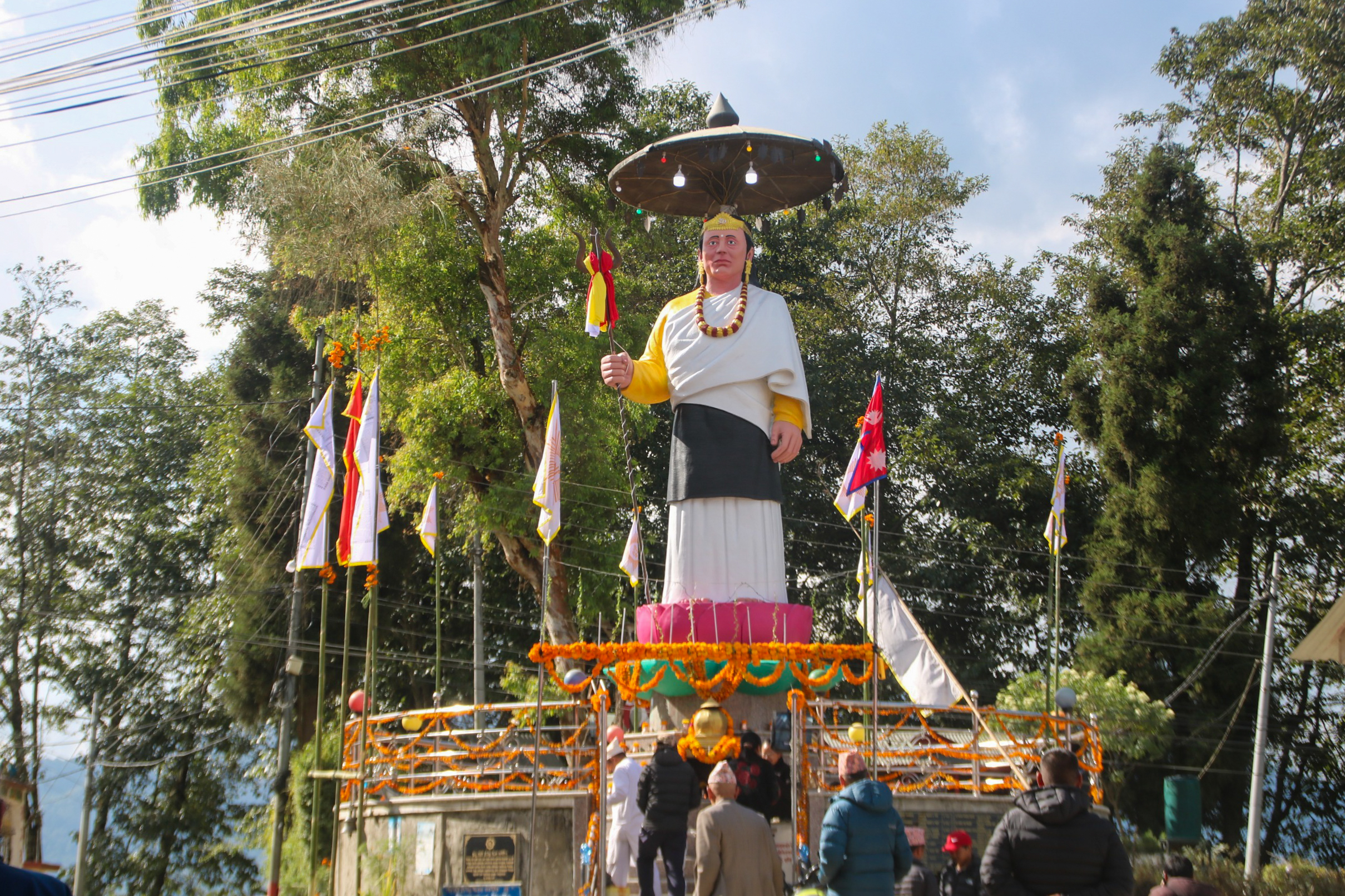
Statues of Phalgunanda have been erected in different parts of Phalgunanda. Eight statues of Phalgunanda have been erected at different places in Taplejung district.
Although the statue of Mahaguru Phalgunanda was first installed in Damak of Jhapa on the same day and at Bhanjyang of Mangsebung, Ilam on November 9, 2004. After that, the statue of Mahaguru was erected at Chokmagu Labrekuti in Phidim Municipality, Panchthar. Similarly, statues of Mahaguru have also been installed at Aathrai Sankranti Bazaar of Tehrathum, Beldangi of Damak Municipality and Shantinagar of Buddhashanti Rural Municipality of Jhapa. His statues have also been installed in Rabi Bazaar and Tumbewa of Miklajung Rural Municipality of Panchthar, Feden of Panther, Arjundhara of Jhapa, Pathibhara Kshetra (Mukkumlung) of Taplejung and Tandi of Miklajung Rural Municipality of Morang. Similarly, the installation of statues in Kerabari and Letang of Morang and Bharaul of Sunsari is continuing.
Honors from the State
Mahaguru Phalgunanda Lingden has been honored by the state as a national luminary. The state has released a postage stamp of Rs 15 in the name of Mahaguru Phalgunanda. A brief biography has also been published in the Nepali curriculum in the name of Mahaguru Phalgunanda and on November 3, 2006, the Government of Nepal declared him as a national luminary. The Kirant religious organizations had declared Mahaguru’s birth anniversary on May 14, 2014 as a Kirat festival.
In honor of the Mahaguru, the birth anniversary festival is celebrated on Kartik 25, the Memorial Day on April 5 and the Social Reform Day on Baisakh 24 every year. The road section linking Chisopani Panchami and Ravi of Panchthar from Damak of Jhapa to Mangsebung of Ilam has been declared as Phalgunanda Marg. Muhinggum Angsimang Lingden Phalgunanda passed away on Monday, April 6, 2005 at the age of 63 in Hangyak under Silauti of Panchthar.
Statue of Phalgunanda on Tokme hill of Fungling, the headquarters of Taplejung.



 प्रतिक्रिया दिनुहोस्