

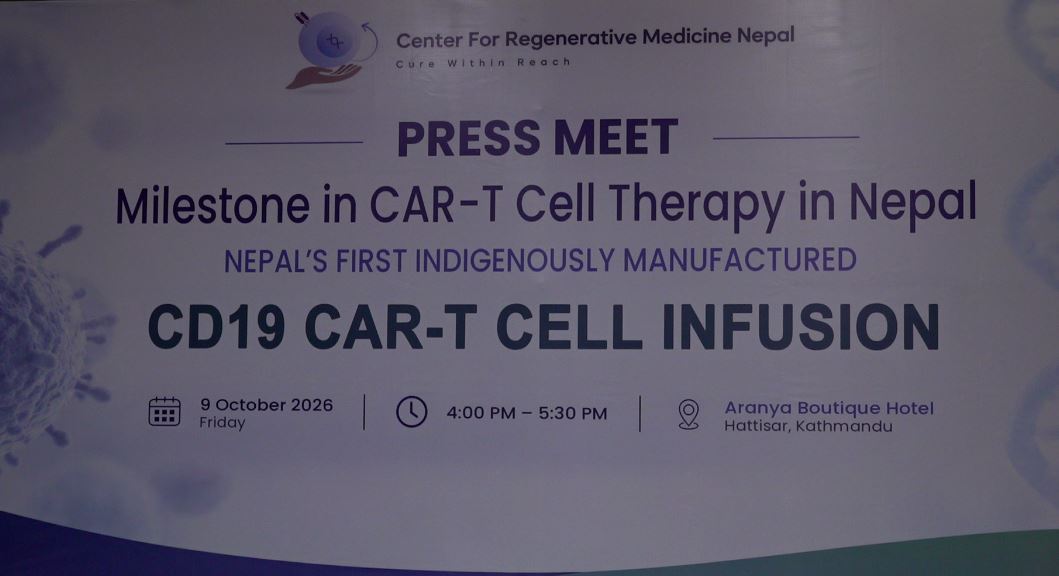
Kathmandu. For the first time, cancer patients have been treated using CAR-T cells developed and manufactured in Nepal.
The treatment is a significant achievement in the field of cancer treatment in Nepal, in collaboration with the Center for Regenerative Medicine Nepal (CRM Nepal) and Tribhuvan University Teaching Hospital. A patient suffering from Acute Lymphoblastic Leukemia (a type of blood cancer) was given to the patient of Tribhuvan University Teaching Hospital (TUTH) in Kathmandu on September 27. According to CRM Nepal, the patient’s health condition is stable and he is recovering. The medical team is monitoring the patient regularly to assess the effectiveness of the treatment, the remission of the cancer, and how long the effect of the treatment lasts. Dr.
Anjan Shrestha, a hemato-oncologist who led the team of doctors involved in the treatment. Dr. Anjan Shrestha said that this achievement has opened up new possibilities in the field of cancer treatment in Nepal.
According to him, CAR-T cell therapy may be useful especially for patients with some types of blood cancer, who have recurred cancer after chemotherapy or have not worked effectively with chemotherapy. He said that the development of this treatment method will help reduce the need to depend on countries like India and China for such treatments. In T-cell therapy, an immune cell called T-cell is genetically modified by extracting an immune cell called T-cell from the patient’s body.
The cancer cells are then grown in the laboratory and transplanted back into the patient’s body. The CAR-T cells produced by CRM Nepal target a marker called CD-19 found in some types of blood cancers.
CRM Nepal’s Chief Scientist Dr. Sanjeevan Gautam said that the initial results of the treatment are encouraging.
According to him, the number of CAR-T cells in the patient’s blood has increased as expected, and the initial positive effect of the treatment has been seen. However, further monitoring and evaluation is needed to determine the overall effectiveness and long-term outcome of the treatment, he said.
Dr. Gautam led the project from 2022, integrating scientific expertise, financial resources, international partnerships and technical support.
Under his leadership, good production practices (GMP) standards were set up in laboratories, technology transfer, capacity building related to production and quality control, human resources training and regulatory process.
The project was carried out through preclinical research from 2022 to 2024. In 2025, the laboratory received approval and manpower training and production preparations were completed. In 2026, CRM Nepal’s CD-19-targeted CAR-T cell production received approval for clinical use in Nepal.
CRM Nepal’s production and laboratory team established and operated the local production system required for the treatment.
The team was responsible for producing separate cells for each patient and evaluating their quality. Decode Genomics has helped in the capacity development of quality analysis.
Similarly, Professor Dr. Om Kurmi of Lincoln University in Academic Strategy and Collaboration. Om Kurmi gave guidance. He stressed on the need to build a culture of biologic drug research and drug development by integrating advanced treatment methods in Nepal’s health and educational system.
Dr. Sudhanshu KC, who is involved in the expansion of clinical cooperation with CRM Nepal. Dr. Sudhanshu KC said that the long-term goal of the organization is to provide advanced treatment to the patients who are unable to go abroad for treatment due to financial and practical difficulties.
Geneticist Balaram Gautam, who has coordinated the national level collaboration and daily operation, said that there is a plan to expand the local capacity to provide treatment services to more patients. Luca Gatinoni, a professor at the Line’s Institute for Immunotherapy and an expert in the field of cellular therapy, and Professor Leo Hansmann of the University Medical Center of Regensburg suggested the clinical management of CAR-T cell therapy.
Dr. Dilip Sharma provided expert assistance while Vedanand Parajuli managed the process from cell production to the patient delivery.
The production of CAR-T cells in Nepal and the treatment of patients has created a new base for research, production, quality testing and skilled manpower development in the country. Dr. Gautam said. He said that this will also help in the development and expansion of other advanced treatment methods in the future. CRM Nepal is an organization established with the objective of building local capacity in the field of advanced cell therapy and immuno-oncology through research, cell production, quality evaluation, manpower training and clinical collaboration. The organization, which is led by Nepali experts in Nepal and abroad, aims to provide advanced treatment technology to the patients of Nepal and other countries.

 प्रतिक्रिया दिनुहोस्