

International Indigenous Mother Language Press Conference to be held in Kathmandu
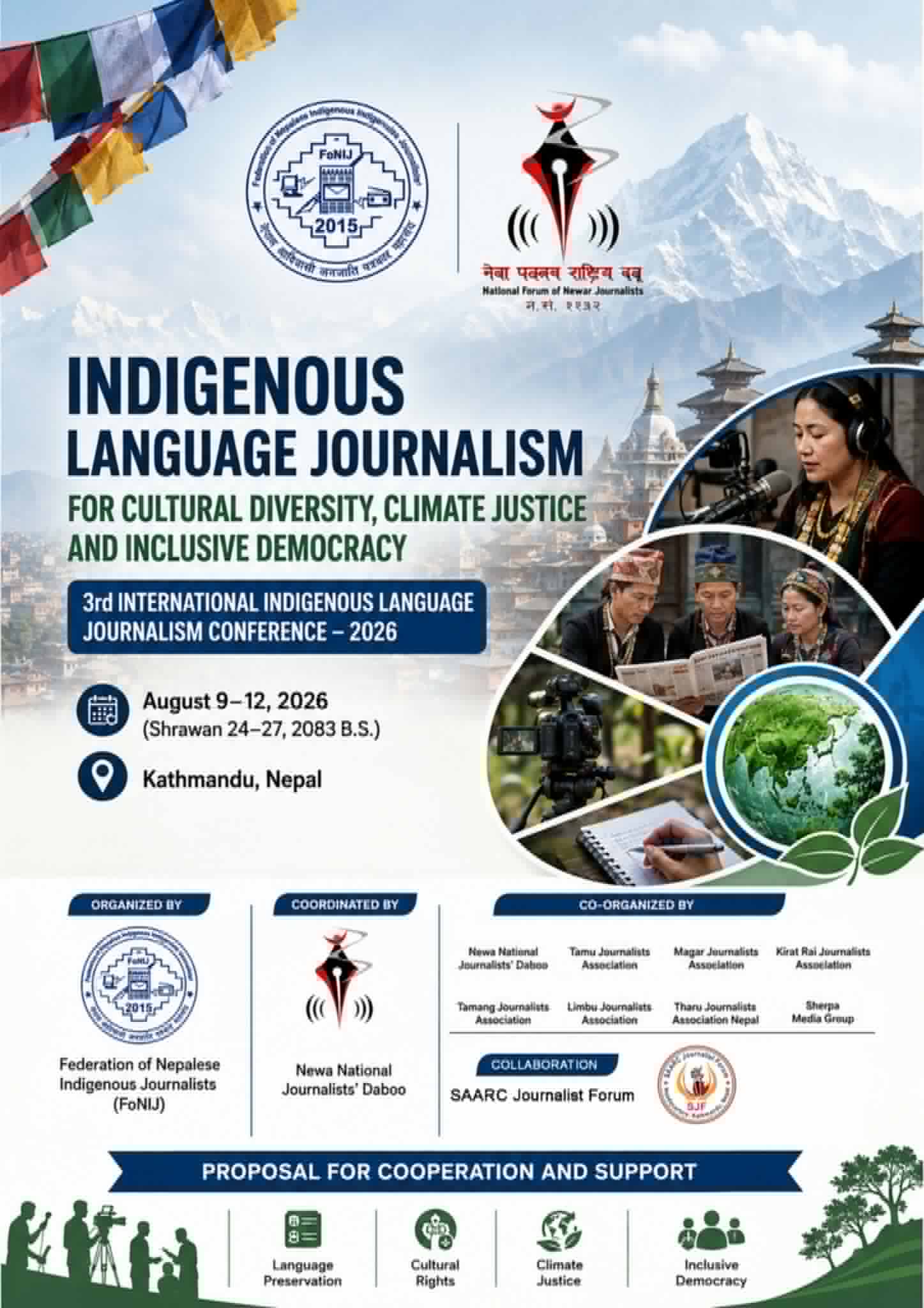
Kathmandu. KATHMANDU: The Federation of Nepal Federation of Indigenous Nationalities Journalists (FONIJ) is organizing the third International Indigenous Mother Language Press Conference-2026 in Kathmandu from August 11 to 11.
Tamang Journalists Association, Kirant Rai Journalists Association, Tamu (Gurung) Journalists Association, Tharu Journalists Association Nepal, Magar Journalists Association, Limbu Journalists Association and Sherpa Media Group will be the co-organizers of the conference. The conference is being organized on the occasion of the World Day of the World’
s Indigenous Peoples and the 27th anniversary of FONIJ in the context of the United Nations declaring the year 2022-2032 as the International Decade of Indigenous Languages and campaigning for the preservation, promotion and revitalization of indigenous languages around the world.
Although Nepal is a multilingual, multi-cultural and multi-ethnic country, many mother tongues are on the verge of extinction.
According to the organizers, a common national and international debate is needed for the protection, strengthening and professional development of mother tongue journalism at a time when the use of mother tongue in the mainstream of information and communication is being limited and the voices of indigenous communities are not adequately represented. The conference is being organized keeping this need in mind.
According to the organizers, the conference will hold serious discussions on the current status, opportunities and challenges of indigenous mother tongue journalism around the world, professional, professional and physical security of journalists, the future of mother tongue communication in the digital age, inclusion in communication policy and linguistic rights. Various sessions will also be conducted on the relationship of indigenous communities to water, land, forests, biodiversity, herbs and natural resources, the impact of climate change on indigenous communities, and the role of media in climate justice.
The inaugural session of the conference will be held on August 9 and 25 and eight thematic papers will be presented by various national and international experts from August 11 to August 11. The present status of mother tongue journalism, possibilities for improvement, adaptation to technology, policy management and professional strengthening of journalism will be drawn through panel discussions, interactions and open discussions.
According to Sameer Balami, Secretary General of FONIJ, the conference will provide an important opportunity for experience sharing, international collaboration, knowledge sharing and building a common campaign among journalists in indigenous mother tongues from Nepal and around the world.
The conference is expected to contribute to the sustainable development of mother tongue journalism, capacity building of journalists and expansion of international network.
About
60 international mother tongue journalists from 27 countries, about 300 representatives from FONIJ chapters across the country, about 40 representatives from Newa Journalists National Dabu and about 100 representatives from ethnic journalists’ organizations are actively participating in the conference. The conference will also be attended by representatives of indigenous journalists’ organizations, media experts, researchers, academics and human rights defenders.
During the conference, the 27th anniversary of FONIJ will be celebrated on August 11 with a special program.
On the occasion, FONIJ Award will be given to journalists and journalists for their significant contribution to the promotion of mother tongue journalism.
According to FONIJ President Lucky Chaudhary, the Kathmandu Declaration will be issued at the end of the conference, which will include the common commitment of policy reforms, guarantee of linguistic rights, strengthening of indigenous media and professional security of journalists. Along with this, the FONIJ report will also be made public which includes the rights of indigenous nationalities, current issues, practices of mother tongue journalism, achievements, challenges and future course of action.
According to the organizers, this conference is not only a formal event but will also strengthen the common voice of indigenous mother tongue journalists spread across the globe, make the role of media more effective in preserving linguistic and cultural diversity and prove to be an important milestone towards building a democratic, inclusive and multilingual communication system.
Sameer Balami, general secretary of FONIJ, said that discussions and meetings with various organizations, including Newa Patrakar Rastriya Dabu, have already started in preparation for the conference.

 प्रतिक्रिया दिनुहोस्