

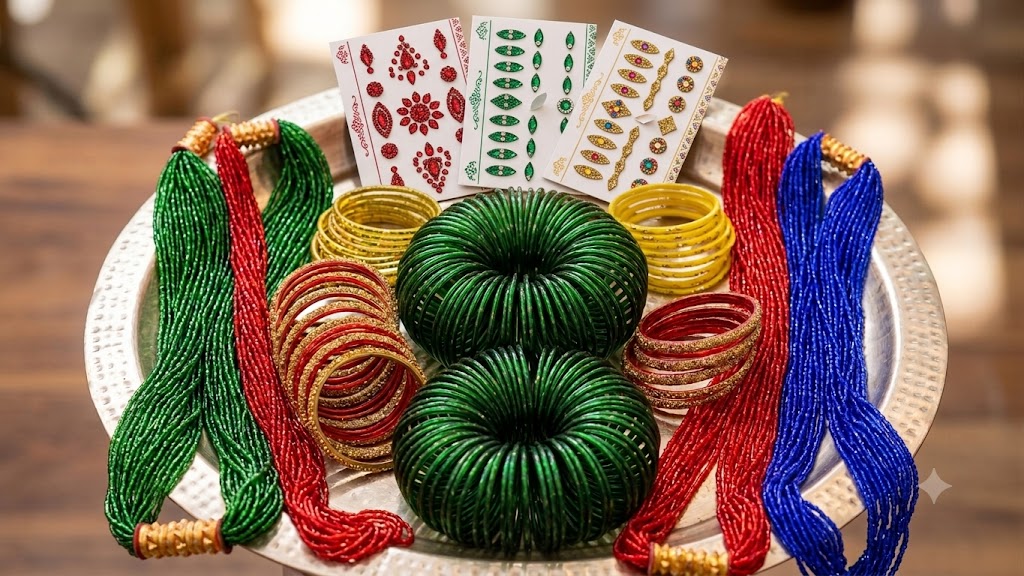
. With the beginning of the month of July, the necks and wrists of Nepali women are decorated with green and yellow bangles. For Hindu women, Saun is not just a month but also a confluence of nature and culture.
This tradition of wearing green dresses and cosmetics to unite with nature is as beautiful as it is, its economic aspect seems to be equally dependent. Millions of rupees are spent every year on the purchase of bangles, colourful bangles, and tika on the forehead worn by Nepali women.
If we look at the data of the Department of Customs for the last three fiscal years, the import rate of these decoration items in Nepal is very high.
In the last fiscal year 2082÷83, Nepal imported bangles, tika and pots worth Rs 604581 thousand.
During this period, 34,
70,525 such items have been imported. The department uses the gross unit for the import of bangles, pote and tika. There are 144 bracelets in a single bite.
This data shows that the makeup of Nepali women is completely dependent on foreign imports due to the lack of adequate production potential in the country or the existing industries are not able to sustain the market.
In the previous fiscal year 2081÷82, 3,82,803 gross bangles, pots and tika worth Rs 546.48 million were imported.
Similarly, in the fiscal year 2080÷81, these materials were imported at a cost of Rs 542 million 74 million.
Analyzing the data of the last three years, it is seen that an average of more than Rs 530 million is spent annually from Nepal to buy bangles, pots and tika. In Nepal, these materials are imported not only from neighboring countries India and China but also from various far-flung countries of the world.
According to the statistics of the Department of Customs, apart from India and China, Nepal also imports bangles, pota, and tika from Qatar, America, Uzbekistan and Australia.
may sound surprising, but the business network of traditional dresses and cosmetics worn by Nepalis has spread to the countries of the world’s most powerful economies. In particular, the poached grains come from third countries and are then exported to the market.
In the month of Saun, especially married women, pray for the long life of their husbands and unmarried women worship Lord Shiva wishing for a good groom. Green and yellow colors are preferred. The market starts crowding the shops a week before the month of July. From the streets of the city to the shops in the villages, green bangles are full of green bangles. But the colourful items hanging in those shops also represent a part of our trade deficit.
According to cultural experts, wearing green in the month of Saun means being close to nature.
Since there is greenery all around during the rainy season, women wear green dresses and makeup as a symbol of this. But the economic dependence hidden behind this cultural beauty is frightening. If the production of such materials is emphasized in the country, then more than Rs 50 crore going abroad can be saved every year.
The statistics of the Department of Customs show that the demand for cosmetics in the Nepali market is stable and high.
It seems that both our culture and economy will be strengthened if such consumption during festivals and special months can be linked to domestic production. For now, the enthusiasm of Nepali women is dependent on foreign bangles and paintings.

 प्रतिक्रिया दिनुहोस्