

ethanol blending policy made but implementation slow: Ved Prasad Kharel
Ethanol blending plan limited to paper: Entrepreneur Kharel
Kathmandu Industrialists have said that although it has been a long time since the government brought the policy of blending ethanol in petroleum products, its implementation process has not moved forward. Industrialists who are ready to invest in ethanol production have said that the project could not move ahead due to the lack of necessary facilitation and clear initiatives from the government.
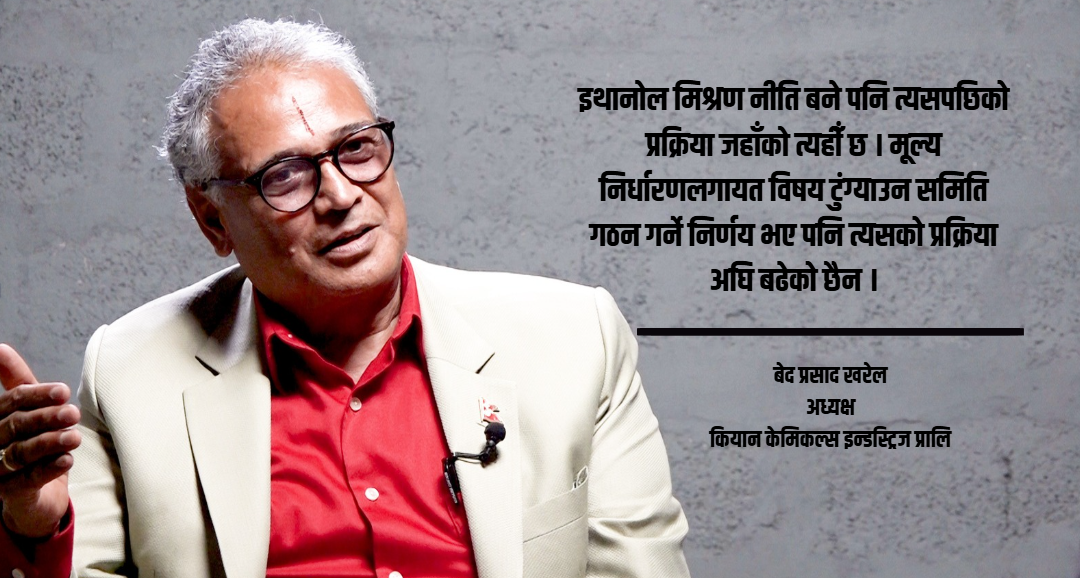
Bed Prasad Kharel, chairman of Kian Chemicals Industries Pvt Ltd, said that although the policy on ethanol blending has been published in the Nepal Gazette, the environment required for the establishment of ethanol industry has not been created yet.
According to him, the government is yet to formally call the investors to come to the sector, form a price determination mechanism and forward the process of purchasing the agreement through the Nepal Oil Corporation.
The policy is still there, but the process is still there. The government has not been able to create an environment for industrialists to set up industries,” Kharel said. According to him, although there is a provision to form a committee under the chairmanship of the secretary of the Ministry of Industry to finalize the price fixation and other issues, the process has not moved forward.
He said that although the Nepal Oil Corporation (NOC) was supposed to sign purchase agreement with industrialists after determining the price of ethanol, all those steps have been stopped now.
“Price determination, government decision and purchase agreement have not been carried out, so the process has not moved forward,” he said.
According to Kharel, although they have been holding discussions with the government time and again in the hope of creating an environment conducive for investment, the expected progress has not been made.
According to him, the investors including Kian Chemicals have applied to the Nepal Oil Corporation twice but the process has not moved forward.
10 percent ethanol blending will replace billions of imports
The government aims to blend 10 percent ethanol in petrol. Kharel said although it was difficult to reach 10 per cent at once, the production could be increased in a phased manner. According to him, India has also started with a low percentage in the beginning and is now moving towards high mixing.
According to him, around
Rs 16-17 billion worth of foreign currency could be avoided annually if 10 per cent ethanol blending is implemented in Nepal. “This is not only a matter of reducing the import of petrol, it will also contribute to the expansion of employment and industries,” he said.
According to Kharel, three to
five big ethanol industries may be needed to meet the target of 10 percent blending. According to him, an investment of around Rs 3 to 3.5 billion is required to establish an industry and Rs 10-15 billion can be brought in if five industries are operational. He said that 20,000-25,000 direct jobs could be created from such industries.
Claim that ethanol blending in petrol will cause problems in vehicles, he urged people not to believe in rumours. Kharel said that the notion that ethanol affects vehicles is wrong. According to him, petrol mixed with ethanol has been used in many countries of the world for a long time. In the US, gasoline blended with 10 per cent ethanol has been used for decades, and countries such as Brazil use a high percentage of ethanol, he said.
He said that there is no need for major changes in old or new vehicles as Nepal is currently talking about 10 percent blending.
He said that some technical adjustments will be needed only when a high percentage is mixed.
Kharel said that mixing ethanol with petrol will help reduce pollution as it has high oxygen content.According to him, ethanol blending will help reduce carbon emission and can also contribute to carbon reduction goals set by Nepal.
He said that although hydrogen energy is also important, it requires preparation of market, infrastructure and technology.
He said that ethanol can be produced immediately and blended with petrol, so it will have a quick impact on import substitution.
‘Hydrogen is a good technology, but its market needs to be ensured. Ethanol can be produced and used right now and it is a technology that has been tested all over the world,” Kharel said.
The industrialists have demanded that the government should make clear decisions, investment facilitation and purchase guarantee for the development of ethanol industry in Nepal.
They believe that ethanol can make a significant contribution to energy security as well as industry, employment and foreign exchange savings if the policy is accelerated ।



 प्रतिक्रिया दिनुहोस्