

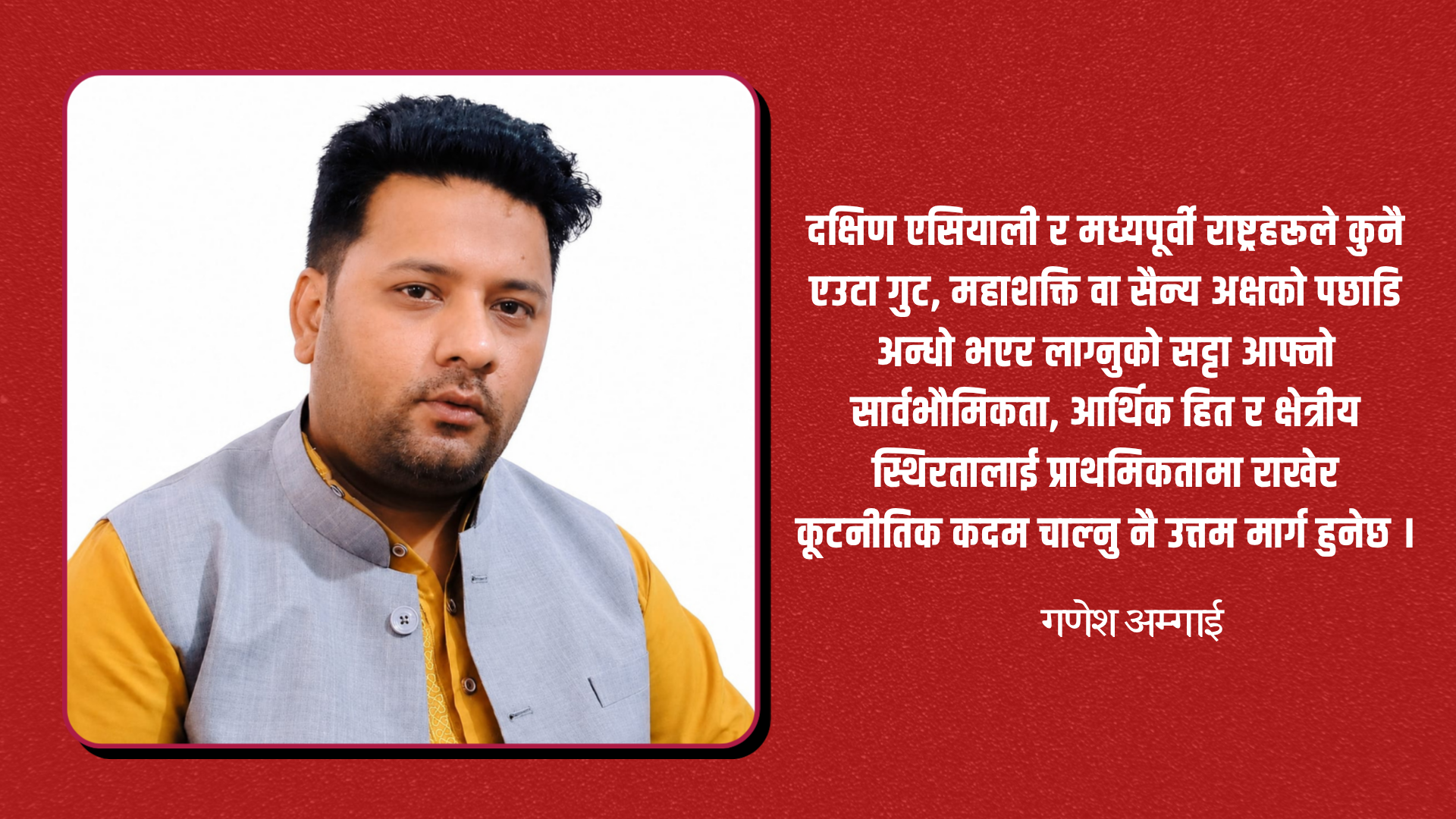
The best course of action would be for South Asian and Middle Eastern countries to take diplomatic steps, prioritizing their sovereignty, economic interests and regional stability, rather than blindly following any one faction, superpower or military axis.
The Makkah Agreement and the Geopolitical Waves
Ganesh Amgai
The recently concluded Joint Defense Agreement between Saudi Arabia, Turkey and Pakistan in the holy city of Mecca has created a big stir in world politics. An armed attack on one of the three countries by the other two is seen by many analysts as the rise of an “Islamic NATO” or new “Sunni axis”. The alliance appears to be a direct response to growing mistrust of the United States and regional insecurity that has been a key guarantor of the Gulf region’s security for decades. The landmark Mecca Accords offer a clear blueprint for a multipolar world order, signalling a complete overhaul of traditional security architecture.
Each partner in this trilateral alliance has its own unique and complementary strategic strengths.
Turkey contributes advanced military technology, world-renowned drone technology, and long military experience to the North Atlantic Treaty Organization (NATO). Saudi Arabia, on the other hand, brings to the table its immense economic power and power to control the global oil market. At the same time, Pakistan, which is facing an economic crisis, has presented itself with a vast, well-trained military force and status as the only Muslim nuclear power. On the surface, this agreement appears to be beneficial for all, but behind it lies a complex geopolitical interest and a new balance of power game.
This new change in world politics has strategically affected the diplomatic and military equation from the Middle East to South Asia.
On the one hand, it has challenged the growing military alliance between the US and Israel, and on the other hand, it has encouraged regional nations to stand on their own feet. The agreement is not only limited to military partnerships but also serves as an important foundation for future international diplomacy, energy security and regional dominance struggles. This has forced the world’s powers to rethink their traditional approach to the Middle East.
US failure and new alternative
Over the past few years, the Middle East region has been caught in a whirlwind of extreme military tensions, wars, and uncertainty. The devastating conflict between Israel and Gaza, airstrikes on diplomatic missions in Qatar, and a direct military confrontation between Iran and the United States-Israel have roiled the region.
Iran’s missile and drone strikes on oil facilities and US military bases in the Gulf have completely destroyed the country’s traditional security architecture.
This turbulent environment has forced the Gulf nations to be serious about their survival and security.
The United States, which had been the main security provider in the region for decades, proved to be a complete failure during this serious security crisis. Despite the U. S. military presence, it has not been able to provide its Arab allies with an effective air defense system when they needed it.
All U. S. attention, diplomatic power, and military resources were focused solely on Israel’s defense.
As a result, the Gulf states, including Saudi Arabia, realised that their blind dependence on Washington could be fatal and were forced to choose an alternative course of action.
The Mecca Accords are not designed to completely displace the United States from the region.
Rather, it is a cautious move to reduce strategic dependence on Washington and balance U. S. diplomatic pressure. The Gulf countries have now stopped handing over the keys to their security completely in the hands of external superpowers. They have forged new military ties with regional powers while maintaining relations with Western powers through multilateral diplomacy.
This development confirms that America’s monopoly in world politics is diminishing and the era of multipolarity has begun.
When a superpower is unable to meet the minimum security obligations of its allies, it is natural for new regional alliances to emerge. Saudi Arabia’s alliance with regional military powers such as Turkey and Pakistan has ended the US monopoly in the Middle East. Now, Washington has to think twice before imposing its policies in this area.
Long-term, it is important to see how the partners of the Mecca Agreement fill this void created by the U. S. failure. If the US continues with its Israel-centric policy, the Gulf nations will be more committed to this new alliance. This will raise questions about the legitimacy of US military bases in the Middle East. Ultimately, it will force the West to rethink its Middle East security policy and accept the region as sovereign partners.
Religious Diplomacy and Internal Interest
Although the new military alliance was announced with the slogan of religious brotherhood and Islamic solidarity, its internal contradictions are clearly visible. If this alliance is purely for the defense of Muslim nations, then the question naturally arises as to why Iran, which is currently facing direct military attacks from the US and Israel, was not included in it. This indicates that the alliance is motivated by the aim of ensuring the security of not the entire Islamic world, but especially of Sunni Muslim nations, and to curb the regional influence of Shiite Iran.
There are serious religious and internal political maneuvers behind this alliance.
The US has been stepping up diplomatic and economic pressure on Saudi Arabia and Pakistan to recognise Israel (extend the Abraham Accords). The rulers of Saudi Arabia and Pakistan have been using the Mecca agreement as a “safety net” and “religious shield” to protect themselves from the wrath of their citizens and religious groups. This allows them to placate radicals internally.
The deal provides a political clout to facilitate the smooth landing of U. S. plans to normalize relations with Israel externally. Behind the scenes, the rulers have strategized to continue to make pragmatic deals with Israel and the United States, demonstrating to the public that they are committed to Islamic security. In this sense, the Mecca Accords are not only a military strategy to defend against external aggression, but also a prudent political move to maintain internal power and manage public anger.
On the other hand, Turkey’s role has also become a matter of great interest.
Turkey’s joining the alliance despite being a member of NATO is seen as Erdogan’s ambition to become a leader of the Muslim world. Turkey sees the dual benefit of getting the Gulf’s immense capital for its advanced defense industry and restoring its lost historical influence in the Islamic world. As a result, internal economic and strategic interests are clearly embedded in the religious slogan.
Therefore, the stronger and more religiously united the coalition appears from the outside, the more strategic differences exist within. It risks exacerbating the Shia-Sunni divide, which could push the Middle East into more sectarian conflict in the long run. How fruitful this religious diplomacy will be in the face of internal selfishness and external pressure will depend on how partner countries manage their contradictions.
The new power equation in South Asia
The creation of the Mecca Security Agreement has created major ripples not only in the Middle East but also in South Asian geopolitics. The deal is a lifeline for Pakistan, which has been facing a prolonged economic crisis, political instability and international isolation. Pakistan has skillfully used this security crisis as a rare opportunity to regain its lost international influence and revive its economy.
Pakistan has reasserted its grip on the Middle East by promising nuclear security and massive military force to wealthy and militarily strong nations such as Saudi Arabia and Turkey.
In return, Pakistan has paved the way for massive financial aid from Saudi Arabia, concessional oil, and advanced military technology from Turkey. This strategic victory has once again established Pakistan as an important and unavoidable player in regional politics.
On the contrary, for India, this new situation has become very challenging and complicated. Saudi Arabia and other Gulf countries, considered traditional allies of India, are gradually entering Pakistan’s military sphere of influence. It has put pressure on India by adding a military-strategic dimension to India’s strengthened ties with Gulf nations in renewable energy, labor and trade. This new height of Pakistan has further increased India’s regional security concerns.
India’s close ties with Israel and the United States, contrary to the spirit of its historic non-aligned foreign policy, have led to a strategic alienation of its Arab allies.
As it lagging behind in regional diplomacy, India risks suffering major strategic, diplomatic and economic losses in the Middle East in the future. As Pakistan strengthens military ties with the Gulf nations, it will be challenging for India to ensure its economic interests in the region and the safety of the vast migrant workers.
Ultimately, the agreement adds a new dimension to the balance of power between South Asia’s two neighbours, India and Pakistan.
With Pakistan positioning itself as the security guarantor of the Muslim world, India needs a comprehensive review of its foreign policy. Middle East politics is no longer a distant topic for South Asian nations; It is directly affecting the security, diplomacy and economic future of the country.
Conclusions and Diplomatic Path
The Mecca Security Accord has brought a new and epoch-making turning point in the balance of power in the Middle East and in international diplomacy. The breaking of superstition in superpower America and the creation of their own security architecture by regional nations shows that world politics is rapidly moving towards multipolarity. But internal interests, deep Shiite-Sunni divides, and pressure from Western powers remain unanswered about how durable and effective the tripartite alliance will be.
In the coming days, it is imperative for the nations of the region to adopt a balanced and pragmatic foreign policy rather than an aggressive military alliance.
While military agreements and demonstrations of strength may provide a sense of security in the short-term, long-term peace is possible only through inclusive dialogue and mutual trust. Any security architecture that completely isolates neighbors like Iran will not bring lasting peace in the Middle East, but will only fuel a new arms race.
The best way forward is for South Asian and Middle Eastern countries to take diplomatic steps, prioritizing their sovereignty, economic interests, and regional stability, rather than blindly following a single bloc, superpower or military axis. Countries like India and Pakistan should not use the conflict in the Middle East as their bilateral confrontation. Small and developing countries too should protect their national interests through non-aligned diplomacy without bending to any one pole.
Finally, the Mecca Agreement is a strong symbol of the globally changing power equation. This has prompted the world’s small and medium powers to look for new options for their own security and development. The international order must be based on multilateral cooperation, diplomatic maturity and economic partnership rather than on military force and threats. Diplomatic dialogue, not military polarization, is the only sustainable option to maintain peace, stability and prosperity in a tense world politics.


 प्रतिक्रिया दिनुहोस्