

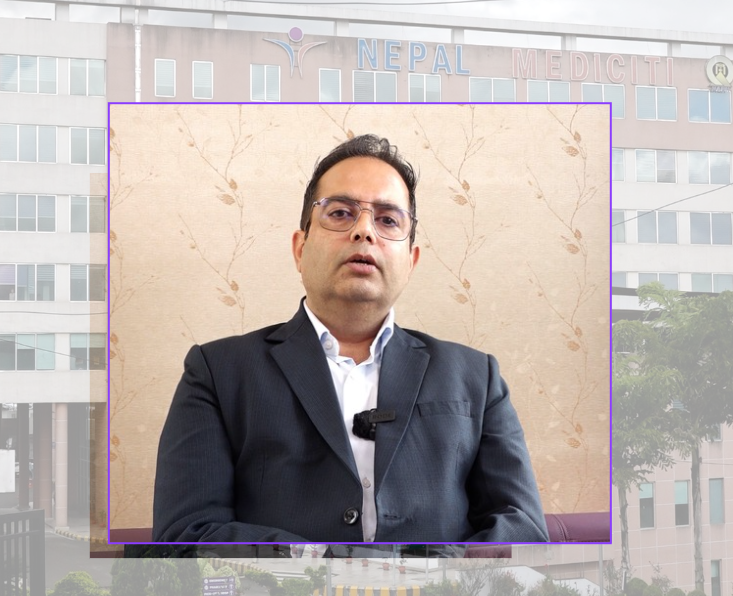
Collaboration among hospitals needed to make Nepal medical hub: Dr. Bhattarai Dr. Amit Tomar
Nepal Mediciti Hospital will soon bring robotic surgery service: Dr. Amit Tomar
Pramila Karki, Nepal News Bank
Kathmandu. Chief Executive Officer (CEO) of Nepal Mediciti Hospital, Dr. Dr. Amit Tomar, Vice-Chancellor of the Ministry of Health and Family Welfare, said that collaboration among hospitals is necessary to develop Nepal as a medical hub.
In a conversation with Nepal News Bank, Dr.
According to him, there was a huge potential in health sector as the health service expansion was fast in Nepal and new technology was coming in.
‘The pace of health service expansion in Nepal is increasing rapidly. New hospitals have opened in the last year and new technologies are being introduced into healthcare every day. So there is a huge potential here for healthcare management students in the coming times,” he said.
He said that special
attention should be paid to communication, patient safety and quality of health service to be successful in hospital management. He said that with the development of AI, the need for new management systems and technologies in the health sector is also increasing.
‘ is the true communication of success in management. Communication with partners, patients and external stakeholders is critical in healthcare,” he said.
Regarding the use of AI, he said that students and managers in the health sector should be technology-friendly.
‘With the advent of AI, this field has expanded significantly. What is working today may not work tomorrow. So they should be updated about AI and learn how to run an AI system. Ultimately, that’s the future,” he said.
Stressing that every decision of the hospital should be patient-centric, he said that the patient’s experience and treatment outcomes should be prioritized. Stating that the system and process play an important role in the operation of the hospital, he said that the people at the management level should understand it well.
He said that effective decisions can be made when more and more people are involved in the decision-making process.
He said that Nepal
Medicity has prioritized patient safety and quality of health service. According to him, the hospital has a separate quality and patient safety department and regular audit of various systems and processes is being carried out.
‘We are conducting regular training and regular audits. We are the first hospital in the country to have a separate quality and patient safety department. It audits the various processes and systems in the organization and evaluates whether people are following the systems and procedures,” he said.
He said that special attention has been paid to infection control, safe surgery and drug safety for patient safety.
According to him, safe surgical checklist is being used to minimize human error during surgery.
He said that there are some challenges in bringing health technology to Nepal.
According to him, it will take time to bring some of the technologies that are easily available in neighbouring countries including India to Nepal and the cost will increase as most of the equipment has to be imported.
He said the hospital has been providing financial support to the economically weaker patients and has been conducting free health camps in the rural areas.
He said, “We take care of the patient if he or she is unable to afford it.
We are conducting health check-up camps in many rural areas. They are free. “We are providing health counseling to Nepalis living abroad through the telemedicine service
,” he said.
“We are one of the first hospitals in Nepal to introduce telemedicine technology. “We have been providing telemedicine consultations to Nepalis living abroad, especially those who want second opinion,” he said.
He also informed that Nepal Medicity is preparing to start robotic surgery service.
‘We are in the process of bringing in robots. That will start soon and you will soon see robotic surgery services in Nepal Medicity,” he said.
He stressed on the need to use skilled human resources along with technology to make Nepal a medical hub.
He believes that Nepal can make a big stride if an environment conducive is created for Nepali doctors and nurses living abroad to provide service by bringing them back home.
“If we can bring in new technology and bring our people back from abroad to provide health services in Nepal, then no one can stop Nepal from becoming a big medical hub,” he said.
Stating that the efforts of a single hospital would not be enough to make Nepal a medical hub, he urged all hospital managers and CEOs for cooperation.
000000000
Cooperation Among Hospitals Essential to Make Nepal a Medical Hub: Dr. Amit Tomar
Nepal Mediciti Hospital to Launch Robotic Surgery Services Soon
Kathmandu: Chief Executive Officer (CEO) of Nepal Mediciti Hospital, Dr. Amit Tomar, has said that collaboration among hospitals, adoption of advanced technology and development of skilled human resources are essential to establish Nepal as a regional medical hub.
Speaking to Nepal News Bank, Dr. Tomar said Nepal’s healthcare sector is expanding rapidly, creating significant opportunities for healthcare management professionals.
“Healthcare services are expanding rapidly in Nepal. New hospitals are being established and new technologies are being introduced every day. Therefore, there is a huge opportunity for healthcare management students in the coming days,” he said.
He said healthcare managers need strong skills in communication, leadership, team building, task prioritization, strategic planning, financial and resource management, risk management, patient safety, quality improvement and data-driven decision-making. They must also be capable of managing multidisciplinary teams, resolving conflicts, engaging stakeholders and continuously improving hospital processes.
“Communication is the key to success in management. Communication with healthcare partners, patients and external stakeholders is extremely important,” he said.
Dr. Tomar said the rapid development of artificial intelligence (AI), digital health, automation and data analytics is transforming healthcare management. Professionals therefore need to remain technology-oriented, digitally literate and adaptable to changing systems.
“With the arrival of AI, this field has become much broader. What works today may not work tomorrow. Therefore, they need to stay updated about AI and learn how to operate AI systems. Ultimately, that is the future,” he said.
However, he emphasized that technology must always support the human side of healthcare. Patient safety, quality of care, patient experience and treatment outcomes must remain at the centre of every hospital decision.
Quality and Patient Safety
Dr. Tomar said Nepal Mediciti has made quality and patient safety a core priority, supported by a dedicated Quality and Patient Safety Department that regularly audits systems and processes.
“We conduct regular training and regular audits. We are the first hospital in Nepal to achieve international accreditation for quality and patient safety,” he said.
He said effective hospital management depends on strong systems, clearly defined processes and the involvement of relevant stakeholders in decision-making.
Challenges Facing Nepal’s Healthcare Sector
Dr. Tomar said Nepal still faces several challenges in modernising healthcare. Compared with neighbouring countries such as India, advanced medical technologies can take longer to reach Nepal due to regulatory, logistical and infrastructure-related challenges. Since much of the medical technology and equipment is imported, costs are also higher.
He identified skilled manpower migration as another major challenge. The migration of trained doctors, nurses, technicians and other healthcare professionals makes it difficult to retain specialised expertise and build strong healthcare teams.
He also pointed to limited health insurance coverage and utilisation, which contributes to high out-of-pocket expenditure and can restrict patients’ access to timely and specialised care.
Expanding Digital Healthcare and Robotic Surgery
Dr. Tomar said Nepal Mediciti is using technology to expand access to healthcare for Nepalis both within the country and abroad through telemedicine.
“We are among the first hospitals in Nepal to introduce telemedicine technology,” he said.
He also announced that Nepal Mediciti is preparing to launch robotic surgery services shortly.
“We are in the process of bringing in a surgical robot. It will start soon, and you will soon see robotic surgery services at Nepal Mediciti,” he said.
He said advanced technologies such as robotic surgery can further strengthen Nepal’s ability to provide sophisticated treatment within the country.
Bringing Talent Back and Working Together
Dr. Tomar stressed that technology alone cannot make Nepal a medical hub. The country must also create opportunities for Nepali doctors, nurses, technicians and other healthcare professionals working abroad to return and contribute to the domestic healthcare system.
“If we can bring in new technologies and bring our people back from abroad to provide healthcare services in Nepal, I believe no one can stop Nepal from becoming a major medical hub,” he said, adding that Nepali medical professionals are recognised internationally for their dedication and compassionate patient care.
He also emphasized that no single hospital can achieve this vision alone.
“Cooperation among hospitals is essential. We need to work together, share knowledge and build a stronger healthcare ecosystem,” he said.
According to Dr. Tomar, Nepal must first build the capacity to retain its own patients by providing international-standard healthcare, advanced technology, quality and patient safety, and compassionate care.
“Once we are able to retain our own patients and build confidence in our healthcare system, we can gradually attract patients from other countries as well,” he said.
He said a combination of skilled human resources, advanced technology, quality and patient safety, strong hospital collaboration and Nepal’s tradition of compassionate care can position Nepal as an emerging medical hub in the region.



 प्रतिक्रिया दिनुहोस्