

MP Khagendra Sunar’s series of controversial statements: Decreasing decorum of the post
Akanksha Dhami, Nepal News Bank
Kathmandu. Every question raised by a person in public office has its own importance. In particular, when lawmakers question state agencies, it has both public interest and institutional implications. Therefore, it is imperative to have evidence, facts and responsibility for making serious allegations.
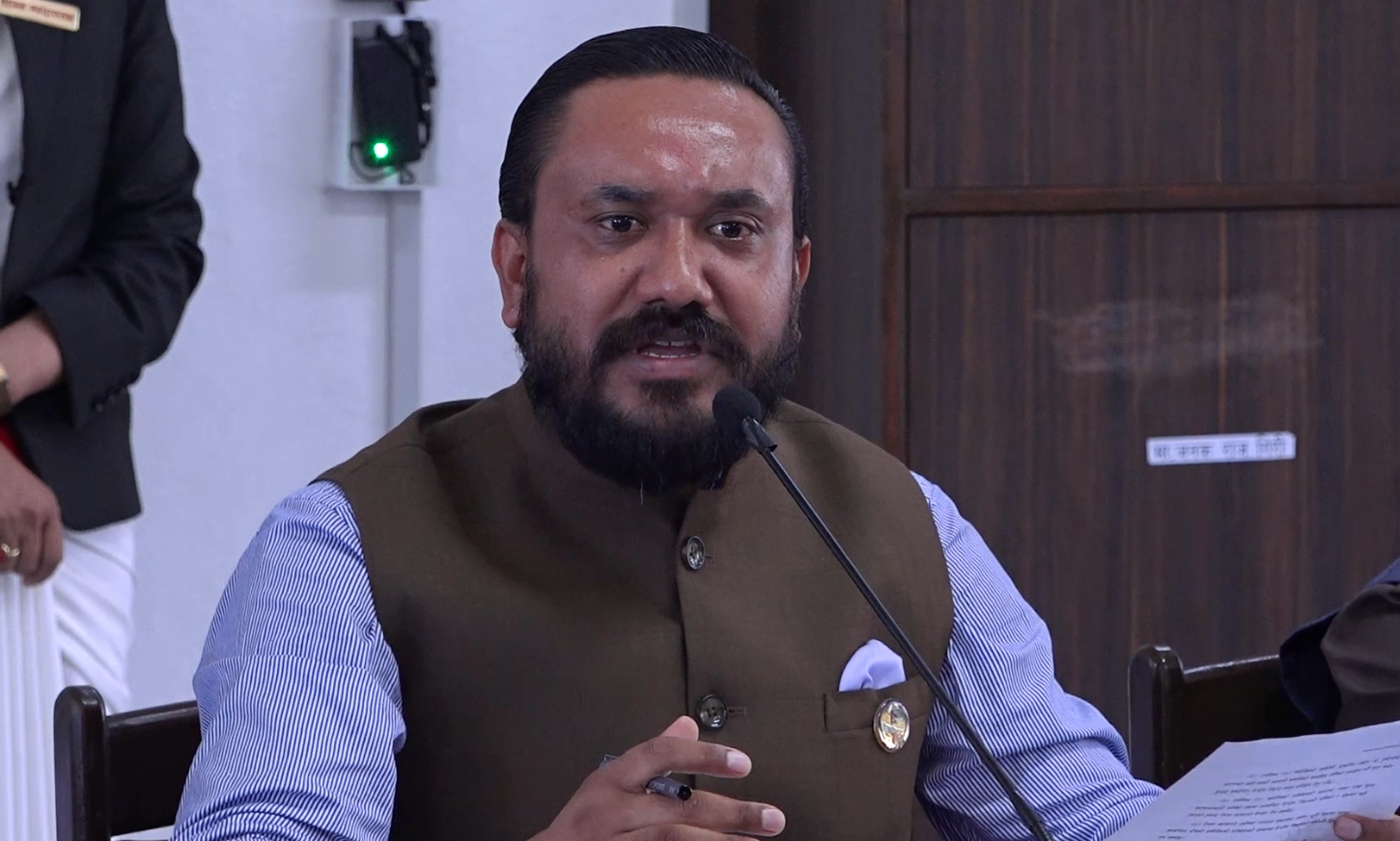
However, the recent public statement of Rastriya Swatantra Party (Rastriya Swatantra Party) lawmaker Khagendra Sunar has raised a serious question: Is it the responsible role of the lawmaker to make serious allegations without evidence? In the meeting of the Public Accounts Committee (PAC) on Wednesday, Sunar also questioned Inspector General of Police Dan Bahadur Karki, claiming that there was financial irregularities in the purchase of Nepal Police equipment.
Expressing his intention to indulge in corruption in the purchase of shoes, socks, uniforms and sticks of the police, he demanded an impartial investigation into the case.
It is not only the right but also the responsibility of the lawmakers to raise questions about corruption and irregularities. But making an allegation and proving an allegation are different things. When a serious allegation of financial irregularities is made against a public institution, documents, facts or evidence are required to support it. Such statements, without evidence, can affect the reputation of the institutions and individuals concerned, rather than strengthening the campaign against corruption.
During the meeting, IGP Karki clarified that there was no financial irregularities or corruption in the procurement process.
Stating that the expression presented in the meetings and discussions of public bodies should be decent, he warned that baseless accusations being made from a responsible place could affect the morale of the employees.
This is not the first time that Sunar’s public statements have been controversial.
In the past, he was in controversy after a video of him making a statement in Nepal that he should be allowed to eat beef. Sunar then claimed that the video was misinterpreted and clarified that he was a vegetarian and respected the national animal.
Likewise, Sunar’s public image has been linked to Sunar’s public image, such as his statement of ‘slapping a teacher’, his outrageous remarks targeting judges and the court after the court’s verdict on the Soti incident, and the accusation of using derogatory language against women advocates.
An arrest warrant was issued against him.
Likewise, a video of Shree Krishna BK, 22, of Sunkoshi Rural Municipality-3, Jumledanda in Sindhuli district was seen making threatening statements like ‘dragged away’ targeting the police chief while he was staging a sit-in at the gate of the District Administration Office demanding justice.
Such statements seem to raise questions about the dignity, language style and responsibilities of the people’s representatives.
Being aggressive in politics and raising voice in favor of the people is not in itself negative. But the line between aggression and irresponsible expression is very thin. People’s representatives can put forth their dissent strongly, but they need to be based on facts and logic.
The tendency to make allegations without evidence and not take responsibility for them can raise questions about the dignity of the parliament and the credibility of the parliamentarians themselves. Every word spoken by a person holding public office has a different effect than that of an ordinary citizen. Therefore, it is necessary to develop a political culture of raising questions on the basis of facts, evidence and investigation rather than making the parliament forum a place of accusations and counter-accusations.
If Sunar has claimed that there was irregularity in the purchase of police, then the grounds to prove it should be made public. The greater the gravity of the allegation, the greater the need for evidence.
Another controversy over the style of Sunar’s expression was also seen during the inaugural ceremony of the general convention of the RSP.A controversy erupted over his use of words like ‘corrupt’ and ‘terrorist’ targeting the representatives of other political parties who were invited to the inaugural ceremony of the general convention in Chitwan.
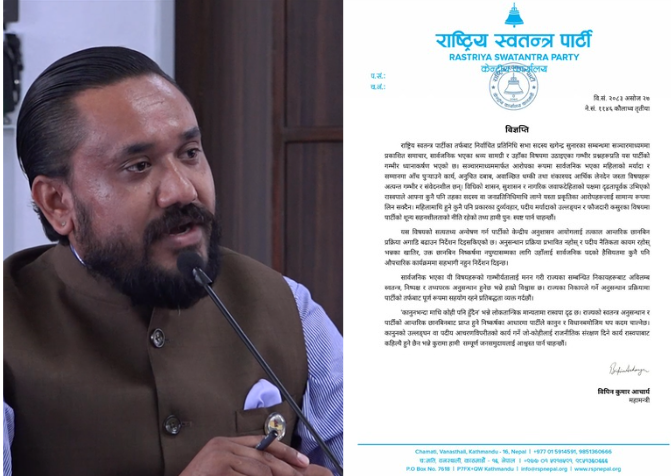
There was dissatisfaction within the RSP over such a comment made on the guest invited by his own party. Party leader Manish Jha said that the guests invited by the party should be treated with respect. He said it was wrong to make non-political comments to his guests.
Zenji activist Raksha Bam also commented on this issue on social media, saying that Sunar’s statement reflected “intoxication of power” and arrogance.
He argued that although there may be different ideologies, principles and political opinions, respect to guests is a fundamental part of democratic culture.
Everyone has the right to disagree. But disagreement and insult are not the same thing. Treating people with different views with respect, especially in democratic practice, is considered an important aspect of political culture.
The job of the parliamentarian is to raise questions, but making serious allegations against any person or institution without evidence in the name of raising questions cannot be considered a responsible political practice. If there is corruption, there should be a demand for investigation, there should be an initiative to gather evidence, and if found guilty, the way should be opened for legal action. But the tendency to conclude allegations before they are investigated can itself undermine the credibility of the anti-corruption campaign.
If there are facts and evidence on the issues raised by Khagendra Sunar, they should come into the public debate and there should be necessary investigation.
However, it is not appropriate to present the allegation as true until there is evidence.
The power of a public representative should not be seen in the loudness of his voice, but on the strength of the facts, evidences and arguments he presents.
Therefore, lawmakers holding public office need to be more sensitive to their words and expressions. Maintaining this basic decorum is the first test of a responsible parliamentarian.
Sunar’s past
Sunar, a member of the House of Representatives, seems to be from a controversial background.He was an accused in a case of breaching public peace at the District Police Office, Surkhet on Asar 13, 2080. He was released on bail of Rs 20,000 on June 24 as per the order of the District Administration Office, Surkhet.
Similarly, on June 23, 2
081, he was accused of misbehaving with doctors and health workers at Mehelkuna Hospital, Gurvakot Municipality-8, Surkhet, vandalizing health institutions and manhandling health workers. The case is sub judice.
Likewise, advocate Manisha Gautam had filed a case at the Kavrepalanchok District Court on July 17, 2002 for using derogatory and objectionable language against her through social networking sites and issued an arrest warrant for the same. A single bench of Kavrepalanchowk District Court Judge Nagendra Kumar Kalakheti had ordered his release on a bail of Rs 50,000.
Looking at the past events, the goldsmith does not seem to be pure. He has been involved in various cases and has been embroiled in controversy for speaking ‘without evidence’.

 प्रतिक्रिया दिनुहोस्