

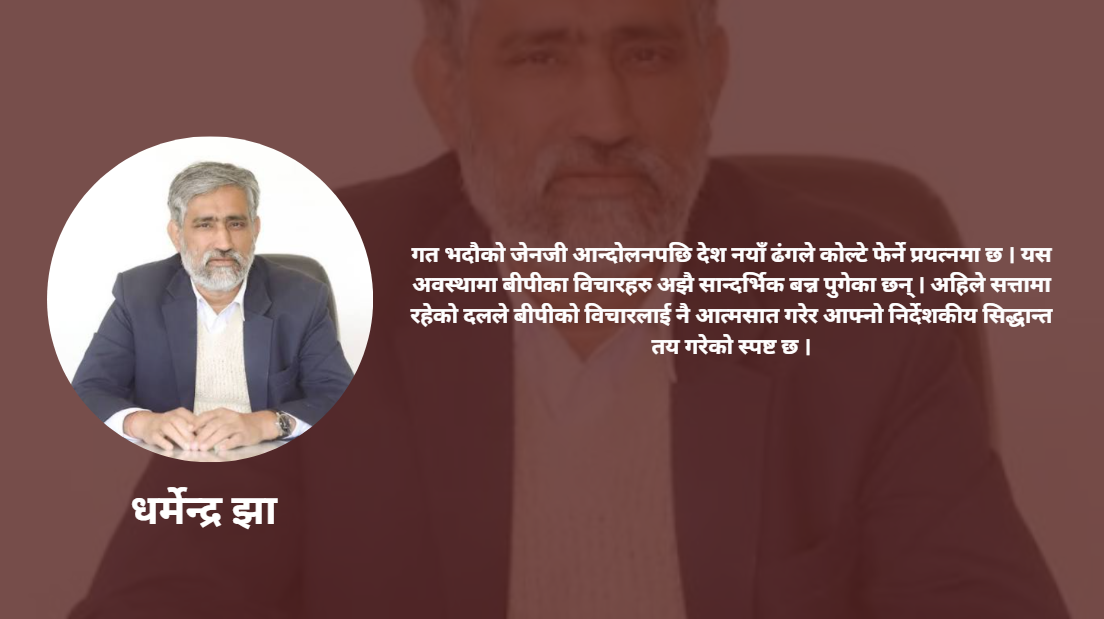
Dharmendra Jha
BP Memorial Day Special
BP’s Dream: Inclusive Democracy, Inclusive Nepal
Dharmendra Jha
There can be no disagreement, the founding leader of Nepali Congress, Mahamanav BP Koirala was and will remain the towering figure not only of the Nepali Congress but also of the entire democratic movement. He was not a status quoist leader of status quoist politics, but an epoch-making personality who reformed himself according to the country, time, circumstances and international context. BP was a statesman who could give an ideological leadership to the Socialist International and could speed up the existing politics on the basis of ideology and philosophy and take it to a logical conclusion by twisting it as per the time. He was so influential in contemporary world politics that it was a matter of concern for the international community to know what BP’s views would be on a particular subject. BP was known as an international politician with extraordinary ability and tact. Certainly, it is a matter of pride for Nepal and Nepalis. Today is the 44th memorial day of that great man. Through this article, an attempt has been made to discuss some things about him.
It would not be an exaggeration to say that BP Koirala has proved to be an epoch-seeing personality in Nepal’s politics.
He not only dreamed of a prosperous and prosperous country but also prepared a plan with a vision to implement it. His nearly 18-month premiership is considered to be a golden period for democratic practice. It is not unusual to say that this period was not only a starting point in the direction of modernization and development of the country, but it was also the beginning of a clear vision and far-sighted politics. Under the leadership of BP, a prominent leader of the world socialist movement, the fundamentalization of socialism in Nepal was conceived and a future line was drawn for the country. It would not be inappropriate to say that the blueprint of Nepal’s development today is based on BP’s thinking.
Today, there is a lot of talk about ‘inclusion’ in the country. Today, a situation has been created that the Prime Minister of the country will be from the Madhesi community, i. e. the inclusion group. It is a different matter that the Nepali Congress itself could not get BP’s party to become the Prime Minister from the inclusive group, but it would not be wrong to say that the concept of inclusion has gained meaningful meaning in the country because of BP. He had made a timeless effort to connect the Nepali society and geography on the basis of people-centered politics. In order to give a new meaning to politics, he has started the concept of implementing the concept of bringing the excluded castes, communities and geography into the mainstream of the state. Today, those who do politics in the name of inclusion need to understand that BP had not only propounded the principle of inclusion but also implemented it and tried to guide the process of nation building in the right direction. It would not be absurd to say that BP laid the foundation for the inclusion in 2015 BS. If you look at the various appointments made in his cabinet and during his prime ministership, all the geographies, castes, classes and communities of the country are represented. BP tried to use the concept of inclusion as a tool in the way of establishing social justice. In the days that followed, the implementation of this concept could not be continued. To such an extent that even his own party did not give importance to his concept, the Nepali Congress became very far away from the campaign of socialization. Although it appeared to have happened, those close to the leader could not be absolved of the allegations. As a result, the situation of becoming the executive head of the country for a long time could not be created on the basis of the concept of inclusion, for which we had to wait a long time.
On the basis of BP’s analysis of thought, it can be said that his basic human value was the principle of equality. He was convinced that this situation could be achieved through democratic system and socialism. There is no doubt that this determination of BP is the guiding principle of today’s Nepali politics. Many of the policies adopted by the Nepali Congress at that time were the reflections of the party’s womb theory, i. e., socialist philosophy. Due to the political perspective and changing world politics, there is always a need for national unity for nation building. He was clear that the concept of inclusiveness could be an important mechanism towards building and promoting this national unity. He believed that the collective campaign would create an institutional base for emotional unity of the Nepali people. There is no doubt that the inclusive and pluralistic concept is such a mechanism for developing a collective spirit.
If the socialist economic policy, strategy and action plan adopted by the BP government is analysed in a reflective way, it seems that BP wants to accelerate the development of the country on the basis of collective and inclusive policy.
Not only this, it is clear that the blueprint of development drawn by him is also inclusive. He also stressed on the construction of Postal Road in Madhes and North-South Road in the hilly mountains. The meaning of this was clear: opportunities must be created for more people to connect with each other. Nepal’s geographies should be connected in an easy way. Minorities should also be the jewels of the country and they should also have the opportunity to shine.
Today the question may arise, is BP’s policy relevant in today’s situation? Yes, the policies of BP and Nepali Congress, who are considered to be the pioneers of liberal politics in Nepal, are relevant even today. Is there any justification for the policy adopted by BP at a time when fundamentalism is occupying a place in the world including Nepal? Yes, it is. The country has gone to federalism today. There is a stage of preparation of a debate paper regarding the amendment of the new constitution. The political situation is different from yesterday. New characters and ideas have emerged in politics. The geopolitical situation is sensitive. In such a situation, perhaps Nepal’s politics and overall situation is more complicated than yesterday. In such a situation, there can be no doubt that the relevance of the path shown by him has increased. If we analyse the development process of any country, one thing can be equally present, that development is not possible unless the people of that country take ownership of the process and the ownership of the development process cannot happen until everyone feels that they are participating in the process. BP understood that this spirit could only be developed through the implementation of the concept of inclusion. Unfortunately, he did not get long to implement the programs, plans and policies he had started. Had he been able to work according to his vision for a few years, Nepal would have been able to catch up with the pace of development like the rest of the developed countries of the world.
In the end, Nepalese politics became a victim of conspiracy and the country could not find the right path for a long time. In the meantime, Nepal faced one-party autocracy, armed conflict and political instability. Now there is democracy in the country. It’s a new environment. There is a new leadership. After the Genji movement last August, the country is trying to change things in a new way. In this case, BP’s ideas have become even more relevant. It is clear that the party in power has adopted BP’s ideology and formulated its directive principles. Let us hope that if an environment can be created to speed up the development of the country by honestly following BP’s timeless ideas, this will be a true tribute to BP.
(The writer is a former president of Rastriya Samachar Samiti and Federation of Nepali Journalists)

 प्रतिक्रिया दिनुहोस्