

Nepal’s education should have been about identifying the soil and awakening the heart, but it did not happen: Dr. Bhattarai Chintamani Yogi
Prosperous Nepal is not possible without cultured and nation-oriented education: Dr. Bhattarai Chintamani Yogi
Kathmandu Cultural scholar, spiritual thinker, and educationist, Dr. KATHMANDU — Chintamani Yogi has said that although the present education system of Nepal is producing skilled human resources, it has not been able to produce patriotic, cultured and self-reliant citizens.
In an exclusive interview with Nepal News Bank, he stressed the need to link education system with culture, spirituality, morality and national identity.
Dr. Yogi said that although education is producing “doctors, engineers and management experts”, it has not motivated them to contribute to the country.
According to him, Nepal’
s education system is making the youth foreign-oriented and this has increased the risk of making the country a manpower company. He was of the view that education should not only be a means to get employment but also a means to develop personality, morality and national consciousness. “Our education should have been about identifying the soil and awakening the heart, but that did not happen,” he said.
Dr. Yogi said that basic sectors like education and health should not be a business subject. The State should ensure accessible and quality education to all citizens, he said. Rather than the debate between private and public schools, it was important to create environment in which people of all classes, castes and communities can get education in easy and easy manner, he said.
He complained that the current curriculum has not given enough space to history, culture, agriculture, medicinal herbs, yoga, spirituality and local knowledge system.
According to him, although each district of Nepal is rich in its own history, traditions, agricultural production and entrepreneurship, education has not been able to connect students with these subjects.
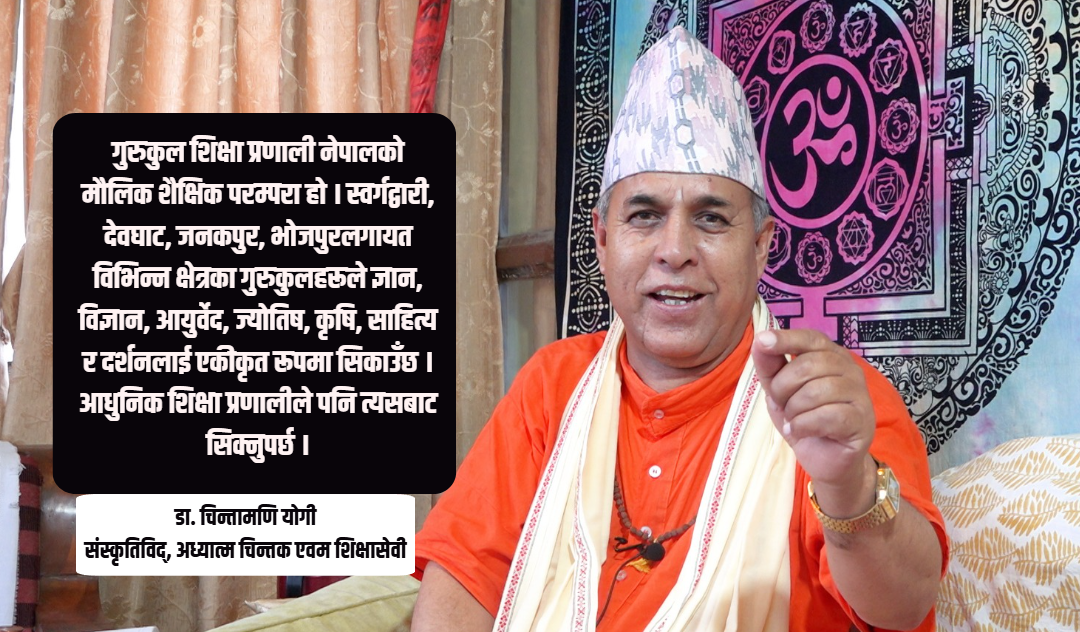
During the conversation, he reminded that the Gurukul education system is the fundamental educational tradition of Nepal.
Stating that the Gurukuls of Swargadwari, Devghat, Janakpur, Bhojpur among other areas have been teaching knowledge, science, Ayurveda, astrology, agriculture, literature and philosophy in an integrated manner, he said the modern education system should also learn from this.
Dr. Acknowledging the importance of modern education and technology, Yogi made it clear that they should not be completely rejected. He also stressed the need of including Nepal’s Vedic knowledge, yoga, culture and traditional science in the education system along with modernity. “We need modernity as well as knowledge of antiquity,” he said.
According to him, there is a huge possibility of promoting Nepal’s cultural heritage, yoga, meditation and spirituality at the global level.
Nepal could create a new identity by linking Lumbini, Gorakhnath tradition, Ashtavakra philosophy, Vedic knowledge and natural heritages with tourism and cultural diplomacy, he added.
. According to him, Nepalis living abroad and foreign nationals are attracted to Nepal because of its culture, nature and philosophy of life. According to him, Nepali citizens have not been able to understand the values and specialties of their own country, but foreigners return home with deep inspiration.
Stating that culture-based, consciousness-based, spirituality and nation-based education was the foundation for prosperous Nepal, he expressed the belief that the future of the country could be bright if a balance was maintained between the Gurukul tradition and modern education.
Nepal’s Arogya Darshan can be a guide for the world
Dr. He said Nepal’s nature, culture, family lifestyle and spiritual consciousness have unique ability to show the path of wellness to the world. He was of the view that Nepal should be developed not only as a tourism destination, but also as a centre of health, peace and philosophy of life.
Dr. Expressing concern over the increasing mental stress and lifestyle problems in the developed countries, Yogi said that Nepal’s environment can naturally provide peace and balance to people.
He said that a 16-year-old girl of Nepali origin who grew up in the United States of America had shared her experience of being completely relieved of her mental stress after staying in Dang for a few weeks.
“Nepal’s nature, its family culture, its lifestyle in the villages, the environment of the hills and the mountains give inner peace to a person,” he said. According to him, foreigners come to Nepal and are impressed by the culture and human behavior here.
He pointed out the possibility of making Nepal a global hub of ‘health tourism’.
He said that there is no need for expensive infrastructure, artificial programs or business packages. He said that foreign tourists can experience real health only if they can be connected with Nepal’s village, hills, mountains, Terai, culture and daily life.
Dr. Yogi said that health should not be seen only in terms of medicine or treatment. According to him, the Oriental philosophy gives importance to the lifestyle to prevent the disease rather than treating it after the disease. “The West focuses on the treatment of diseases while the East focuses on the prevention of diseases through a healthy lifestyle,” he said.
Stating that holistic lifestyle is the basis of health, he said that although Tulsi, herbs, yoga, pranayama and naturopathy methods are important, love, positivity and life should be at the center of it.
“The life of life is greater than pranayama, the life of love is greater than the asana,” he said.
Discussing the global impact of yoga and meditation, Dr. Yogi said the world needs rest and mental peace rather than complex yoga practices. Describing ‘Savasana’ as a symbol of complete relaxation, mental emptiness and inner balance, he said that the leaders and policy makers of the modern world also need to understand its essence.
According to him, health is not only physical health but also a state of mental, intellectual, emotional and spiritual balance.
He said that this holistic approach can give Nepal a different identity in the world.
Dr. Recalling the Vedic concept of ‘Arogyam Dharma Sadhanam, Arogyam Karma Sadhanam, Arogyam Rashtra Sevanam’, the yogi suggested making health the basis of education, family, tourism and national development policy ।



 प्रतिक्रिया दिनुहोस्