

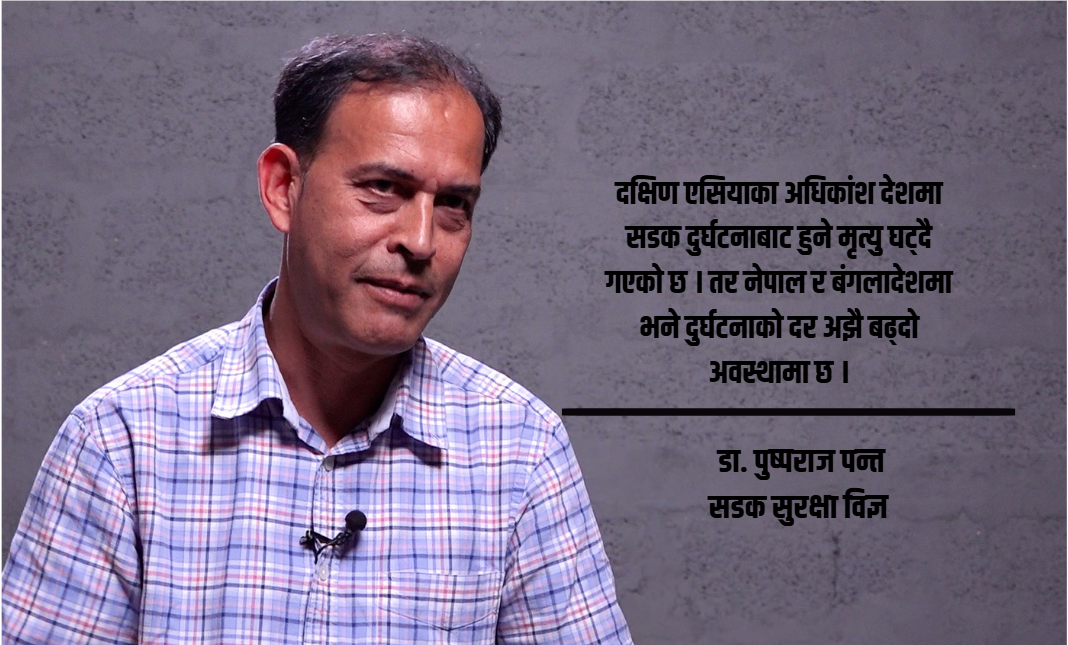
Dr. Pushpa Raj Pant
Road Safety Expert
It is a traditional trend in Nepal to blame only the drivers when road accidents occur: Dr. Pushpa Raj Pushpa Raj Panta
Road Safety Council should be formed immediately and work should be done to reduce road accidents: Dr. Pushpa Raj Pant
Traffic fines are necessary but high fees are not the solution without preparing the preparations: Dr. Pushparaj Pant
Kathmandu. Road safety researcher Dr. Giriraj Singh said that the actual situation of road accidents in Nepal is more serious than the government statistics. KATHMANDU: Pushpa Raj Panta has underscored the need for extensive reforms in policy, structural and data management regarding road safety.
Pant said that the weak data system to reflect the real situation of road accidents in Nepal has also affected the policies and programs made on the basis of it.
In a conversation with Nepal News Bank, he said that evaluating the status of road safety will not only reduce the number of accidents, deaths and injuries but also the work done by the responsible bodies to reduce them.
According to him, although the activism of the policy makers and implementing agencies has increased in recent times, there is a problem in the basic data.
“The main thing right now is to find out the cause of death and accident,” he said.
The nature of the injuries also shows the state of road safety. For this, it should also be determined what the concerned agencies are doing. However, the activism of policy makers and implementing agencies has increased. He claimed that the official statistics of road accidents in Nepal do not reflect the real situation. According to him, the government records an average of seven people die in road accidents every day, according to the modelling of the World Health Organization (WHO), 23 people lose their lives in road accidents every day. According to him, around 8,500 people die annually in Nepal.
Giving the example of Lumbini Province, he said, “The government has been saying that seven people die every day.
According to the World Health Organization, 23 people die in Nepal every day. On an average, 8,500 people lose their lives in Nepal annually. For example, in Lumbini province, 585 people died and 1,800 were seriously injured. Now, the number of those 1800 seriously injured is not counted. Dr Pant said that the national transport policy was formulated on the basis of weak data. “If the figure of seven deaths per day is taken into account, then the programs will be limited accordingly,” he said.
The traditional tendency to blame only the driver
He also questioned the traditional thinking about the cause of accidents. “There is a misconception that 90 per cent road accidents occur in Nepal due to driver’s negligence while only 1 per cent are due to road infrastructures,” he said.
‘Our practice is to blame the drivers. It is estimated that 90 percent of the accidents occur due to the negligence of the drivers and 1 percent due to the poor condition of the road infrastructure. After all, the foundation is the road. Whether you drive a new car, motorcycle or bus, the road determines everything,” he said.
He said that safe road infrastructure is the foundation of a safe transportation system.
‘If the road is good, all types of vehicles, new or old, can be operated safely. Therefore, road infrastructure should be prioritized,” he said.
Independent Road Safety Council needs
Dr. He also said that there is no clear division between the road construction bodies and the bodies regulating road safety in Nepal. According to him, although the Ministry of Physical Infrastructure is fulfilling the responsibility of road construction, an organization like the Independent Road Safety Council has not yet been established in Nepal.
‘The main job of the Ministry of Physical Infrastructure is to construct roads or bridges. Road safety is a way of thinking about the safety of people, drivers, or people on the road. The purpose of road construction and security is different. There is no such body like Road Safety Council in Nepal,” he said.
Recalling that there has been a long demand for the formation of a Road Safety Council, he said such council has been envisaged in the recently passed National Transport Policy.
He expressed the belief that the road safety management would be more effective if the bill could be implemented soon.
He said that the bodies regulating road construction and road safety would be different in developed countries and there would be separate mechanisms for formulation, implementation and monitoring of safety standards. According to him, there is a lack of long-term plan for road safety at the local level.
Giving the example of no plan to repair or replace the convex mirrors installed in the rotating area, he said road safety management should be developed as a regular and continuous process.
Panta, an expert on road safety, said that the research reports prepared after road accidents in Nepal are mostly limited to general suggestions.
He said that although the report on the Simlat bus accident that took place a year ago included around one hundred suggestions, most of them were ‘generic’ enough to be applicable everywhere. According to him, the investigation of any accident should focus on identifying the real cause of the location and resolving it accordingly.
‘If an accident is happening only at night in a foreign country, the reason for it is separately studied. If there are more accidents in some places during the festivals, then the solution is sought by targeting the same reason,” he said. He compared it to the process of treating a patient only after an MRI is done by a doctor to find the real cause of the disease.
Dr. Panta said that although strict fines are necessary for road safety, necessary infrastructures, clear rules and public awareness should be made before that.
He expressed the view that it would not be justified to increase the fine without creating a system to inform the citizens about the road rules, the necessary infrastructure to follow the rules and create awareness.
‘You have to teach for a year and take the exam. If the exam is taken on the same day of admission, the student fails. That’s our situation now,” he said.
He said that strict action should be taken if anyone violates the rules even after providing all the infrastructure and facilities. But he said that the basic system is not complete in Nepal at present.
Dr. Pant said that the implementation of lane discipline in Nepal has not been effective due to lack of infrastructure.
According to him, many roads do not have white lane markings, arrows and clear lane signs.
‘How can we be fined for violating the lane without knowing where the lane is?’ he asked.
He said that in developed countries, it is customary to clearly indicate lanes, destinations and directions on roads and to impose fines only for violations.
Dr. According to Panta, it is the responsibility of the state to provide the necessary instructions, signs and infrastructure to the drivers to drive the vehicle safely.
‘Nepal is also a country where tourists come in. Drivers coming from India, China and other countries do not know about the local roads. So, there should be clear directions and signs on the road,” he said.
Giving the example of parking management, he said that the citizens are confused as there is no provision for parking where to park.
According to him, it is not enough to make road safety effective, it is not enough to make the rules effective, it requires quality infrastructure, clear signage system, scientific research and effective implementation.”Road safety is not only the responsibility of drivers, but the entire road safety system should be improved by ending the tendency of blaming drivers only for reducing road accidents in Nepal,” he said.
During the conversation, he also said that there is a need to make it easier for passengers to complain against drivers who drive unsafely.
‘I’ll get on the bus myself. The driver is found to be driving recklessly. But there is no effective system of where and how to report it,” he said.
He said that not only the passengers but also the drivers should be given the right to enforce the rules.
According to him, there should be a legal and policy basis for the driver to say that he will stop only at the designated stop if the passenger is pressured to stop at a specified stop.
Dr. Pant said that the current transport policy lacks such concepts.
“The policy seems to think that all problems can be solved only if the driver drives well, but in today’s society, that is not enough,” he said.
According to him, Nepal lacks an integrated road safety system despite having several laws and policy documents related to road safety. According to him, although there are separate legal provisions regarding road construction, maintenance, driving license and rescue after accidents, an integrated road safety system has not yet been put in place.
Dr. Panta said that the information received from the citizens should be used effectively in road safety management. Stating that the traffic police have been trying to receive complaints through various means, he suggested extending such system through the local level, ward and civic mechanism.
As road safety is a multi-dimensional and complex issue, he stressed the need of coordination among drivers, passengers, pedestrians, road construction bodies, local government and traffic police.
Dr. According to Panta, excessive use of motorbikes in Nepal has also increased the risk of road accidents. According to him, many people are compelled to use motorcycles due to the lack of effective public transport.
“If public transport was good, many people wouldn’t be riding motorcycles,” he said.
He said that although most of the drivers do not intend to cause accidents, the problem has increased due to the fact that those who violate the rules get the benefit rather than those who follow the rules.
‘Those who follow the rules fall behind, those who break the rules. This culture has weakened road safety,” he said.
Dr. According to Panta, road safety measures should be different according to urban and rural areas. He said that special attention should be given to branch roads, zebra crossings, speed control and pedestrian safety as there is more traffic congestion in urban areas.
He said that if the road is raised a bit in sensitive places like school areas and a raised crossing or speed table is constructed, the driver will automatically be forced to reduce the speed.
‘Speed control should not depend solely on the will of the driver. The design of the road should also compel the driver to reduce speed,” he stressed.
Stating that only painting zebra crossings would not make the road safer, he said that driver-guided signage, lane signs, illuminated signboards and scientific road design were needed. According to him, although there are dozens of laws, rules and directives related to road safety in Nepal, an integrated road safety system to coordinate all of them has not been developed yet. He stressed the need for a policy to incorporate road construction, maintenance, driving license, rescue service, traffic management and citizen participation under a single structure.
Lack of basic signal in Nepal
Dr. According to Panta, in developed countries, there are signboards at every 100 meters on the roads giving different information. Signs giving information about petrol pumps, parking, bridges, turns, emergency services, etc. are illuminated so that they can be seen even at night.
‘The driver is notified first. Even after that, strict fines will be imposed only if the rules are violated,” he said.
Improving the Licensing System
Dr. Panta said that reforming the driving license system in Nepal would be one of the most effective measures.
According to him, about
three lakh new drivers are added to the road every year, so there is a need to give them adequate theoretical and practical training.
He said that after obtaining a temporary license abroad, one can take the trial exam only after learning to drive in different road environments for about one hundred hours under the supervision of a trainer. He said that the number of accidents has increased due to rigorous training as in foreign countries and the tendency to issue licenses without the certification of instructors.
‘There are urgent changes in Nepal. Which has long-term benefits. That’s licensing reform. About three lakh Nepali licenses are obtained annually. There are many people who get licenses only because they have the skill of driving. Which is the cause of the accident. Like in foreign countries, there is a complete lack of a system of learning to drive, giving trials only after being certified by instructors, and following strict rules.
Accidents burden the health system
. According to Panta, head and spinal injuries caused by road accidents are adding a huge financial burden to the health system of Nepal.
Although the government has provided limited financial assistance to some of the seriously injured, most of the medical expenses are still borne by the victims’ families, he said. He suggested that a national campaign should be launched to make the use of helmets effective.”Serious head injuries can be significantly reduced if we can only ensure the correct use of helmets,” he said. He suggested setting up a laboratory to test quality helmets in Nepal and encouraging the use of certified helmets as per the national standards.
. According to Panta, road safety is not limited to drivers or roads but is also related to the quality of vehicles.
According to him, there is a need to enforce clear safety standards for buses and other vehicles imported and operated in Nepal.
He said that vehicles with safe structures can significantly reduce the loss of life in accidents.
According to him, various international studies have shown that road accidents cause economic loss equivalent to three percent of Nepal’s GDP.
“Investing in road safety is not an expenditure, it is an investment in economic development,” he said.
Accidents are increasing only in Nepal and Bangladesh
Dr. According to the World Health Organization, the number of deaths due to road accidents is decreasing in most of the countries of South Asia. According to him, the number of road accidents is still increasing in Nepal and Bangladesh.
Citing the example of India, he said that the same leadership for a long time has made road safety a priority and made roads more prone to accidents safer under special reform programmes.
Dr. Panta said that the access of people with disabilities, senior citizens and children should also be given priority while constructing road infrastructures.
According to him, road safety could be improved significantly if proper height platform at bus stops, arrangement of stopping buses at specific places, scientific use of traffic signals and pedestrian-friendly infrastructures could be constructed.”Since road safety is a multi-dimensional issue, there is a need for a long-term strategy to incorporate infrastructure, policy, education, health, technology and citizen participation,” he said.
Explained.



 प्रतिक्रिया दिनुहोस्