

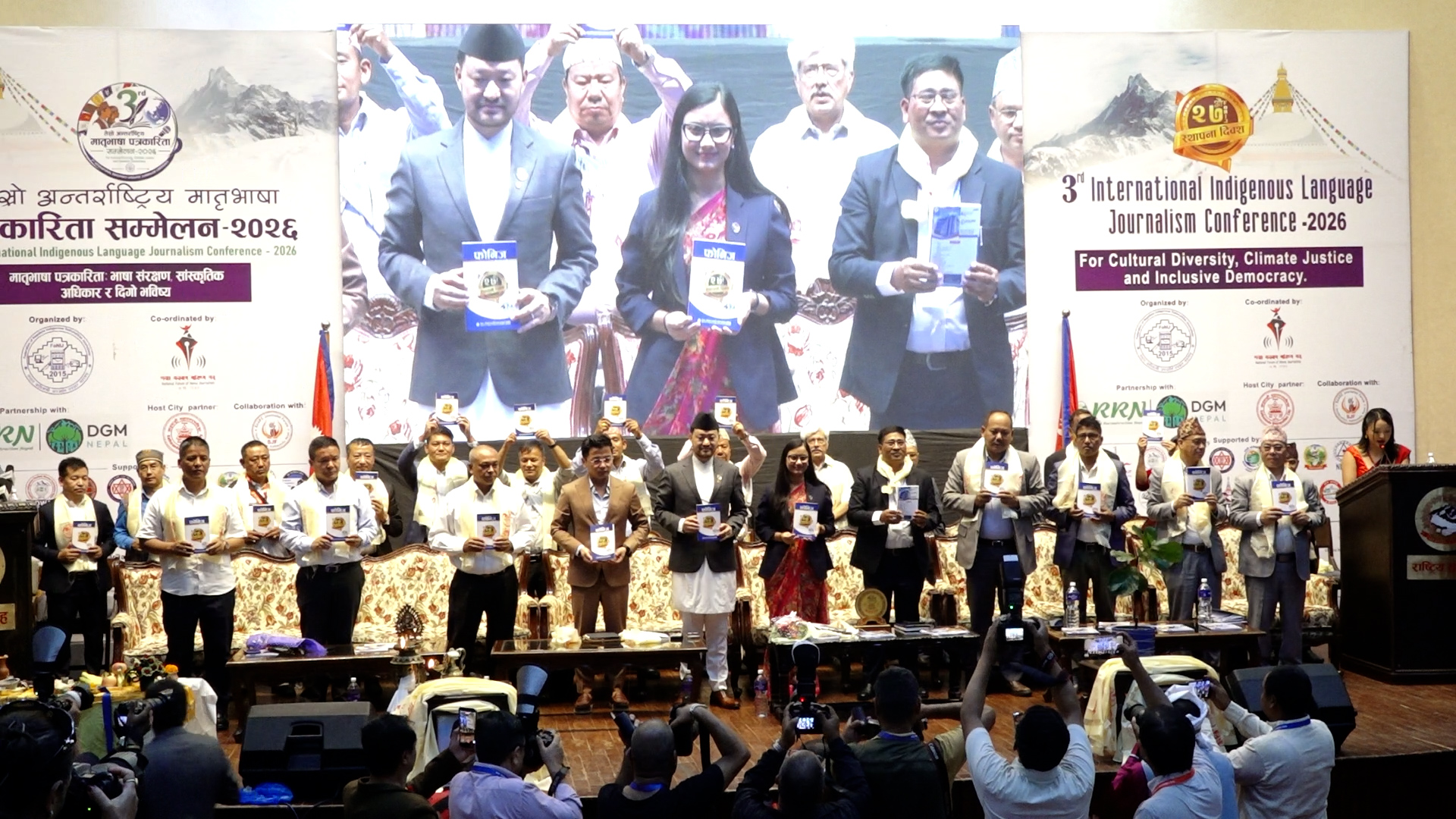
. KATHMANDU: The Third International Mother Language Journalism Conference kicked off in Kathmandu on Monday will feature panel discussions and debates on various genres for three days.
Minister for Law, Justice and Parliamentary Affairs, Sobita Gautam, inaugurated the three-day conference organized by Nepal Federation of Indigenous Nationalities Journalists (FONIJ) and organized by Newa Journalists National Dabu.
Addressing the program, Minister Gautam said that the role of mother tongue journalism was important to strengthen democracy.
According to him, it was necessary for democracy to ensure that citizens could get state information in one’s own mother tongue.
“Nepal is a multi-ethnic, multilingual and multicultural country. The role of mother tongue journalists is important in this. Realizing the importance of mother tongue journalism, you are taking it forward as a campaign,” she said.
Minister Gautam said that Nepal’s identity was not limited to the historical documents and that Nepal’s diversity is reflected in its culture, festivals, language and customs. Nepali Congress lawmaker Nishkal Rai said the state should be more sensitive on the issues of mother tongue, identity and linguistic rights.
According to him, mother tongue and identity are not only issues related to the individual but also to the entire nation.
‘We are not born thinking that we will adopt a certain language. Nature has given birth to us where we are connected with identity, diversity and culture,” he said.
Rai said that human beings do not choose any particular language or identity when they are born, adding that language and identity are linked with nature, identity, diversity and culture.
He accused the state of not being comparatively sensitive to the issues of mother tongue and indigenous nationalities in recent period.
‘Regarding indigenous peoples, it is clear from the budget speech. It is clear from the budget allocated to the Tharu Commission or the Dalit Commission that the state is not very sensitive,” he said.
The conference kicked off with the slogan ‘Base for Prosperity, Fully Inclusive Communication’, attended by around 300 journalists from India and Bangladesh including lawmakers from various political parties, representatives of government and non-government organisations related to indigenous nationalities, Federation of Nepali Journalists and SAARC Journalists Forum. During the conference, discussions will be held on topics such as indigenous agriculture, food security, traditional knowledge and relation with forest, status of mother tongue journalism in government media and private media, and mother tongue journalism, climate change, forest management, state policies, practices and indigenous communities
।



 प्रतिक्रिया दिनुहोस्