

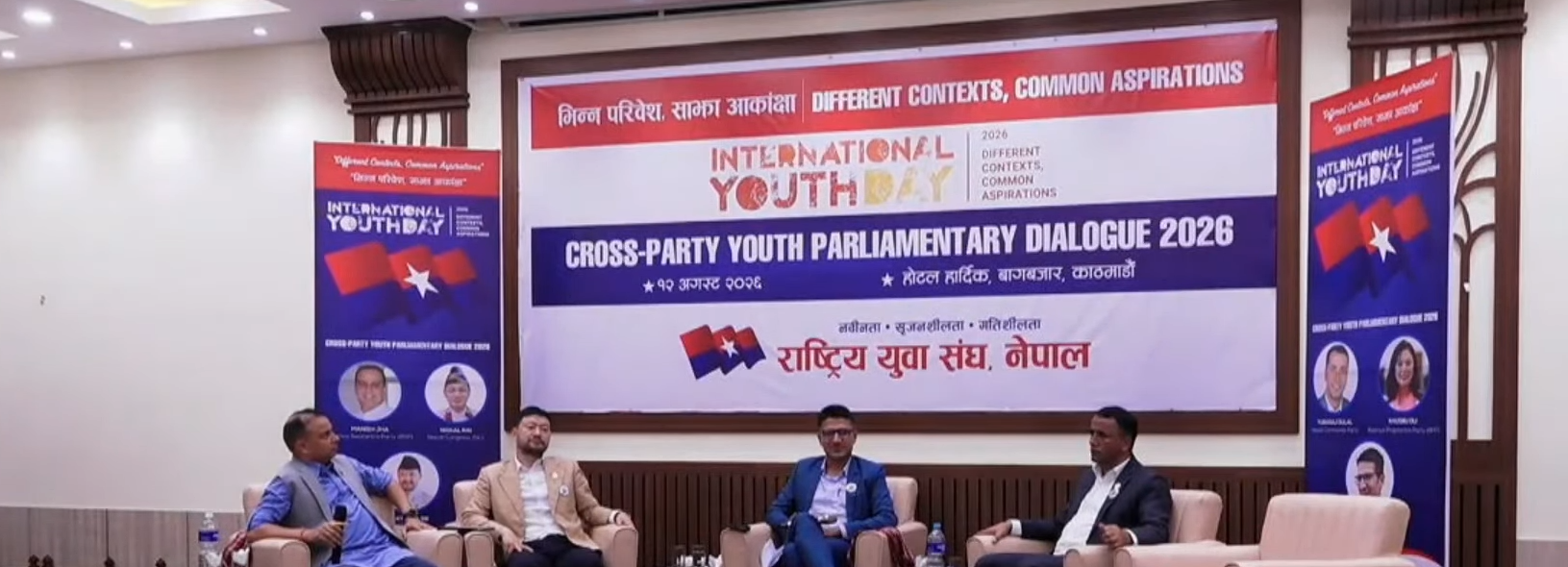
Debate on youth issues and political leadership in ‘Different Contexts, Shared Aspirations’
Debate on the politics of the younger generation and the dignity of the parliament
Kathmandu. The panel discussion on ‘Different Context, Shared Aspirations’ organized on the occasion of International Youth Day 2026 was held in Kathmandu on various topics including youths’ employment, mental health, political leadership, parliamentary dignity and the recent youth movement.
Speaking at a program organized by the Youth Association close to the CPN-UML, CPN-UML lawmaker Kshitij Thebe said that the problems seen in the internal and external employment sector in Nepal are similar in the developing and least developed countries. According to him, the role of the state is significant in terms of education system, health, employment and opportunities to the youths in Nepal, Bangladesh and Sri Lanka of South Asia.
He said that the state should provide dignified opportunities to youths and protect them would also have an impact on mental health.
“As much as we are facing employment problems, the problems of internal and external employment are the same in LDC countries,” he said, adding that how the state provides and protects young people with dignified opportunities also has a huge impact on mental health. Speaking at the program, Rastriya Swatantra Party (RSP) lawmaker Manish Jha said decency, study and discipline were necessary for good leadership in democracy.
He stressed that the opposition party should play a responsible and decent role in the parliament instead of being aggressive.
Stating that they had been in the opposition for 34 months, Jha said he saw Nepali Congress lawmaker Niskkal Rai as a potential leader in the next generation of politics.
“Good leadership in a democracy requires decency, study and discipline,” Jha said, adding, “We have a long experience as an opposition.” So, I urge the opposition not to show too much aggression and show decency. Nepali Congress lawmaker Niskal Rai said the role of all political parties and parliamentarians was important to make the parliament dignified.”Every generation has to deal with questions related to politics,” he said.
He said that the present generation has inherited the achievements made by the previous generation through struggle for democracy, political rights and other issues.
“We all need to make the parliament dignified,” Rai said, adding, “The previous generation struggled for democracy and political rights.” Today, our generation seems to have almost inherited those achievements. Similarly, Yubaraj Dulal of the Communist Party of Nepal (CPN) said that the level of consciousness, socio-economic situation and the level of development have influenced the different scenarios during the youth movement in India, Nepal, Sri Lanka and Bangladesh.
He said that the age and context of the present generation should also be paid to the question whether the Maoist movement has influenced the participation of youths in violent agitation or not.
“Three factors seem to be at work in terms of why the protests in India, Nepal, Sri Lanka and Bangladesh have a different scenario,” Dulal said, “Our level of consciousness, socio-economic situation and level of development are the main reasons for this.” “
It has been almost two decades since the Maoist movement ended, he said, adding that most of the youths today were neither born then nor were in their childhood. Therefore, the movements and political activities of the present generation should not be linked only with the past Maoist movements, he argued.

 प्रतिक्रिया दिनुहोस्