

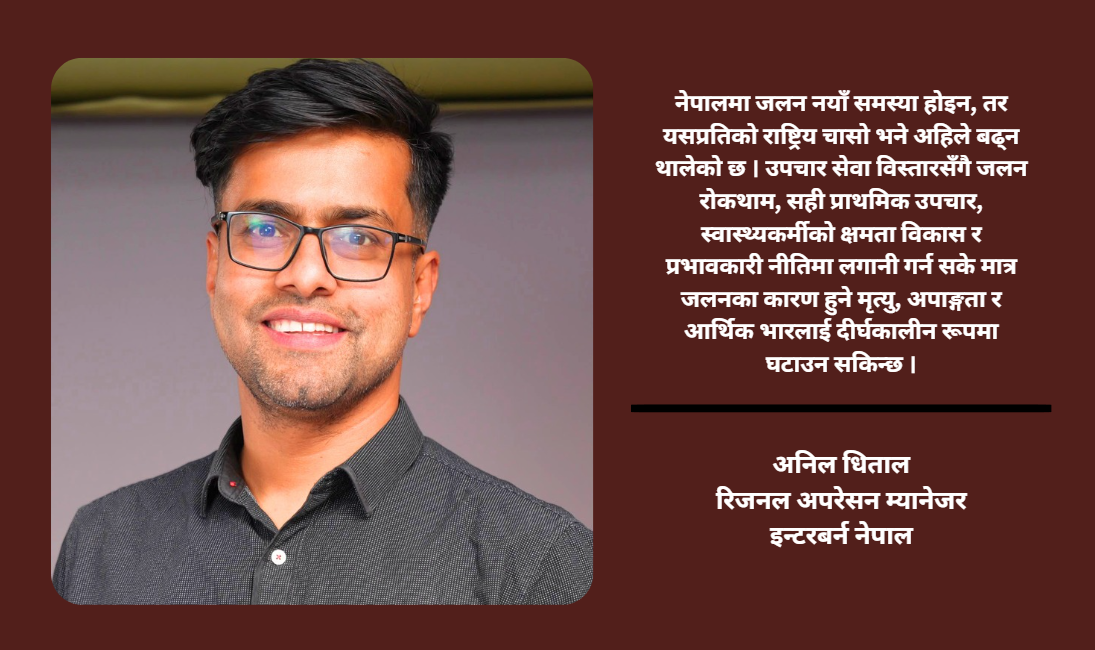
Burning is not a new problem in Nepal, but national interest in it is now growing.
Burn death, disability and economic burden can be reduced in the long term if we invest in burn prevention, right first aid, capacity building of health workers, and effective policies.
Anil Dhital
Regional Operations Manager
Interburn Nepal
Incidents of burnout are not new, our concern is new: Anil Dhital
In the last few days, we hear the news of burn everywhere in Nepal. From television news to social media, from hospitals to ministries, from schools to communities, the same question is being raised: “What to do now?”
This change is positive. But it also raises a question in my mind: Has the problem of irritation just begun? The answer is obvious — no.
Burning is not a new problem in Nepal. It’s a neglected public health problem that has silently claimed lives, disabled life, and changed the future of thousands of families in our society for decades. The only difference is that today we are talking about it a lot.
According to the World Health Organization (WHO), it is estimated that around 60,
000 burns occur in Nepal every year and about 2,200 people lose their lives. These figures are based on the number of patients who have reached the hospital. People living in many remote areas of Nepal cannot access hospitals due to financial constraints, transportation difficulties, or limited access to health care. Some are treated locally, some do not get treatment at all. So the actual number is likely to be much higher.
Burns not only cause death, but also lifelong effects.
Many people are forced to live with physical disabilities, mental anguish, social discrimination and economic hardship. About 5 percent of the disabilities in Nepal are related to burnout. So. Burns can not only be seen as accidents; It is an issue related to development, poverty and public health.
Women and children are the most affected groups in Nepal.
Even now, in many homes, the main responsibility of cooking is on the shoulders of women. Women and young children are most at risk from accidents at home due to open fires, unsafe use of traditional stoves, firewood, gas and the practice of heating fires in winter. Therefore, burnout is not only a health issue, but also an issue of social and gender equality.
In working with communities in different districts of Nepal for more than a decade, I have experienced one thing time and again. We have been imparting training to schools, women’s groups, female community health volunteers, community health workers and other community members on irritation prevention, proper first aid, initial assessment of burn patients, basic management and timely referral. Similarly, we have been conducting training on ‘Essential Burn Care/Advanced Burn Care’ for doctors, nurses and health workers from district hospitals to state and central hospitals.
“I’ve worked in health care for 30 years, but this is the first time I’ve had formal training in burns.”
It’s not just an experience, it’s a real picture of our health system. When frontline health workers do not have such opportunities, how does the right knowledge reach the community?
Today, the government is showing interest in establishing more burn wards and expanding treatment services. This is a very welcome step. But one question we all need to ask ourselves is: Can we solve the problem of inflammation by simply adding hospitals? The answer is again, no.
Treatment is necessary, but treatment does not prevent accidents. If we don’t create an environment that prevents burning, new burn wards will continue to fill up. Therefore, it is imperative to make prevention a national priority along with treatment.
Irritation prevention and first aid may be included in the school curriculum. Regular public awareness programs can be conducted through women’s groups, women community health volunteers, community health workers, local governments and workplaces.
Safe cooking practices, child safety, safe use of fire and gas, and common sense of proper first aid can prevent thousands of accidents.
We talk about burns a few days after every major accident. Then we forget again. But incidents of burnout are happening in someone’s house every day.
Today, there is a debate about burning all over the country. This debate should not be limited to a few days of news. It will have real meaning only if we can translate it into national policies, community-based prevention, capacity building of health workers, rehabilitation services and sustainable investment. Because Nepal needs not only more burn wards but also policies and programs to help prevent burning. Treatment saves lives, and prevention changes lives.

 प्रतिक्रिया दिनुहोस्