

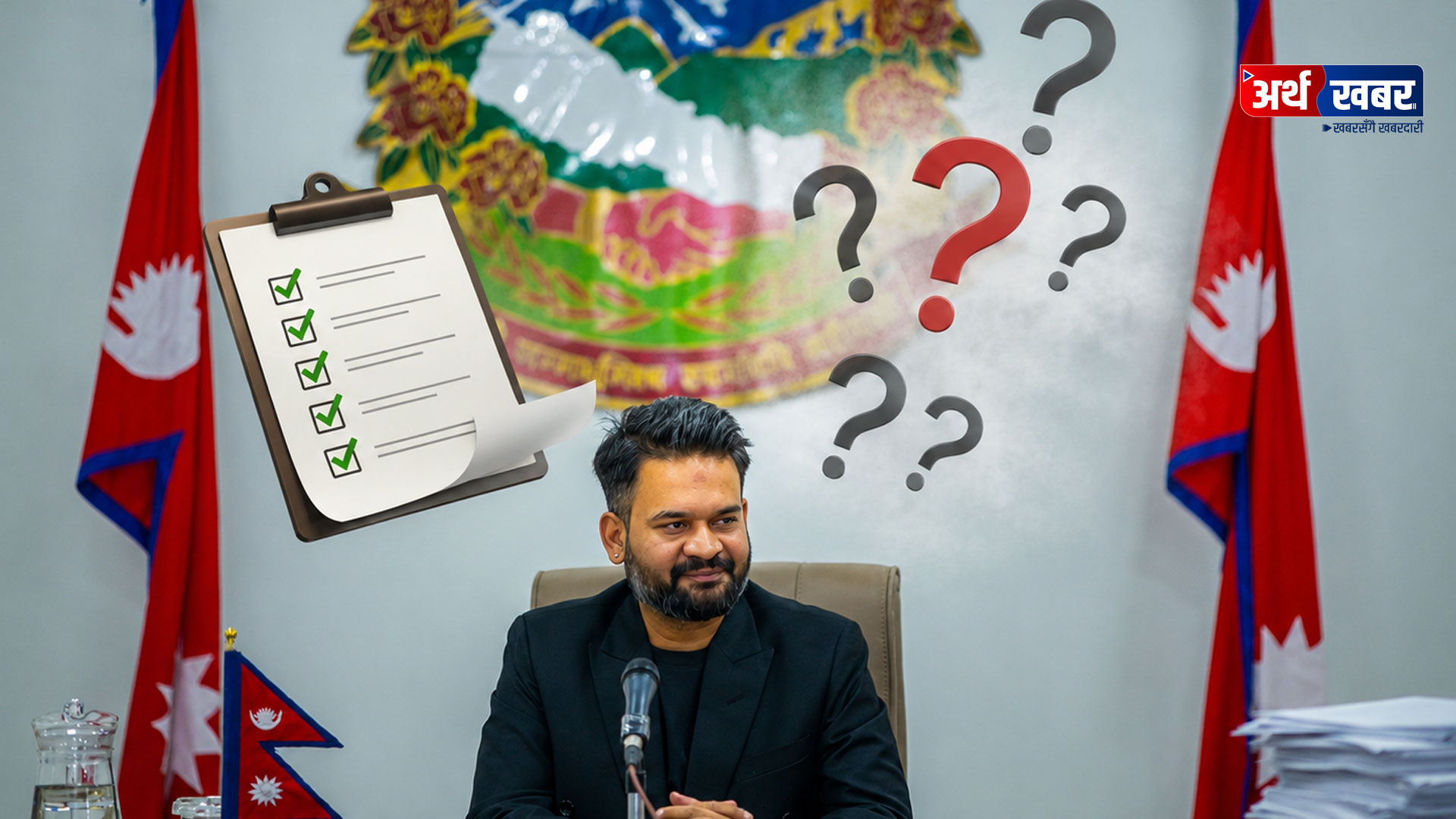
Kathmandu. The first one hundred days of any new government is considered as the honeymoon period. During this period, the government gives an initial indication of its priorities, working style and political will. In the context of the completion of 100 days of the government led by Prime Minister Balendra Shah, it is necessary to review the works carried out by the government, the unfulfilled commitments and the challenges seen.
With the formation of the government on March 26, 2002, good governance, improvement in service delivery, corruption control, employment generation, economic reform and development construction were given priority. Although there was a positive beginning in some areas in the first hundred days, many commitments are still in the implementation phase.
Senior leader Shah had unveiled ambitious plans and promises after assuming the office of the Prime Minister with the overwhelming mandate of nearly two-thirds majority. As well as fiscal year 083. Policies and programs and budget for 084 are also being made public.
Expecting massive governance reforms, he took the first hundred days as a time limit to show the pace of his work and make an impact. On the day he assumed office, he had brought a hundred-point agenda. There is a need for a serious review of how much work has been done and how much remains as per the agenda.
Senior leader of the Rastriya Samajwadi Party (RSP) Shah took over as the Prime Minister on the strength of two-thirds majority. He had taken the first hundred days as an opportunity to leave a clear impression of his working style, capacity and leadership. It was also decided to make public a hundred-point agenda on the day he assumed office. The evaluation of how much work has been completed according to the agenda and how many are still in limbo has become the main debate at the moment.
The changes that are directly felt in the daily life of the common people in a hundred days can only be counted on fingers. However, the government has made significant changes in the traditional structures, power centres and institutional practices of the state.
The influence and interference of the government on the major organs of state governance such as the President, parliament, judiciary, constitutional bodies, bureaucracy and security apparatus is visible to all.
During this period, some old political norms have been shattered and some legal and constitutional boundaries have also been challenged. Equally strong accusations of ignoring institutional traditions and established practices have also been raised.
The relationship between Prime Minister Shah and President Ram Chandra Poudel has been seen far away from the physical distance between the Prime Minister’s official residence in Baluwatar and the President’s official residence, Sheetal Niwas.
The Prime Minister has not paid a courtesy call on the President even once in the last hundred days. Although the President is the constitutional head of the state without executive powers, it has been a practice for the chief executive to pay courtesy call on him from time to time. Although the meeting took place in the swearing-in ceremony, the Prime Minister has not felt the need to meet the President separately.
The attempt to break the old political culture may be positive, but a serious question has arisen whether the tendency to weaken the institutional dignity and respect for the constitutional post in the name of it is justified or not.
Another important incident that showed the distance between the Prime Minister and the President was seen in the parliament on May 28. President Bhandari was present in the parliament to present the annual policies and programmes at the invitation of the government. However, the Prime Minister walked out of the parliament soon after the President read out the policies and programmes. The exit of the Prime Minister at a time when the parliament passed the vote of thanks to the President has not been completed has raised questions about parliamentary decorum and respect for the head of the state.
Similarly, the government’s decision to withdraw the parliament session and issue an ordinance became another controversial step. After calling the parliament meeting, the government adjourned the session and sent eight ordinances to the President. The President had sent back the ordinance on the Constitutional Council for reconsideration, saying it was against the spirit of the constitution. But the government sent the same ordinance back to the President without any amendment and finally the President issued it.
Of these ordinances, only four have been registered as replacement bills in the parliament so far. The fate of the remaining four is still uncertain. It is unclear whether they will come as replacement bills or will be automatically defunct.
Diff views on Republic Day
Similarly, a different scene was seen on the Republic Day of Jestha 15. In the past, there was a tradition for the Prime Minister to address the House of Representatives in the presence of the President, but this time the President addressed the House of Representatives as per the decision of the Council of Ministers. It was not unusual for the President to address the symbol of the republic.
However, the Prime Minister himself, entrusted with the responsibility of addressing the President, did not give any public congratulations or message on the occasion of the Republic Day, which came as a surprise to many. Prime Minister KP Sharma Oli’s silence on Republic Day has raised many questions.
The Prime Minister is the main leader of the parliament in the parliamentary system. The government born out of the trust of the parliament is most accountable to the parliament. However, the Prime Minister has not made any official address to the new parliament formed after the March 4 election. He has not even made the minimum political practice of expressing gratitude to the people who elected him, presenting the government’s views or informing the parliament about the future course of action.
Away from Accountability
In almost all the meetings of the parliament, the opposition parties demanded the presence of the prime minister and accountability. But the Prime Minister continued to distance himself from it. Finally, after intense pressure from lawmakers, he went to the parliament’s rostrum on May 17 and participated in a direct question-answer session in a different style than the practice established in the regulations.
During this time, his statement that ‘Nepal has also encroached on India’s land’ became the center of national debate and controversy. After this statement, the opposition parties are constantly demanding clarification. Although the Prime Minister has tried to correct his statement, he has not been able to give a clear and convincing answer to the satisfaction of the people and the parliament.
Overall, the Prime Minister’s apathy towards the parliament, disregard for institutional practices, increasing distance from the President and controversial decisions have raised more questions than achievements.
The government, which came to power promising reforms, good governance and a new political culture, has not only failed to deliver results as per the expectation but has also raised serious questions over its commitment to constitutional institutions, parliamentary decorum and democratic practice.
Corrective signal
In addition, the government has made efforts to make public service delivery faster, simpler and technology-friendly. In some government services, initiatives have been taken to expand the digital system, use online processes and reduce the hassle of the citizens.
Giving priority to good governance, efforts have also been made to send a strong message against irregularities and corruption. Monitoring has been intensified in some government bodies while necessary preparations have been forwarded for administrative reforms.
The government is active on improving the investment climate in the economic sector, holding dialogue with the private sector and increasing capital expenditure. Various policy discussions have also been held with the objective of attracting foreign investment and accelerating economic activities.
The government has also taken preliminary steps to increase infrastructure development, education, health and coordination with the local level.
Most of the agendas announced by the government have not been able to gain the expected momentum. Notable achievements are yet to be made in the areas of job creation, price control, market monitoring, increase in production and improvement in the services that citizens feel directly.
Problems like economic slowdown, low capital expenditure, delay in development projects and low morale of the private sector are yet to be resolved. Although some policy decisions have been taken, their impact will take time to be seen in practice.
Likewise, the challenges of improving the administrative mechanism, removing legal complexities and maintaining effective coordination among the federal, provincial and local levels remain.
Although the first hundred days showed the government’s political line, now the phase of giving results has begun. People expect implementation rather than announcement, achievement rather than plan and direct change rather than assurance.
The main test of the government now will be to make the sluggish economy dynamic, expand employment opportunities, make public services effective, achieve concrete achievements in controlling corruption and speed up development works.
The Independent Citizens Accountability Project (AGPR) has been making public the points mentioned by the government to evaluate the status of the implementation of the promissory note set by the government.
Out of 100 commitments, the government has moved ahead with 36 agendas in a positive manner. There are 59 agendas in the implementation phase. Some have not even started and some have been postponed.
Some points at the implementation stage
1. Expressing gratitude to those who conducted free, fair and free elections.
2. Implement results-based governance arrangements.
3. Prepare a ‘National Commitment’ document incorporating the implementable issues of the manifestos of all the parties.
4. To form a taskforce to prepare a debate paper on constitution amendment.
5. Implement a justice, rehabilitation and integrated relief package for the families of the victims of the Gen-G movement.
6. Limit the number of federal ministries to 17.
7. Implement the Direct-to-Corrupt Declaration (DH) in all government agencies.
8. To abolish or restructure unproductive boards, committees and institutional structures.
9. Eliminate partisan trade unions by making public administration free from political interference.
10. To prepare national standards for the organization survey at the federal, provincial and local levels.
11. Prepare a list of all service training for front desk employees.
12. Operate a 24-hour national citizen assistance and complaint management system.
13. Upgrade ‘Hello Sarkar’ with integrated dashboard and real-time monitoring.
14. Passport, citizenship, driving license and other services will be transformed into faceless and digital systems.
15. The certificate will be downloadable through the mobile app.
16. To establish an Office of Information Technology and Electronic Governance under the Office of the Prime Minister and Council of Ministers.
17. Shut down betting apps and websites.
18. To form a high-powered committee to investigate the property from 2048 B. S. till now.
19. To prepare a restructuring plan of the National Vigilance Centre.
20. Implement digital procurement and digital procurement system by amending the Public Procurement Act.
21. One-stop service center will be made effective to facilitate registration of industries.
22. To establish and operate an investment board with the investment board.
23. Implement the Savings and Buy-up System and make arrangements to register the business within two days.
24. To reduce the risk burden to facilitate the flow of credit to the agriculture and sector.
25. I’m going to be able to get the job done.
26. Approve and implement the Private Sector Protection and Promotion Strategy (ACAA).
27. To develop industrial and commercial safety infrastructure.
28. Strict legal action will be taken against those involved in damage and looting of private property.
29. An integrated structure will be created by ending duplication between Investment Board, Trade Promotion Center and Department of Industry.
30. Prepare for the health tourism strategy by issuing a health tourism strategy.
31. Formation of Integrated Water Supply Coordination Task Force.
32. Improve the health sector and implement provisions such as free beds, free beds, and other facilities.
33. Alternative evaluation system will be implemented by removing internal examination up to class 5.
34. Budget will be provided to make Nepal Police Rigveda technologically accompanied.
35. To manage or auction the vehicles parked in the customs.
36. The process of returning the savings of small savers of cooperatives will be started within 100 days.
59 points in operation
1. A high-level committee has been formed to investigate the incident of September 10.
2. Creation of service-oriented administration by implementing the employee code of conduct in letter and spirit.
3. Registration of teachers’ seat rolls and management of facilities after retirement by the province.
4. To prepare an employee performance index (PX) and link it with promotion.
5. To prepare service quality certification standards at the local level.
6. Implementation of minimum standards of physical infrastructure in government offices.
7. Develop the architecture of the Employee Management Information System (ASCO).
8. Establish citizen service centers in major cities and operate at least 12 hours a day.
9. Make the citizenship, passport and national identity card services digital, integrated and faceless.
10. To prepare a plan for office restructuring.
11. The operation of the government documents is to be delivered to the home.
12. To make the system strong and user-friendly.
13. Implement the data system in all government services using the citizenship number.
14. To make government apps and portals disabled-friendly and accessible.
15. Arrangements will be made to apply for police reports, passports and licenses through the citizen app.
16. Implement digital signature through national identity card, biometric or ET.
17. Implement a file tracking system and send automatic notifications to higher authorities in case of expiry of time.
18. Establish a national integrated digital governance platform.
19. Formulate digital governance and personal data protection policies and laws.
20. To make legal provisions for the establishment of an independent regulatory body of information technology.
21. To prepare the Information Technology and Electronic Governance Bill.
22. To prepare the structure of the letter.
23. Establish a unified digital asset database.
24. Second, to issue a national anti-corruption action plan.
25. Implement the National Ethics Policy and the National Ethics Policy.
26. To prepare the ash sleeve of the national priority project and take the sick projects on the fast-track.
27. • Implement the system of •
28. Draft an umbrella law on project facilitation.
29. To supervise major road and transport projects and establish weight bridges in strategic areas.
30. The National Pride and Investment Board will determine the investment modality of the project.
31. Transform the Employment Service Center into an Employment, Skills and Entrepreneurship Center.
32. Provide relief and rehabilitation packages to businesses affected by the Gen-G movement.
33. To establish the Prime Minister’s Work Execution Unit (A: Bhṣṭhībhāṭhā Glast).
34. Industries up to Rs 250 million will be allowed to register only from the Cottage and Small Industries Office.
35. To maintain inter-linkage between the Registrar of Companies, Department of Industry and Department of Commerce.
36. Legal provisions will be made to mobilize the Rich amount in the priority areas through a centralized fund.
37. Implement private sector protection strategies effectively.
38. Removal of supply chain bottlenecks in the import-export route.
39. Opening up and implementing the Renewable Energy Corporation for a clean investment environment.
40. Implement energy export strategy, AAB decision and Nepal Electricity Authority reforms.
41. Conservation, removal of encroachments and rehabilitation of the Fewa watershed area.
42. Urban Development Bill and Garbage Management Bill to be tabled in the Council of Ministers.
43. Mandatory implementation of the definition in large businesses.
44. Implement an action plan to automate tax administration.
45. Consolidate more than 139 funds.
46. To amend the Act by scrapping the dormant mining and mineral license.
47. Restructuring the customs system, making it mandatory and strengthening consumer protection.
48. To prepare a legal basis for the mobilization of the bail amount in the court.
49. To end partisan interference in the education sector and form a new organization.
50. The results of the examination will be published as per the academic calendar published by the university.
51. Implement a provision that does not require citizenship at the bachelor’s level.
52. Minimum support price, timely payment and establishment of cooling center in the agriculture sector.
53. To prepare a digital record of landless landless squatters and initiate the process of resolving the problem.
54. Protect public land, remove encroachments and investigate the land of children’s organizations.
55. Amend the regulations relating to control and confiscation of delinquent assets.
56. To form an inter-ministerial task force to study the impact of the international crisis.
57. Blue bus service to be operated free of cost in all seven provinces.
58. Mandatory implementation of Ritkh, MBJBM and Qidygatal in public transport.
59. Mobilize all stakeholders for the effective implementation of the 2082 mandate.
4 blocked points
1. Announce reform programmes by tendering an apology from the state to the Dalit and historically excluded communities.
2. To initiate necessary procedures to implement the recommendations of the reports of various commissions.
3. To prepare an implementable tourism development blueprint for Udayapur, Achham, Bajura, Api Himal and other areas.
4. Transfer the amount of bank accounts that have been inactive for more than 10 years to the state treasury.
A point not started
1. To operate a pre-scheduling system for the service recipients in the Citizen Service Center within 3 months.
The first hundred days of the government can be evaluated in a mixed manner. While there are signs of improvement in some areas, the achievements that people feel are still limited. After initial enthusiasm, the government is now under pressure to prove its ability through result-oriented performance. At the same time, dozens of questions are still alive on the budget statement.
In the coming days, the government is compelled to travel with the opposition parties and stakeholders to effectively implement its commitments.

 प्रतिक्रिया दिनुहोस्